A Retailer’s Checklist for Choosing Fashion Visual Search
Choosing a fashion visual search tool? Use this practical checklist to explore the must-have features retailers should compare before committing to a solution.

by YesPlz.AIMay 20, 2022

Choosing a fashion visual search tool? Use this practical checklist to explore the must-have features retailers should compare before committing to a solution.
by YesPlz.AIMay 20, 2022
Shopping for a fashion visual search solution is a lot like shopping for clothing itself: the options look similar on the surface, but the details make all the difference.
Many platforms claim to offer visual search for fashion. Far fewer are actually built for its complexity — the silhouettes, necklines, fabric textures, and occasion cues that drive purchase decisions.
Selecting the wrong solution means investing in a tool that identifies a product as a jacket but cannot tell your shoppers whether it is cropped or longline, structured or slouchy, workwear or streetwear.
This checklist gives you specific criteria to evaluate before you choose, as well as questions to ask every vendor along the way.
This is the most important question. And, it is where most general-purpose visual search tools fall short. A standard image recognition model is trained to identify broad categories. It can detect that something is a dress, a shoe, or a handbag.
But for fashion shoppers, that level of recognition is not particularly useful. What actually drives purchase decisions are the granular attributes that sit beneath the category: neckline type, sleeve length, waist fit, silhouette, pattern, occasion, and more.
Fashion has its own language, and that language is constantly evolving with trends. A visual search solution that has not been specifically trained on fashion data will struggle to keep pace. It tags a product correctly at the category level but misses the attributes that shoppers want to filter by.
Do you know which product attributes your shoppers care about the most? Before evaluating any fashion visual search solution, pull your own site search data and filter analytics. Identify which attributes your shoppers interact with most and which searches currently return poor or zero results.
Bring that list into every vendor conversation. A strong solution can demonstrate accurate tagging for your specific set of attributes. Ask whether the solution's attribute taxonomy is fixed or whether it can be extended to match the attributes your shoppers actually care about.
Fashion shoppers do not only search by granular attributes. They also search by occasion, vibe, and theme. Let’s say, summer vacation outfits, going-out tops, office-appropriate dresses, and casual weekend looks. These thematic queries are the hardest part for fashion retailers to serve well without AI.
The challenge with manual theme and occasion tagging is that it is inherently subjective. We all have different definitions of what distinguishes office and daytime dresses. It’s difficult to remain consistent in identifying product attributes that are relevant to a particular occasion. Plus, manually tagging across a large catalog is slow and costly.
That's why you need to know whether a fashion visual search solution has been trained to tag various occasions and vibes automatically.
The following questions will help you understand how a vendor handles thematic and occasion tagging:
Do they offer thematic and occasion tagging automatically? Or is it something you have to do manually?
Can the solution be customized to your brand's specific terminology — the unique way your shoppers search by themes and occasions on your platform?
Are thematic and occasion tags applied to every new product at upload? Or whether they require manual review?
And don’t stop just by asking. Test thematic tagging with the occasions that matter most to your shoppers. If workwear, vacation, or wedding guests are common search terms on your site, run those queries against the vendor's demo and evaluate the relevance of results.
Not all visual search solutions handle every type of product image equally well. Some struggle when images are noisy. The word “noisy” here means:
A product is photographed against a busy background.
It is styled with multiple garments and accessories.
A shot in a user-generated content format rather than clean studio photography.
This matters because most fashion catalogs are a mix. You may have perfect studio shots for core products and messier lifestyle photography for editorial or lookbook content.
So, what will happen if your fashion visual search solution only performs well on clean, isolated product images? A significant portion of your catalog may be tagged inaccurately, which affects shopper product discovery.
Before committing, gather a sample set of your most challenging images — lifestyle shots with busy backgrounds, flat lays, model shots with multiple accessories, and user-generated content. Then, ask a vendor to run their model on that sample. Also ask them:
Does the solution use multi-image inputs per product? Multiple angles and variant-level images (different colors, materials) give an AI-powered tool more signals to work with, improving matching accuracy.
Can the solution cross-reference image data with product text data — titles and descriptions — to fill in gaps when image quality is lower? You will learn more about its importance in the next question.
A visual search tool that processes images alone is leaving performance on the table. Product images are rich, but they do not always tell the full story. Care instructions, fit notes, and shopper reviews live in text.
Hybrid solutions process both product image and text simultaneously. Images provide visual attributes. Meanwhile, text provides context that images may not show clearly. Combined, the two data sources produce a more complete and accurate product profile.
A solution that ignores text will produce less accurate tags, which leads to less accurate search results. The best search results come from solutions that enrich the catalog with hybrid data from the start.
Ask a vendor whether their fashion visual search tool processes both image data and text data. The best solutions do both. Product titles and descriptions help the tool focus on the right item in product images and fill in attributes that are harder to extract visually.
Fashion vocabulary moves fast. A few years ago, no one was searching for quiet luxury, coastal grandmother, or mob wife. These terms exploded overnight. And just as quickly, they'll be replaced by something new.
A fashion visual search model trained once and never updated will tag a cropped vest the same way in 2026 as it did in 2022. But shoppers' search terms, expectations, and the definition of "current" have all moved.
Besides, your own catalog evolves, too. You expand into new categories. You launch a private label. Your shoppers develop new search habits as your audience grows. A model that can't flex to those changes will quietly fall behind. And you won't always notice until your conversion rate tells you something is wrong.
Ask vendors specifically:
How often is the model retrained? How do new trend terms get incorporated? Is the process automated, manual, or a combination?
Can your team add new attributes without engineering work? Is there a console for it?
When the model tags something wrong, how is it corrected?
Can the model be tuned to our specific catalog, audience, and brand vocabulary? Or is it one-size-fits-all?
A visual search tool for fashion with excellent AI performance still fails if it is painful to deploy or maintain. Integration complexity is a real cost — in engineering time, ongoing maintenance, and the speed at which you can adapt when your catalog or platform changes.
Prioritize solutions that offer end-to-end support from integration through ongoing optimization. The best partners monitor performance, flag issues, and iterate alongside your team.
There are a few dimensions to evaluate here.
Platform Compatibility: Does the solution have a native integration with your eCommerce platform? If you are on Shopify, Cafe24, or another major platform, a pre-built integration dramatically reduces the time to go live. If you are on a custom stack, ask about API availability and how much custom development your engineering team will need to handle.
Catalog Sync: Fashion catalogs change constantly — new arrivals, seasonal updates, end-of-season clearances. Ask how quickly new products get tagged and appear in search results after they are added to your catalog. Delays here can mean new arrivals are invisible to your shoppers for days or weeks, which is a real cost to your business.
Ongoing Support: AI models need to be updated as fashion evolves. Ask whether model updates are included in the service or whether you are responsible for retraining.
Use these fashion visual search questions in any vendor evaluation conversation. They are designed to get past the polished demo and surface the details that actually matter for your business.
1. Is your model fashion-specific? Or, is it a general image recognition model applied to fashion?
A general model fundamentally can't tell the difference between a cropped and a longline one.
2. Does your solution process both image and text data?
Image-only models miss everything that lives in titles, descriptions, and shopper reviews.
3. Can we test it on a sample of our actual catalog before signing?
A polished demo on the vendor's curated images proves nothing. If they won't run on your real catalog, that's the answer.
4. What's your tagging accuracy rate? Can you share benchmarks from clients with catalogs similar to ours in size and category mix?
Accuracy claims without comparable benchmarks are marketing copy. You need numbers from peer retailers, not a top-line average.
5. What's your correction workflow when the AI tags something wrong? How fast does the fix go across the catalog?
Every model makes mistakes. The question is whether yours can be caught and corrected before they cost you revenue.
1. How was your model trained? What was the size and composition of the dataset?
Useful for sniff-testing fashion-specificity claims, but vendors are often guarded on specifics.
2. How do you keep the model current as fashion trends and terminology evolve?
Cadence matters less than the underlying mechanism. The correction workflow above illustrates adaptability.
3. How does your solution handle regional language — pants vs. trousers vs. slacks?
Critical if you operate across regions. Less urgent for single-market retailers.
More where this came from — 8 non-negotiables and 11 nice-to-haves to round out your evaluation. The full checklist is in the ebook.
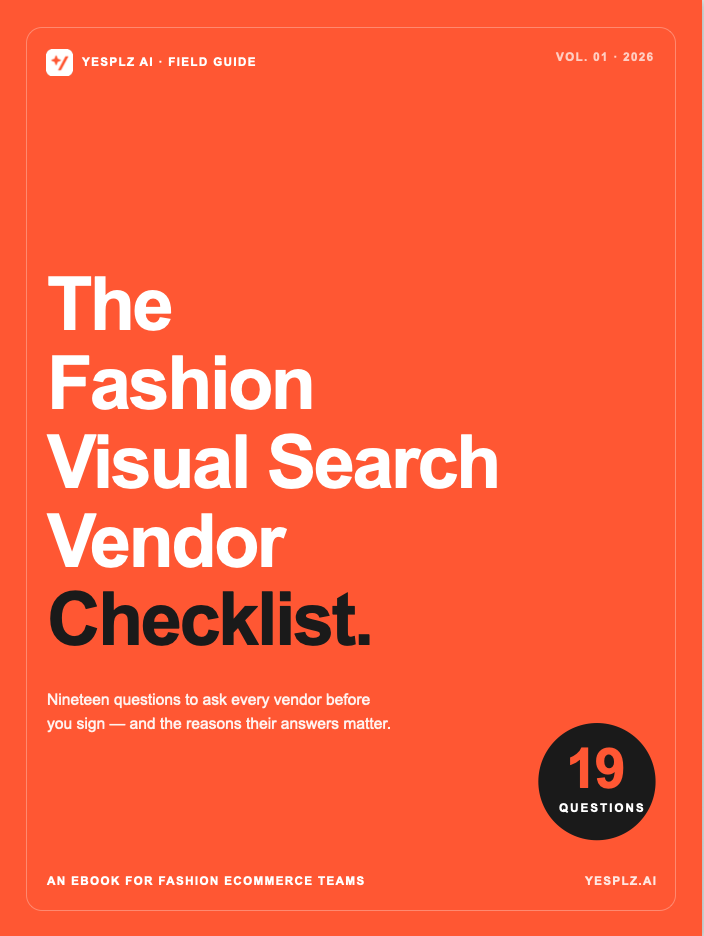
The diligence framework that separates real fashion visual search from the rest — 8 non-negotiables, 11 nice-to-haves, before you sign.
There's no shortcut to finding the right solution. Demo different tools. Test on your real catalog. Ask for references. The questions in this guide exist to help you cut through the noise. Use them with every vendor you speak to.
Bring these questions to a call with us. We'll answer them against your real catalog. YesPlz AI offers a comprehensive, hybrid visual search that can help elevate your fashion eCommerce. Ready to see it in action?
Related reading: What is fashion visual search? — overview of how visual search works for fashion catalogs.

Written by YesPlz.AI
We build the next gen visual search & recommendation for online fashion retailers
