6 Essential Fashion Product Tagging Use Cases to Boost eCommerce Sales
What are product tags used for? It’s a solution to low search CTR, limited filtering, manual collection curations, and more.

by YesPlz.AIDecember 27, 2025

What are product tags used for? It’s a solution to low search CTR, limited filtering, manual collection curations, and more.
by YesPlz.AIDecember 27, 2025
Have you ever wondered why your site search has such a low click-through rate? Or, how do your competitors manage to offer fashion-specific filtering like neckline type, sleeve length, and even occasion types? What if you could effortlessly curate collection pages with fashion-specific metadata?
Product tags make all of this possible. These invisible infrastructure powers online stores. While shoppers never see them directly, product tags enable everything, from instant search results to personalized recommendations.
Understanding product tagging use cases helps retailers transform their digital storefronts from static catalogs into intelligent shopping experiences.
In this article, you’ll discover how to use product tags and why effective product tagging is essential for improved site search results, enriched fashion filtering, SEO, improved collection page, and more.
Table of Contents:
Site Search: Improving Click Through Rate, Reducing Zero Search Rate
Filter & Navigation: Helping Shoppers Narrow Down with Fashion-Specific Filtering Options
SEO & Discoverability: Getting Found on Search Engines and AI Platforms
Collection Curation: Automated Merchandising that Stays Fresh
High zero search rates and low click-through rates mean lost sales opportunities. Every time a shopper searches for something and gets no results or irrelevant results, you risk losing that customer to a competitor.
Typical site search matches a shopper's search query to a product title or description. This approach often misses varied synonyms, typos, or cases where the search keyword simply isn't included in the product title. A shopper searching for "evening gown" might miss products titled "formal dress" even though they're exactly what the customer wants.
When shoppers type ‘red cocktail dress’ into your search bar, they expect relevant results instantly. This seemingly simple interaction relies heavily on how well your products are tagged.
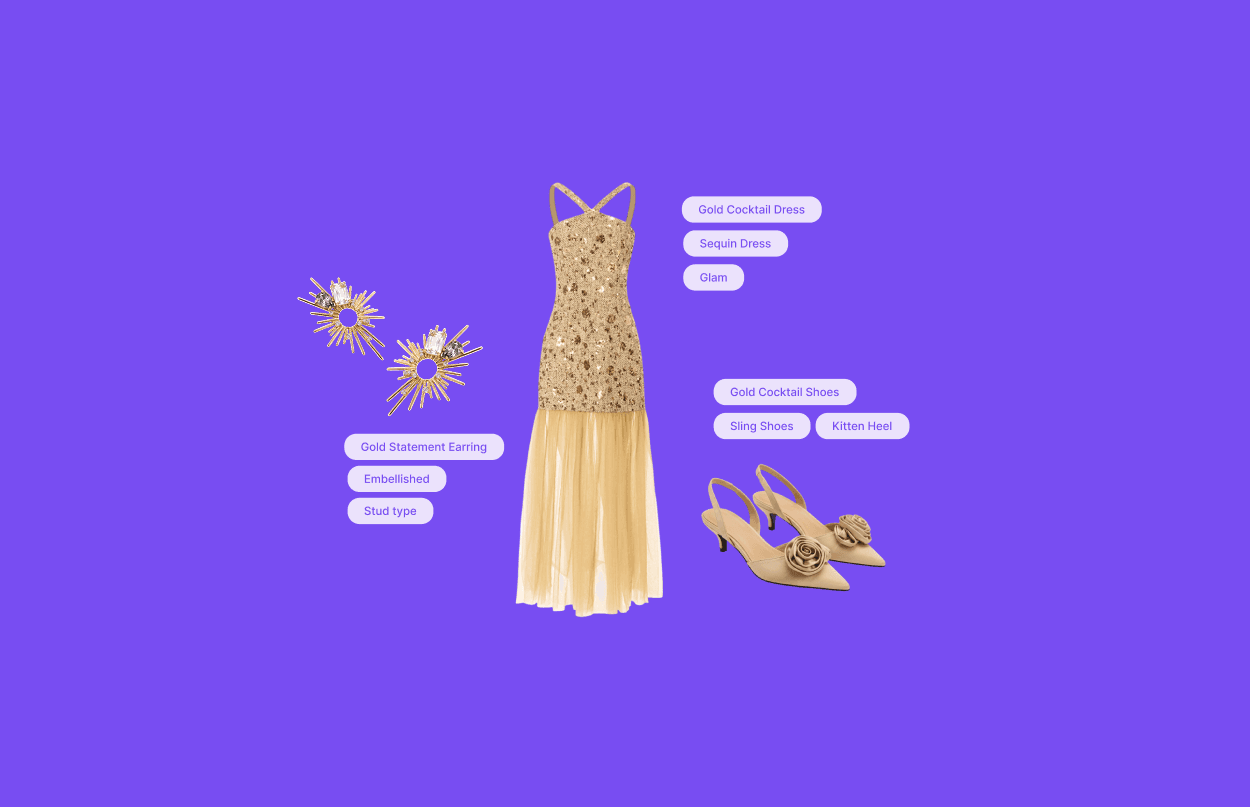
Fashion product tagging automatically tags 10-12 key fashion product attributes for every item in your catalog, ensuring products never miss a matching opportunity. When a shopper types "gold cocktail dress" into your search bar, they expect relevant results instantly. This seemingly simple interaction relies heavily on how well your products are tagged.
 Each item in your catalog needs clear and specific attribute tags, such as color (‘gold'), occasion (‘cocktail’), and category (‘dress’), to appear in search results. Without proper tagging, even perfectly matching products remain invisible to potential shoppers.
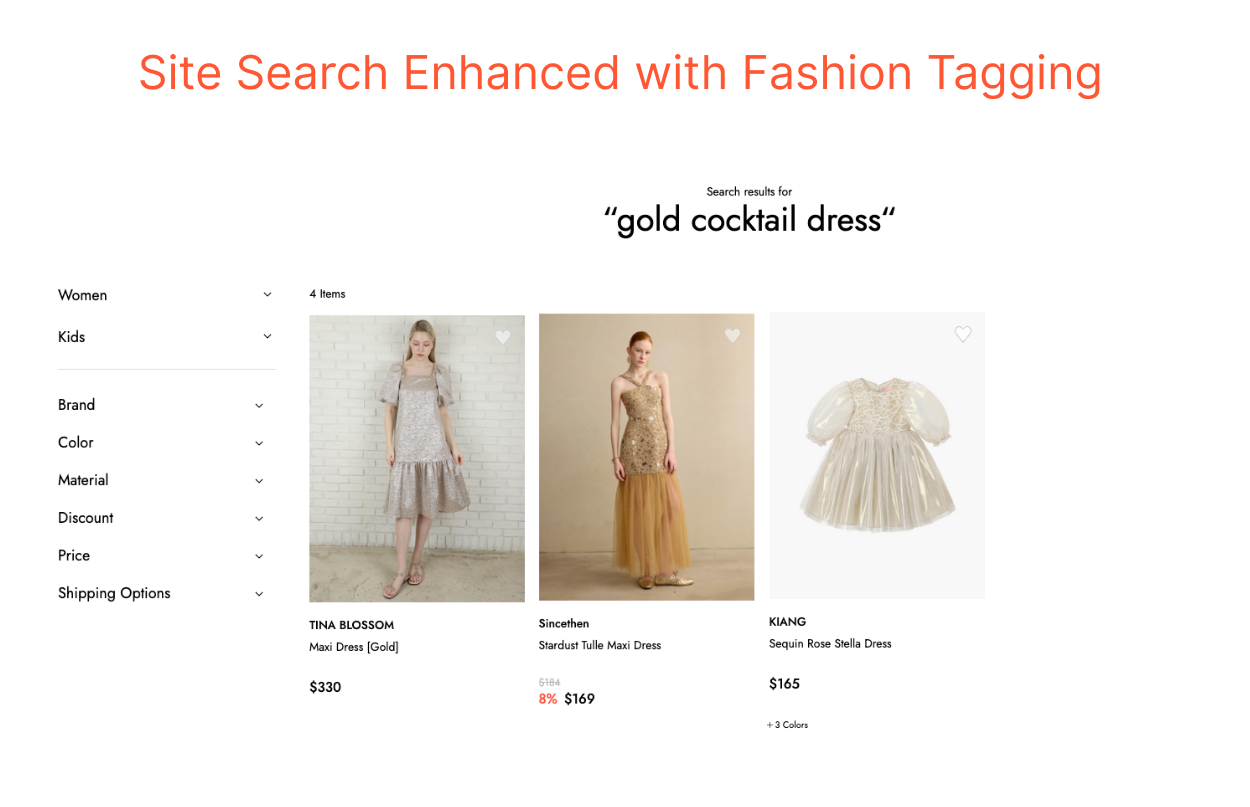
Product tagging enables natural language search functionality. Shoppers can use everyday descriptions rather than memorizing exact product names. A well-tagged catalog understands that someone searching for ‘cozy sweater’ wants items tagged with attributes like ‘knitwear,’ ‘warm,’ ‘relaxed fit,’ and ‘winter.’
This flexibility dramatically improves the shopping experience. When shoppers find what they want on the first try, they’re more likely to complete purchases rather than abandoning your site for competitors.
High bounce rates, especially when there are hundreds of products on listing pages or search results pages, signal a critical problem. Shoppers cannot easily and quickly narrow down hundreds of results to the exact styles they want. Frustrated shoppers bounce off to competitor sites.
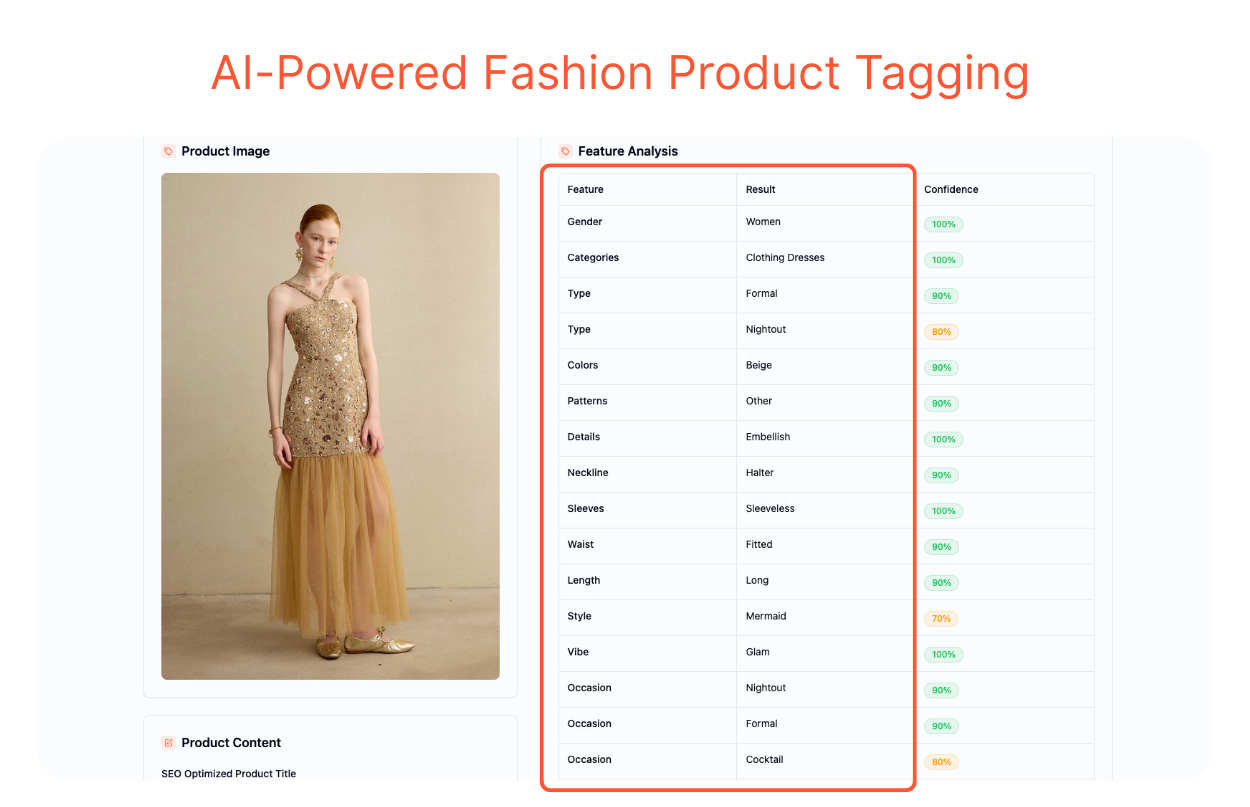
Fashion tags automatically tag 10-12 key product attributes that are ready to go for your fashion filtering. You don't have to manually tag the information because fashion AI does it for you. Shoppers now quickly and easily narrow down hundreds of products with fashion-specific filtering options like neckline type, sleeve length, fit style, and occasion.
eCommerce filters for color, size, price, material, and category rely on product tags. When a shopper selects ‘cropped’, ‘denim’, and ‘jacket’ from your filters, they’re efficiently querying items that match two attribute tags: length (‘cropped’), material (‘denim’), and category (‘jacket’). The product tagging system instantly refines 500 items down to 47 highly relevant options.
This filtering capability, called faceted navigation, transforms broad browsing into a focused search. Shoppers can layer multiple filters, such as color (‘black’), category (‘ankle boots’), and price (‘under $200’), and see results update in real-time.
This works because your product tagging system has already classified every item with comprehensive attributes. Without tags, filters wouldn’t function. With strategic product tagging, your filter and navigation feel intuitive and responsive.
Updating SEO keywords is too labor-intensive, but SEO is too important to ignore. Fashion retailers struggle to keep product information fresh, accurate, and optimized for search engines while managing hundreds or thousands of products.
AI product tags automatically generate relevant keywords based on product images and text using multi-modal analysis. You can save time while having more accurate and enriched product information that helps SEO.
Product tags don’t just improve on-site search. They’re your gateway to being discovered across the entire digital ecosystem, from traditional search engines, emerging AI shopping assistants, and other discovery channels.
When someone searches for a product, your product detail page (PDP) competes with thousands of others. Proper product tagging gives you the edge by automatically enriching the multiple signals that search engines and AI platforms use to understand, rank, and display your products.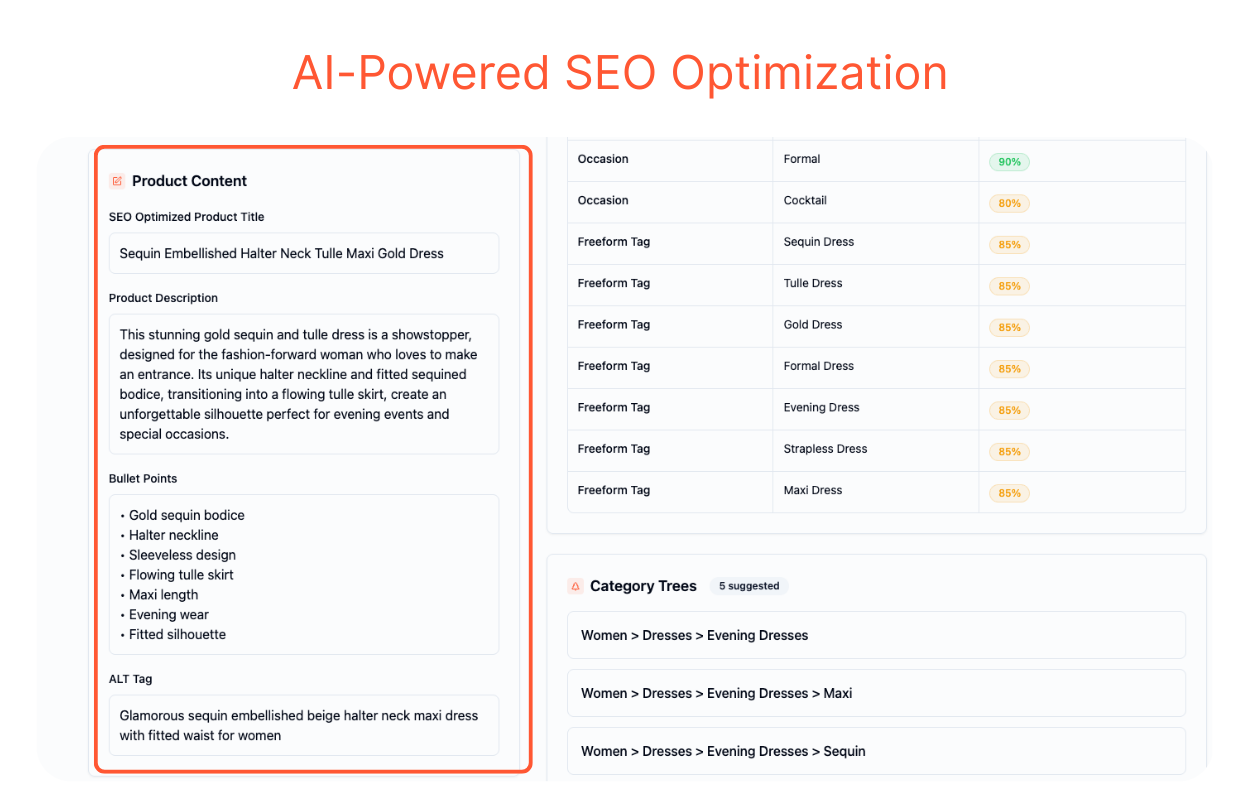 Consider a black jumpsuit in your catalog. You tag it with: ‘minimalist,’ ‘black,’ ‘sleeveless,’ ‘elegant,’ and ‘cocktail party.’ Traditional and AI search engines crawl your PDP and find these tags embedded in your site’s code. They use this structured information to understand your product and match it to relevant queries.
When someone searches ‘elegant jumpsuit for cocktail party,’ search engines recognize your product as a strong match because those exact attributes exist in your tags. Without comprehensive tags, search engines can’t categorize them accurately. Your products become invisible to shoppers.
Whether it's similar items or "complete the look" recommendations, someone has to curate the products based on matching themes. It's almost impossible to manually curate products for every item in your catalog. Therefore, you're missing a huge sales opportunity to increase average order value and customer satisfaction.
Fashion tags can be used to curate recommendations matching similar necklines, colors, fit styles, and even the same occasion, creating highly relevant suggestions automatically.
To understand the product tagging use case in recommendations, consider this example. When a shopper views a bohemian floral maxi dress, recommendation algorithms analyze its product tags: ‘bohemian,’ ‘floral,’ ‘maxi,’ ‘summer,’ ‘festival,’ ‘romantic,’ ‘dress.’
A tag-based recommendation engine then suggests items that share the same tags, not just random products from the same category. It displays:
Layered necklaces (matching ‘bohemian’ and ‘delicate’ tags)
Woven sandals (matching ‘bohemian’ and ‘summer’ tags)
Embroidered clutch (matching ‘bohemian’ + ‘romantic’ tags)
Wide-brim hat (matching ‘bohemian’ and ‘festival’ tags)
This way, product tags let you create style-coherent recommendations that help shoppers complete their looks. Meanwhile, fashion retailers can increase average order values and improve customer satisfaction.
Collections are important to keep your website fresh and offer thematic collections that help shoppers easily find their favorite styles. But let's face it, creating collection pages is no joke. You have to create a theme, then find products that match that theme. This requires a lot of browsing work on your end, and keeping collections updated as inventory changes becomes overwhelming.
What if you could just pull products that match key product themes like a "New Year's Eve Party" collection using product tagging such as 'glam vibe,' 'night out occasion,' and 'cocktail party occasion' tags to effectively curate the matching items? Product tagging enables dynamic collections that update themselves as your inventory changes.
Here are some examples to utilize product tags for collections:
Seasonal Collections: Set rules that automatically prioritize weather-appropriate items. For example, from May to September, your summer collection shows everything tagged with ‘summer’ or ‘lightweight.’ When you add new products with these tags, they appear in the collection immediately. No manual updates required.
Themed-Based Collections: Create themed pages that populate based on tag combinations. A cottagecore collection might display all items tagged with ‘romantic,’ ‘floral,’ ‘vintage,’ and ‘nature-inspired.’ As the trends evolve, you simply adjust the tag criteria rather than rebuilding entire collections.
Cross-category Collections: A romantic collection showcases everything tagged romantic, whether it is a dress, a top, an accessory, or a pair of shoes. This cross-category approach helps shoppers who shop by style rather than by item type.
The efficiency gain is enormous. Instead of manually adding products to multiple collections, you tag once and let automation handle the rest.
Product tagging transforms back-end operations. Analyzing tag distribution across your inventory reveals critical insights. You can compare different data points against your tags to identify what’s working:
Shopper search behaviors: Which tags appear most frequently in search queries? If your shoppers constantly search for ‘sustainable’ or ‘plus size’ but you have limited inventory with those tags, you’ve found a growth opportunity.
Sales velocity: Which tags correlate with faster-selling products? Items tagged ‘vintage-inspired’ might move three times faster than those tagged ‘minimalist,’ informing your next buying decisions.
Engagement metrics: Which tags generate the most clicks and longest browsing sessions? High engagement with certain tags indicates strong shopper interest, even if sales haven’t followed yet. Perhaps due to pricing or limited selection.
This data-driven approach to product tagging transforms inventory planning from guesswork into strategic decision-making. You can confidently adjust your assortment based on concrete evidence of what your shoppers want.
Understanding these use cases is just the beginning. Successful product tagging requires consistent taxonomy, comprehensive coverage, and regular maintenance.
Identify the key attributes of your products, then create a tagging framework to cover these attributes. Train your team to apply tags consistently across all products because inconsistency undermines every use case discussed above.
Treat product tags as living data. Regularly audit your tagging to remove outdated attributes and add new trend-relevant tags when shopper behavior evolves.
If you have a large catalog, consider using AI tools to accelerate the tagging process and improve accuracy. Every item in your catalog can be automatically tagged using these systems.
Product tags are the foundation of modern eCommerce functionality. From the moment a shopper lands on your site through search to the personalized recommendations that encourage additional purchases, product tagging powers every interaction.
Strategic product tagging gains measurable advantages:
Better search rankings
Higher conversion rates
More efficient merchandising
Smarter inventory decisions
In an increasingly competitive market, these operational improvements translate directly to revenue growth.

Written by YesPlz.AI
We build the next gen visual search & recommendation for online fashion retailers
