What Makes YesPlz AI Image Tagging Different for Fashion Retail?
Discover how YesPlz AI image tagging helps fashion retailers replace manual tagging with faster, more accurate, shopper-centric fashion attributes.

by YesPlz.AIJanuary 23, 2026

Discover how YesPlz AI image tagging helps fashion retailers replace manual tagging with faster, more accurate, shopper-centric fashion attributes.
by YesPlz.AIJanuary 23, 2026
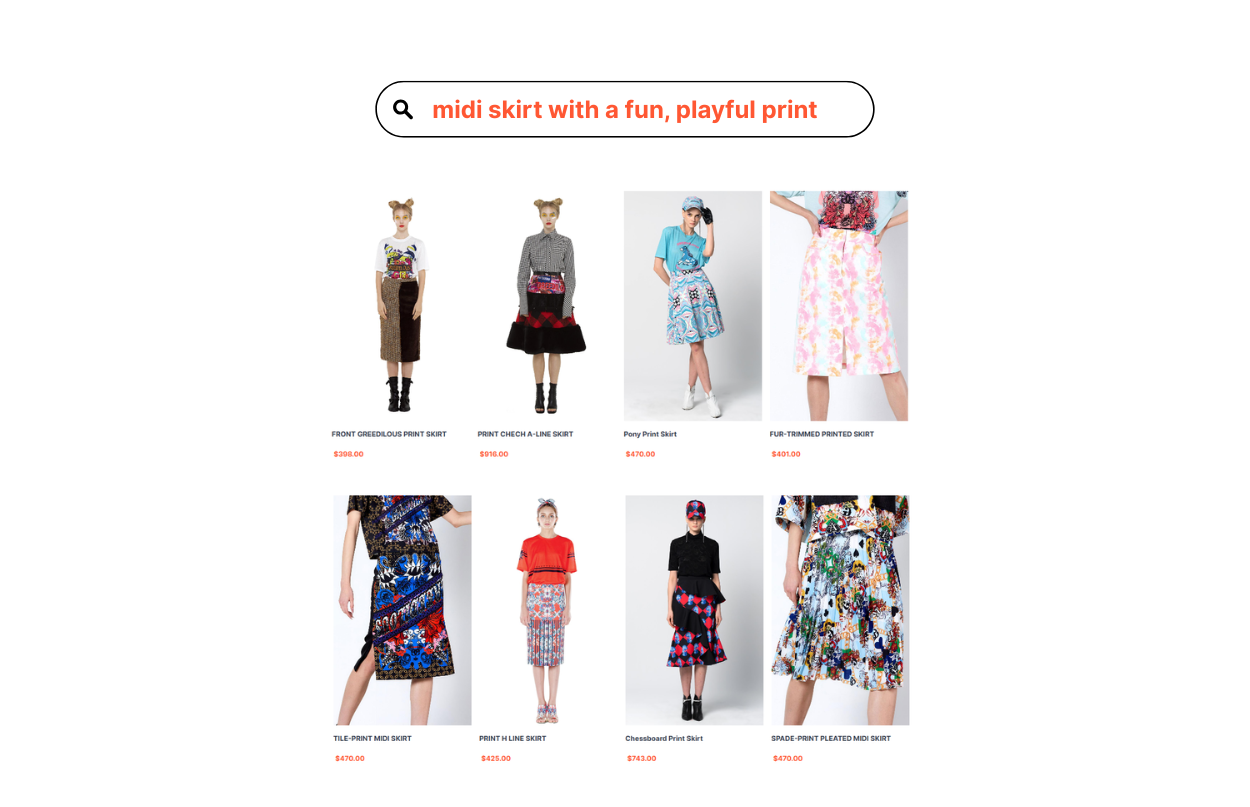
A shopper lands on your website and navigates to the search bar. She wants a skirt with mid-length and a fun, playful print. When she types in her search query for ‘midi skirt with a fun, playful print,’ she receives dozens of relevant search results. The building blocks of these search results are fashion tags, powered by image tagging.
 Behind the scenes, traditional retailers relied on humans to tag each product attribute. This is a painful task when you consider the hundreds or thousands of products uploaded to an eCommerce website every day.
Manual tagging can take hours to complete and is prone to error. For example, one human tagger might label the red skirt as ‘mid-length skirt.’ Yet, another might consider it to be a ‘midi-skirt.’ Human subjectivity often leads to inaccurate product data.
Is there a faster, more accurate way to tag products that also saves time and energy? The answer to your question: AI image tagging for fashion retail.
In this blog post, we’ll walk you through:
AI image tagging for fashion, also known as fashion tagging, is the process of using AI to identify and label product attributes in fashion images.
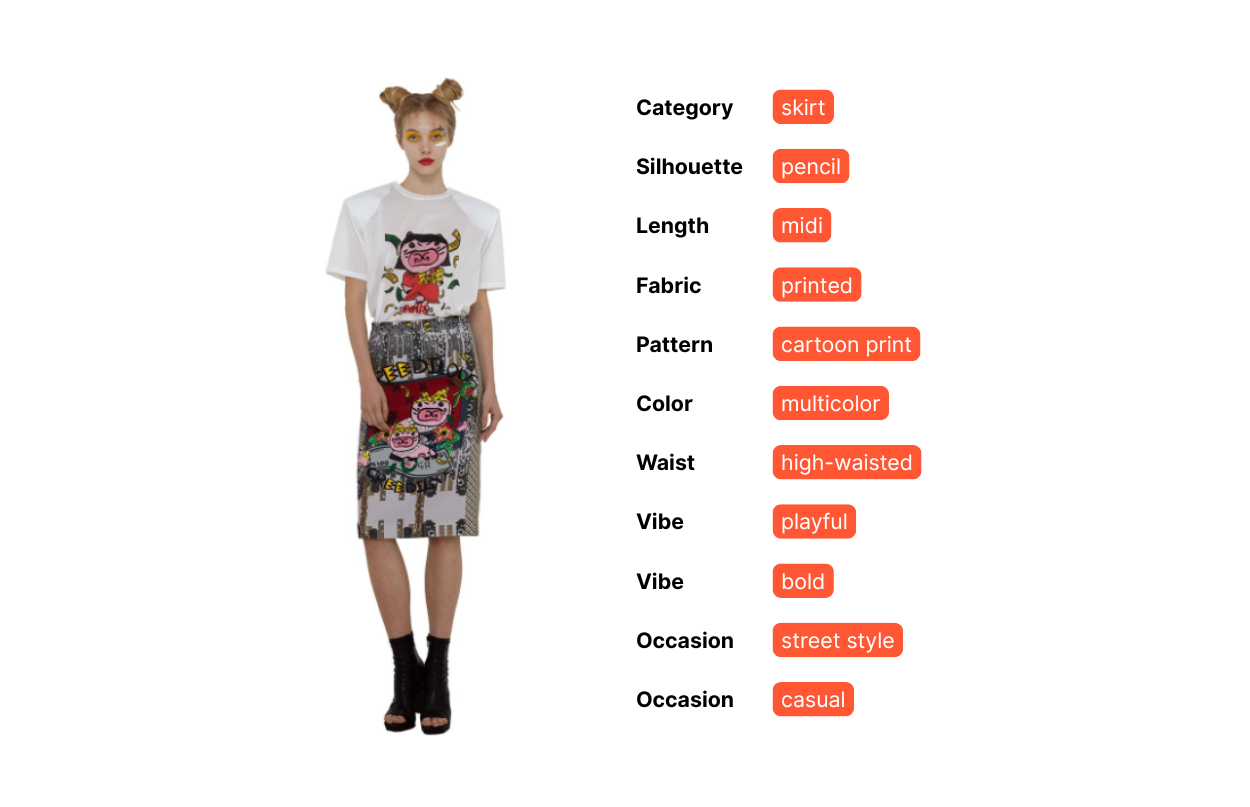
A single clothing category can have between 20 and 60 different attributes. For example, the printed skirt in the image below has at least 9 different attributes.
 Why Do Fashion Retailers Need Automated Tagging?
Traditionally, a member of the merchandising team is responsible for tagging. Designers and third-party vendors provide tagging information. Then, the in-house team is responsible for cleaning up and organizing the fashion tags.
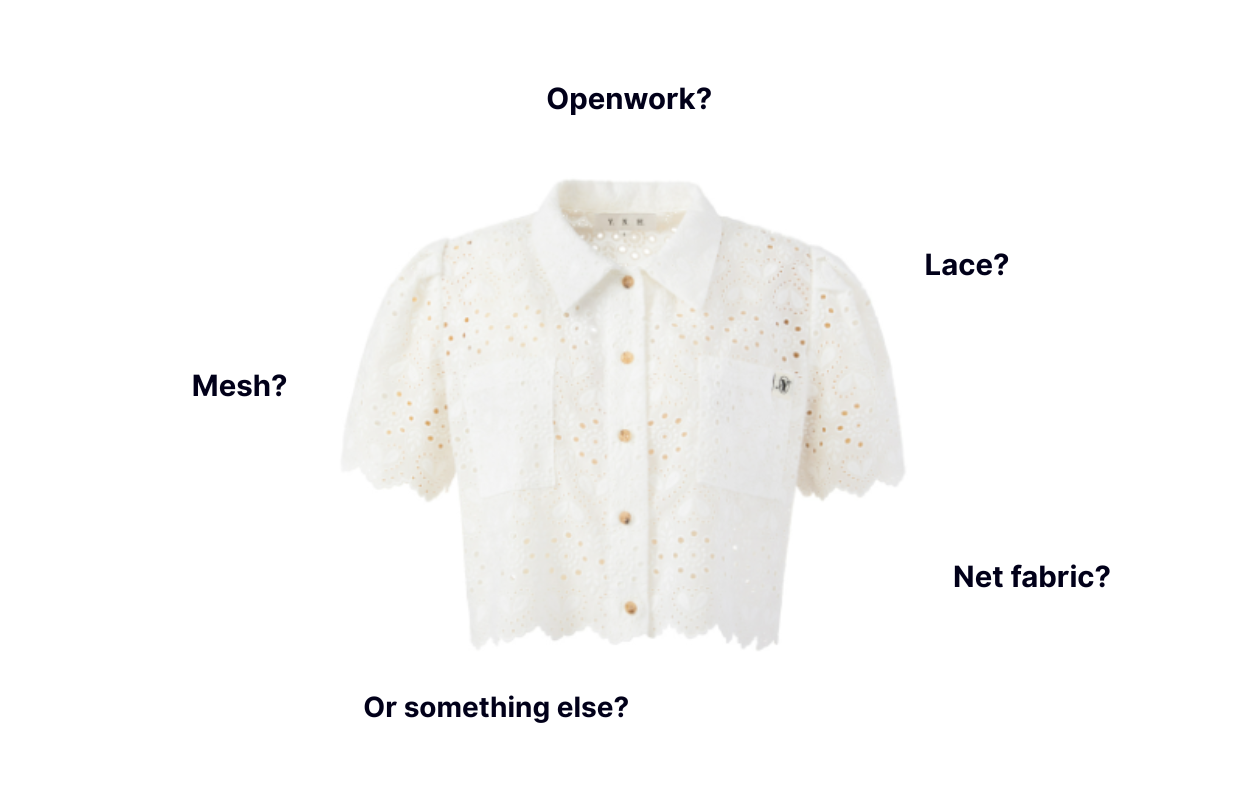
Information that comes from third parties, however, may be inconsistent. For instance, how do you call the shirt fabric in the image below? Lace? Net fabric? Mesh? Openwork? Or something else? Each vendor may use a different word to describe it.
 With so many products needing tagging, this inconsistency creates a mess for your fashion eCommerce. Plus, the in-house merchandising experts may make tagging mistakes (we're all human, after all).
Due to the complications of manual tagging, some fashion eCommerce brands may skip it altogether to save time. However, without accurate fashion tagging, your eCommerce brand can't:
Categorize products effectively
Improve search results relevance
Offer granular filtering options
Generate accurate recommendations
Utilize powerful personalization tools
Create SEO-optimized product descriptions
Correct and comprehensive tags will help enrich product information, resulting in a more satisfying search experience. If your eCommerce is looking to deliver personalization to your shoppers, these tags provide the building blocks to do so.
When asked to describe a superior online shopping experience, shoppers will consistently answer that search and recommendations are key differentiators among the crowded fashion eCommerce space. But did you know that fashion tagging is the underlying technology that powers both these functionalities?
When tagging is poor, search and recommendations suffer—resulting in a subpar shopping experience. Shoppers may not know why the experience feels bad. But a poor online shopping experience will still discourage them from returning.
For fashion retailers, tagging is a necessary but tedious task. When manually tagging, a single batch of products requires days of work. Retailers are tired of doing work and receiving little in return.
Unfortunately, it's not an option to skip this process. Without it, your product catalogs would be disorganized. You can't have powerful and accurate site search, fashion-forward recommendations, or well-organized data to personalize user experiences.
AI image tagging for fashion retail combines multiple advanced technologies to achieve high accuracy and speed.
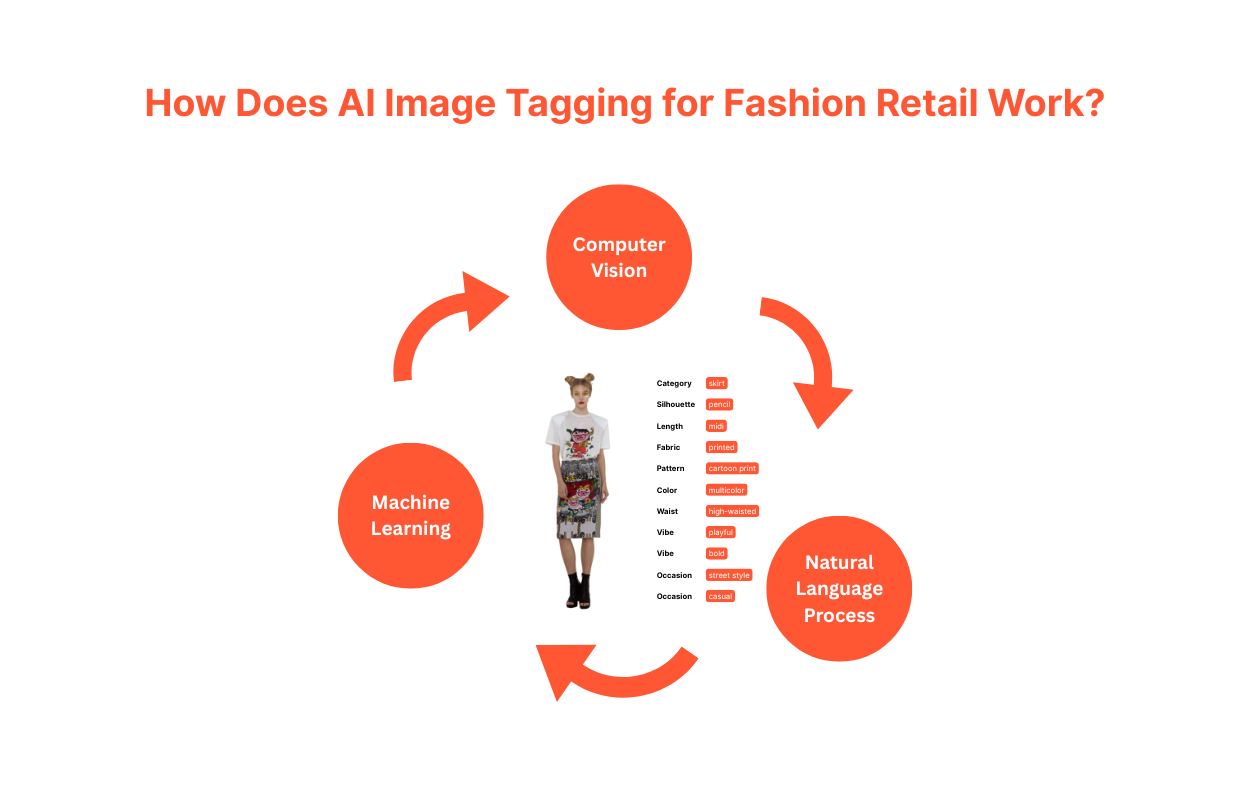 Computer Vision for Fashion Recognition
Computer vision algorithms are trained on millions of fashion images to recognize:
Product categories (dress, top, pants, shoes, accessories)
Visual attributes (color, pattern, texture)
Design details (neckline, sleeve type, hem length)
Style elements (casual, formal, bohemian, minimalist)
NLP helps understand and generate:
Descriptive tags for fashion-specific attributes
Product titles and descriptions
SEO-optimized metadata
Multi-language translations
AI will continuously improve through:
Initial training on curated fashion datasets
Real-world application on retailer catalogs
Expert validation and corrections
Continuous learning from new data
This creates a feedback loop that makes AI more accurate over time.
There are hundreds of tagging tools on the market, but not all of them are created equal. Even powered by AI, it's important to remember that AI is only as good as the input data that trained the algorithm. And when AI makes mistakes, fashion experts with a deep understanding of the industry should be the ones to review those mistakes.
Below, we list essential criteria for fashion tagging solutions.
Is the AI trained specifically on fashion data?
Are fashion experts involved in validation?
Does it understand nuanced style differences?
Does it tag all relevant attributes for your categories?
Can it handle bulk uploads?
What's the turnaround time per image?
Does it scale with your catalog size?
API availability and documentation
Compatible data formats
Multi-language support
Ease of integration with your tech stack
How many additional products become discoverable through AI tags?
Are those tagged-only products relevant to a specific search query?
Whether tagged-only products receive clicks
At YesPlz, we've developed a comprehensive process that ensures accurate and fast image tagging for fashion retailers.
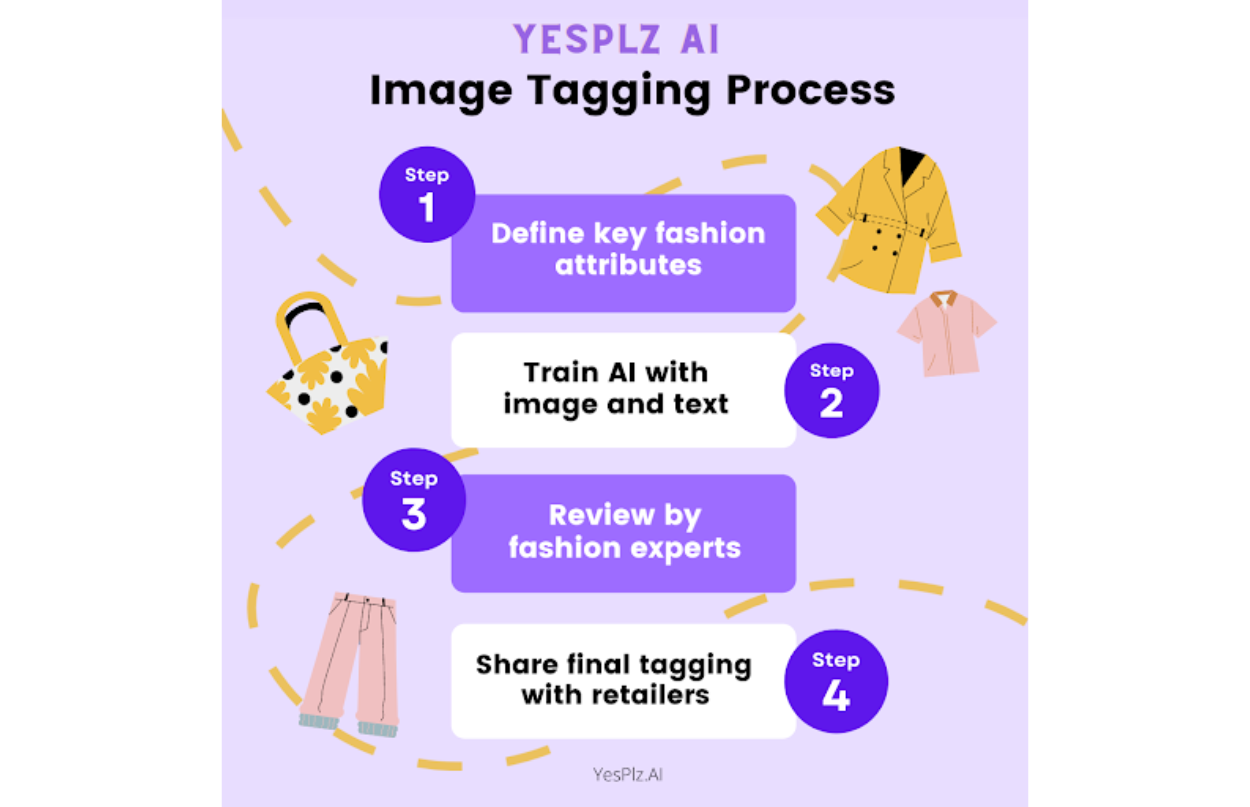
Before building our tagging tool, we defined key fashion attributes that matter to shoppers through extensive user interviews.
We began with user interviews, then sat down with shoppers to define what key fashion attributes they care about the most. Our interviews took hours of probing each individual to find out more about their most important attributes. As a result, our image tagging tool reflects the real needs of shoppers.
Because of the preparation we've put into it, retailers can be assured that our tool tags fashion-specific attributes that shoppers are actively searching for, such as:
Fit and silhouette
Style and occasion
Design details
Material and texture
Color and pattern
Vibe and Occasions
Through a combination of computer vision and NLP technology, YesPlz AI performs deep image tagging. Our AI learns to:
Recognize subtle style differences
Understand context and styling
Apply consistent taxonomy
Handle edge cases and unusual items
AI will inevitably make incorrect inferences, but who is catching those mistakes? At YesPlz, our fashion data annotators are from Parsons School of Design and Fashion Institute of Technology. They understand the industry insights and are up-to-date on the latest trends and terminology.
Combining AI trained in computer vision and NLP with fashion experts, retailers get fast, accurate, and comprehensive fashion tagging.
This human-in-the-loop approach ensures:
Trend-aware tagging
Nuanced style recognition
Quality assurance
Continuous AI improvement
YesPlz image tagging process ends with an output that helps retailers make better decisions based on data. Our API provides you with easy-to-use tagging information in a flexible format that fits your preferences.
Output features:
RESTful API integration
Multiple data formats
Multi-language support
Custom taxonomy mapping
Bulk processing capabilities
Real-time tagging options
Dashboard to monitor and moderate
A shopper is looking for a shirtdress, defined as a dress with a collar and buttons. Let’s compare what she sees on two different fashion eCommerce sites with and without AI image tagging.
The shopper is shown results that include:
T-shirt dresses
Men’s dress shirts, which are unrelated to her original search query.
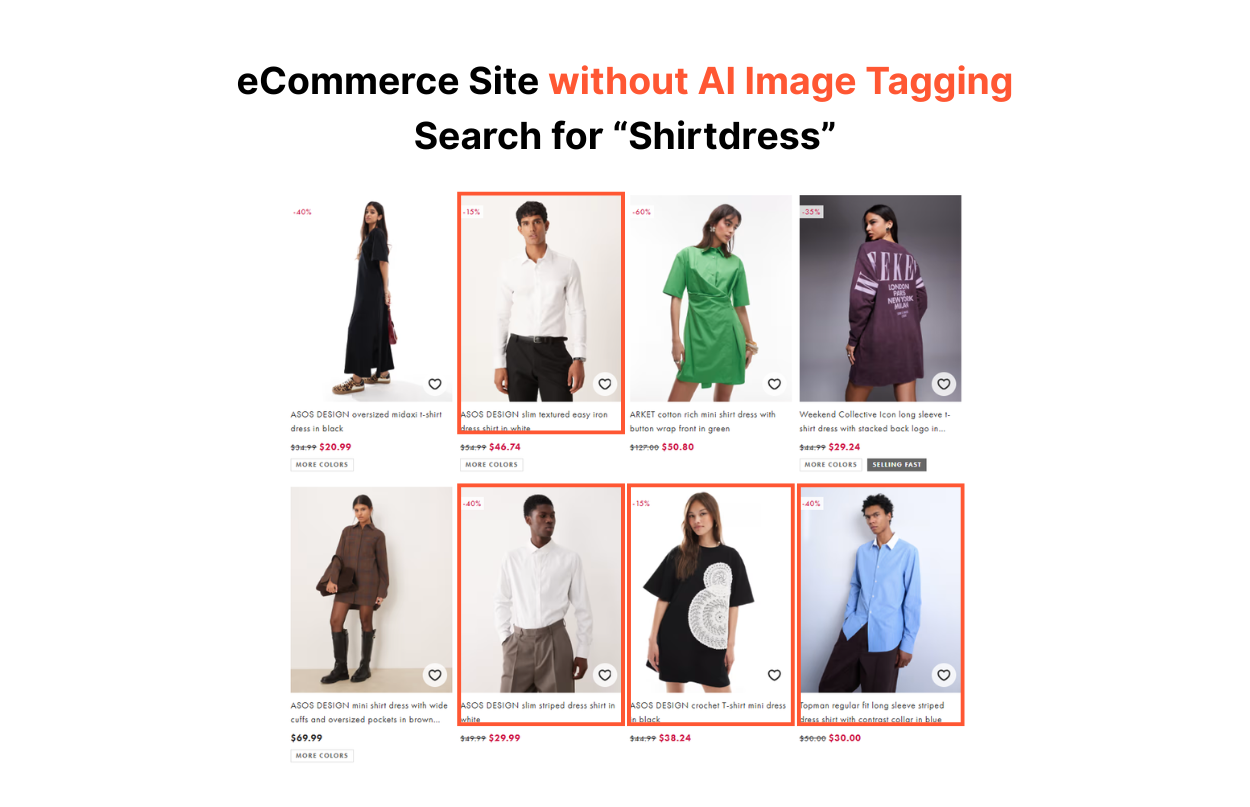 These results highlight the importance of accurate and comprehensive fashion tagging. When tagging is done manually, it often leads to many issues, such as:
Inconsistent terminology
Missing attributes
Irrelevant results
Poor shopper experience
Lost sales opportunities
The shopper receives search results that are clear, accurate, and fully aligned with her intent.
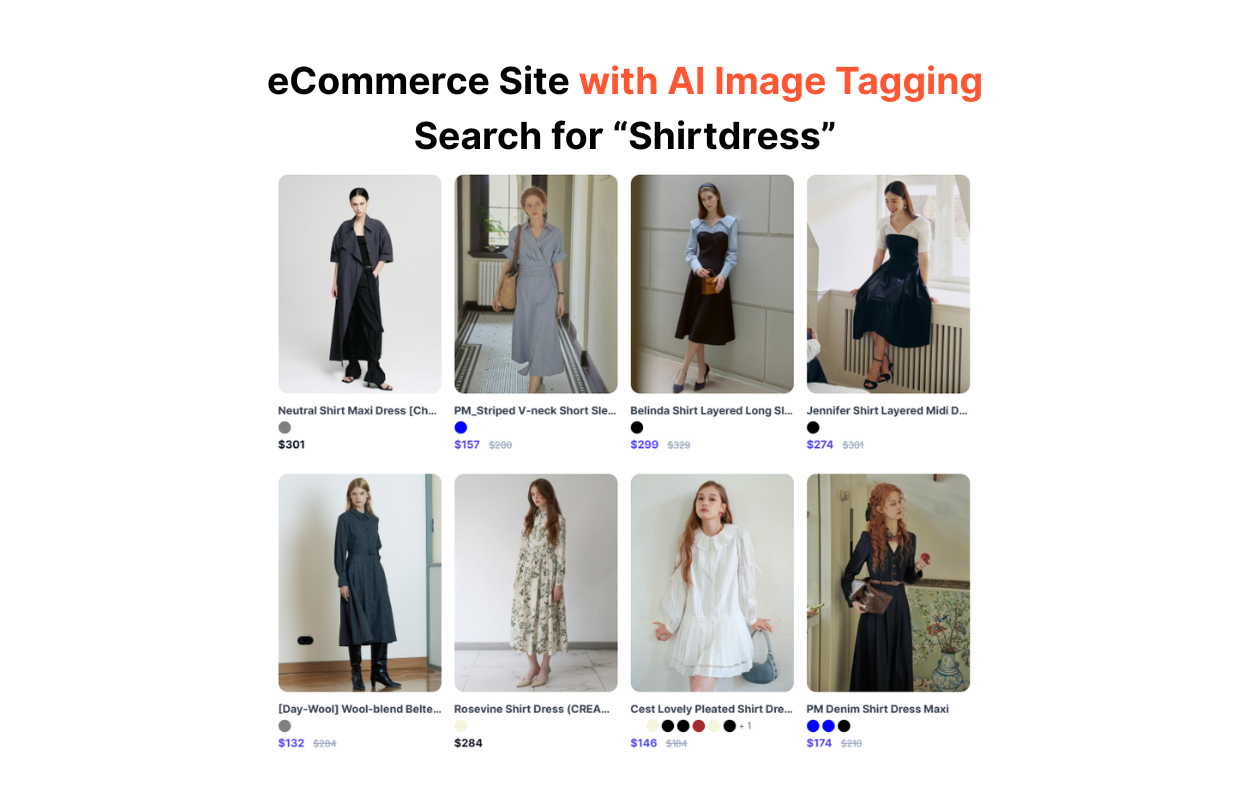 So what’s the difference between the two experiences?
In this second set of results, YesPlz AI fashion tagging accurately identifies and applies the correct attributes for a shirtdress, enabling precise and reliable search performance.
Benefits of AI image tagging:
100% relevant results
Accurate attribute matching
Enhanced filtering options
Improved shopper satisfaction
Higher conversion rates
Fashion tagging achieves 90%+ accuracy when combined with expert validation. This outperforms manual tagging and general AI tagging tools, which often lack fashion-specific context and struggle with nuanced attributes.
AI processes images in seconds. Catalogs with thousands of products can be tagged in a few days.
Yes. Fashion tagging can process a wide range of image types, even in challenging scenarios, including:
Clothing on or off models
Noisy backgrounds
User-generated content
Low-quality images
Multiple products in one image
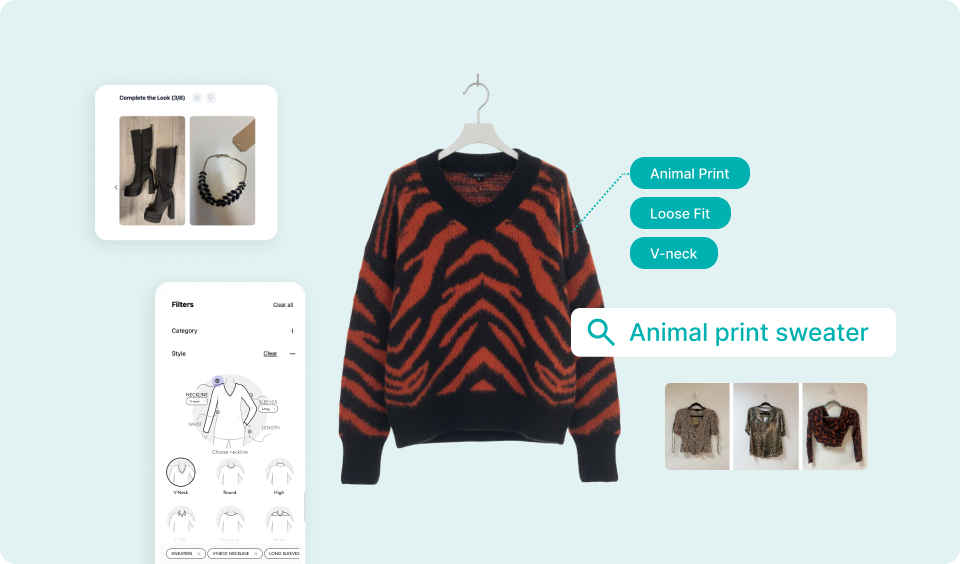
In a case study with Big Sister Swap, YesPlz AI automatically tagged thousands of one-of-a-kind, pre-owned fashion items.
 4. Can AI Image Tagging Support Multiple Languages?
Yes. AI image tagging can work across multiple languages and local markets. For global fashion retailers like W CONCEPT, YesPlz AI fashion tagging was tailored to understand Japanese, English, and Korean. It removes language barriers for shoppers. Also, it enables accurate search and recommendations in every language.
AI image tagging pricing varies based on your catalog size and needs. At YesPlz, we offer:
A flexible pay-as-you-go plan for retailers just getting started
A subscription-based plan that includes tagging plus additional discovery tools.
Use our pricing calculator to get a custom quote based on your SKU count. Or contact us at hello@yesplz.ai to discuss a plan that fits your business size and goals.
Integration is simple and hands-off. Just share your product URL with us. Our team handles the rest, from auto-tagging your catalog to installing the discovery apps. We work seamlessly with Shopify, Magento, and custom-built websites. Depending on your business size and platform, integration typically takes anywhere from 2 to 4 weeks. No heavy lifting required on your end.

Written by YesPlz.AI
We build the next gen visual search & recommendation for online fashion retailers
