Self-Service Product Tagging: Tag Your Entire Catalog Instantly
Inconsistent tags hurting sales? Self-service product tagging delivers accuracy and speed without enterprise prices. Tag products 10x faster.

by YesPlz.AIFebruary 14, 2026

Inconsistent tags hurting sales? Self-service product tagging delivers accuracy and speed without enterprise prices. Tag products 10x faster.
by YesPlz.AIFebruary 14, 2026
Every product image contains dozens of visual details. Shoppers often include these attributes in their search terms. For example, a shopper is looking for women’s slim, long, bootcut, high-waisted denim pants. How can your site show her the relevant items to her search query? Self-service product tagging is your answer. This system scans your product images, identifies, and extracts comprehensive attributes in minutes. That way, your shoppers can find relevant products no matter the search term they use.
Take a look at the image below:
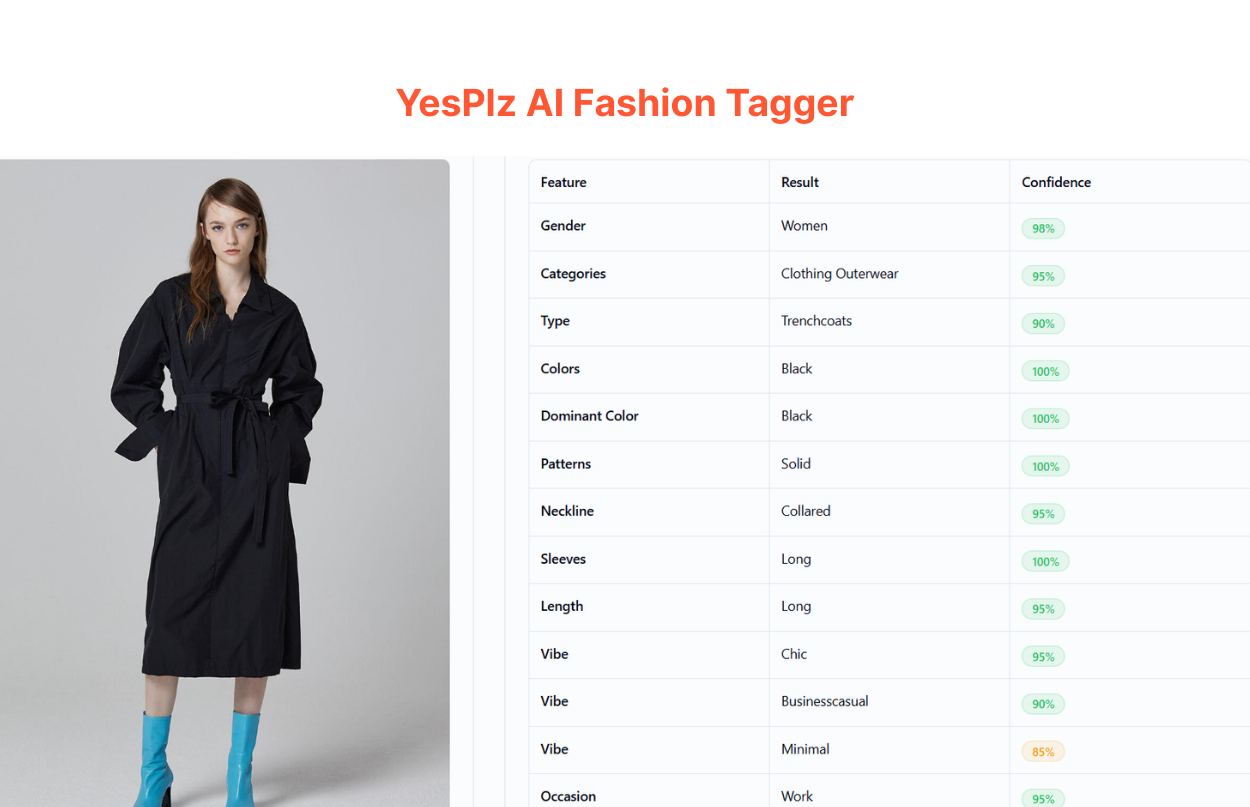
 How many adjectives and nouns can you use to describe the jeans in the product photo? 5, 8, or 10? Meanwhile, product tagging leverages AI and computer vision to generate 20 attributes in seconds:
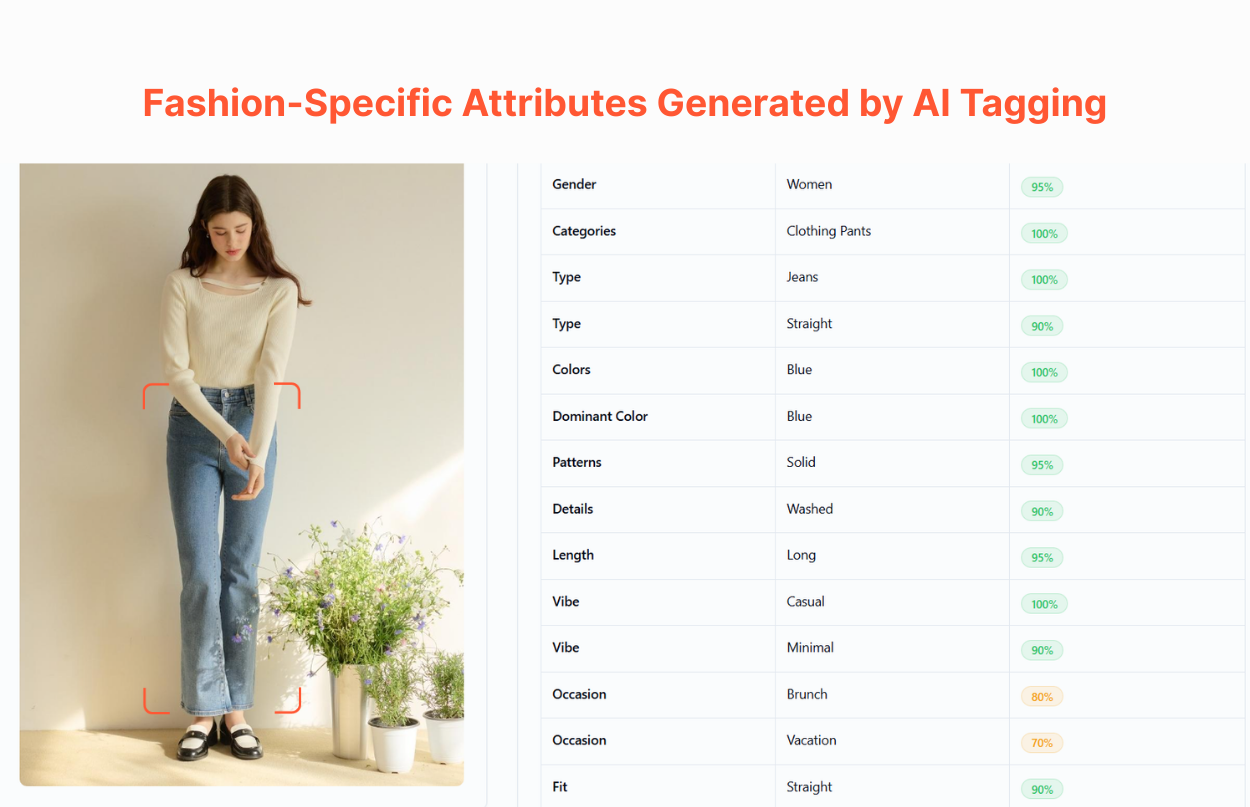 As you can see, the system identified and extracted multiple fashion tags, including gender, category, color, pattern, details, vibe, and occasion. With this rich product data, whether shoppers type ‘women’s slim, long, bootcut, high-waisted denim pants,’ ‘high-waisted blue jeans,’ or any combination of these words, this product always shows up in their search results.
Self-service tagging represents a shift in how modern eCommerce approaches product tagging. Instead of relying on expensive enterprise solutions or exhausting manual processes, this platform lets retailers be in the driver's seat.
If you are a fashion retailer, you can simply provide a product image URL and a unique ID to our Fashion Tagger. You’ll get 10-15 key tagging results, which have been trained on over a million fashion data points, and finally pay for what you tag.
 Self-service tagging provides retailers with the flexibility to work at their own pace. Traditional enterprise tagging solutions require IT involvement, lengthy implementations, and complex integration. Meanwhile, self-service tagging is designed for immediate use.
Tagging is the foundation of exceptional product discovery. In fashion eCommerce, tagging isn’t optional. It’s what powers personalized search, effective filters, dynamic collections, high-performing landing pages, smooth catalog management, and stronger SEO and GEO. All of this adds up to a better, more modern shopping experience. Let’s walk through each use case of product tagging.
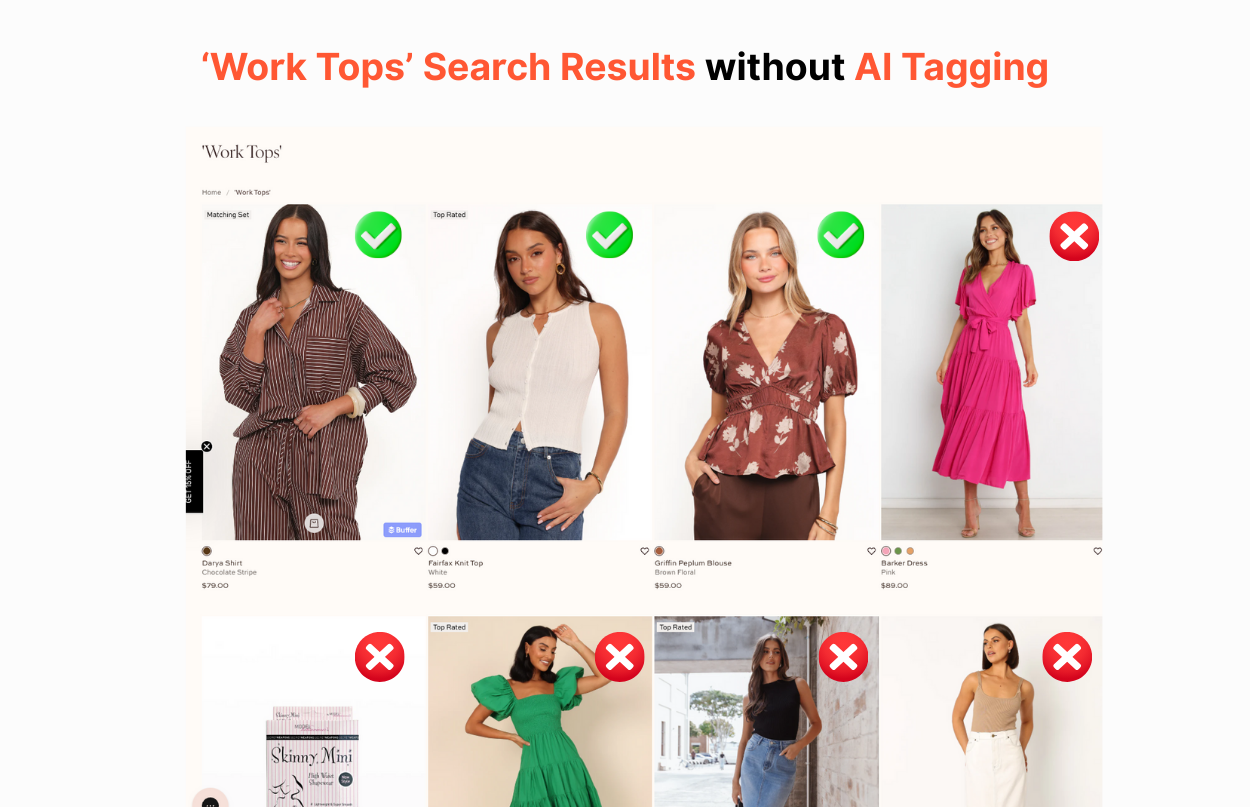
When shoppers search your site with specific needs in mind, your search function needs to deliver exactly what they’re looking for. Take a frequent search query ‘work tops’ as an example. Shoppers want to find professional, office-appropriate clothing. But most product titles and descriptions don’t include this exact matching keyword.
What if these products are tagged with a work occasion? AI automatically labels the products based on when and where they'd be worn. The difference is striking. Compare these two scenarios using the same product catalog:
The site search struggles to identify even the correct product category, leaving shoppers frustrated with irrelevant results. It returns a mixed bag of results. Only 3 items are actually work-appropriate, while 5 are completely unsuitable.
 Catalog with Self-Service Product Tagging
Every single result is relevant and work-appropriate. The search returns 121 professional options, including knitted tops, button-up blouses, and collared shirts in workplace-friendly styles and colors. The AI has automatically tagged products based on occasion, ensuring shoppers find exactly what they need.
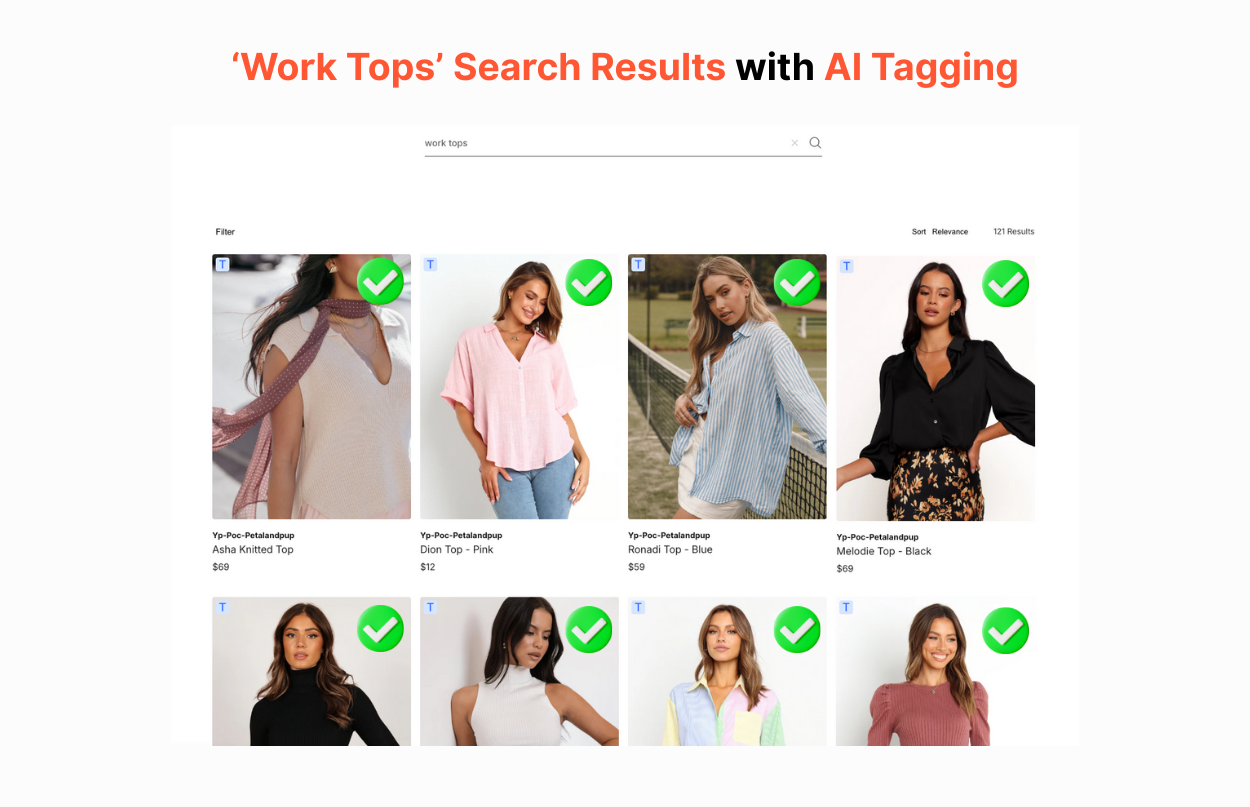 Our recent study shows that AI tagging improves search matching by 22% and click-through rates by 11%. When products are tagged with rich attributes, shoppers find what they’re looking for faster, browse more confidently, and convert at higher rates.
Filtering allows shoppers to take control of their discovery journey, quickly narrowing down hundreds of products to find exactly what they want. But filters only work efficiently if every product is properly tagged. With AI tagging, your entire catalog is automatically configured with detailed attributes.
Your shoppers can start searching using a broad term like ‘denim pants.’ Then, narrow down results by applying multiple filters to find the perfect match. For example, gender: women, category: denim, rise: high, fit: slim, bootcut.
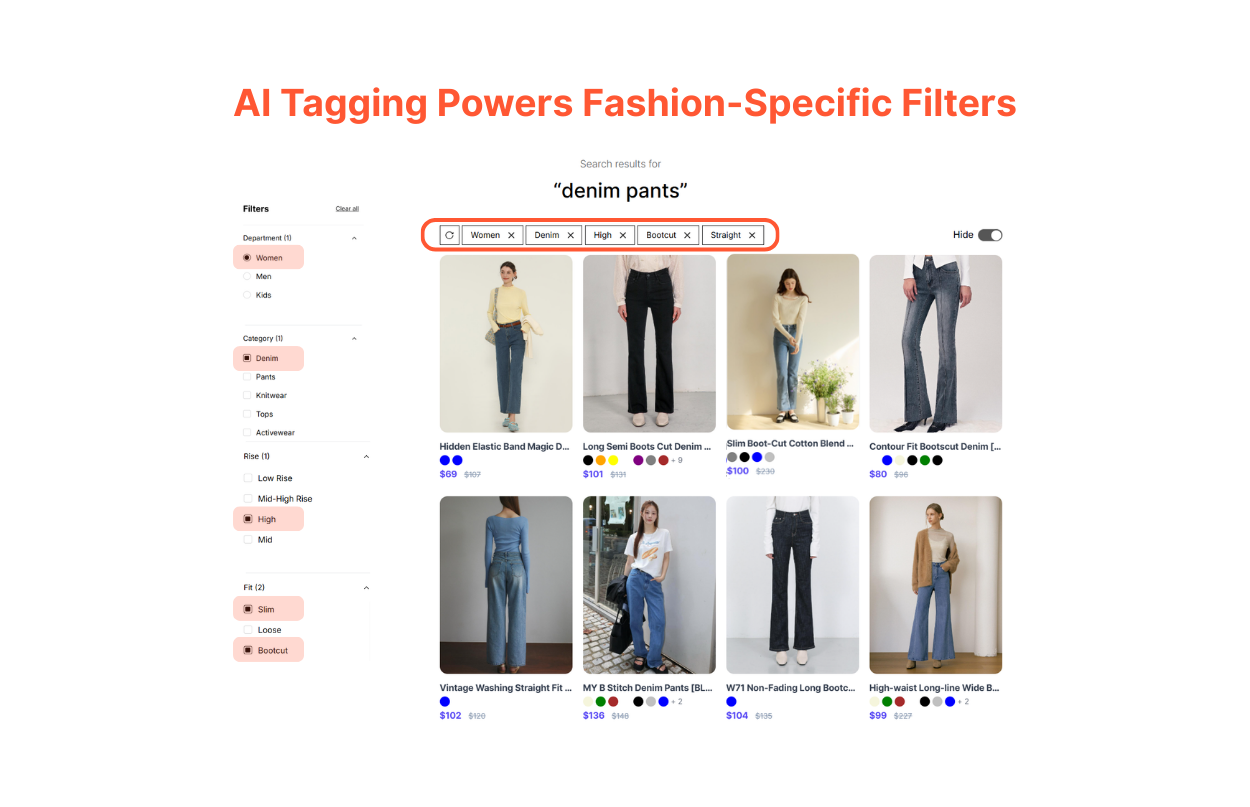 Shoppers who use filters know what they want and are ready to buy. Product tagging makes their journey effortless by providing granular filtering options that they can mix and match. The more detailed your tags, the more ways shoppers can slice through your catalog. They can find their ideal product in just a few clicks, instead of scrolling.
A curated collection page is often where shoppers jump to browse and discover curated items. Each collection page tells a story, inspires shoppers, and makes decision-making easier. But manual collection curation is time-intensive. Your merchandising team scrolls through hundreds of products to hand-pick items. Besides, this manual process can’t keep up with trends and catalog changes.
Fashion tags can assist in easily curating a themed collection. They come with a variety of themes and can be used to easily curate the collection. You simply create a group of conditions with relevant fashion tags. Let’s take an example. You want to create a Garden Party collection. Instead of reviewing hundreds of dresses, you just need to set rules containing relevant tags as follows:
Category Tag: ‘Dresses’
Pattern Tag: ‘Floral print’
Color Tag: ‘Pastel colors’
Length Tag: ‘Midi’ or ‘maxi’
Season Tag: ‘Spring’
The tagging system populates the collection with relevant products. When new inventory arrives with matching tags, it auto-adds to the collection.
Generic landing pages show the same content to every visitor. Personalized landing pages adapt to individual preferences, browsing history, and shopping behavior. Below are some examples of personalized landing pages powered by AI tagging:
Style-based personalization: If a shopper consistently views ‘minimalist’ and ‘neutral’ items, their homepage showcases products with those tags.
Occasion-based personalization: A shopper browsing ‘workwear’ sees a landing page curated with ‘business,’ ‘professional,’ and ‘office’ tagged products.
Seasonal personalization: Automatically adjust landing pages based on the season. Let’s say, show products containing ‘light weight’ and ‘summer’ tags in July, ‘cozy’ and ‘layering’ tags in November.
Behind the scenes, product tags are the organizational backbone of your entire catalog. They determine where products appear, how they’re categorized, and how efficiently your team can manage thousands of SKUs. For instance:
Auto-categorization: Products tagged ‘jacket’ automatically route to your outerwear category tree.
Multi-category placement: A denim jacket tagged with both ‘jacket’ and ‘denim’ can appear in both category trees simultaneously.
Bulk attribute updates: Need to mark all summer items for clearance? Filter by the ‘summer’ tag and apply discounts to hundreds of products instantly.
Inventory planning: Analyze which tags sell fastest to inform future buying decisions.
Product relationship mapping: Tags identify which products work together for ‘Complete the look’ recommendations.
Making a switch to a self-service tagging platform impacts multiple areas of your eCommerce business, including:
In fashion and retail, timing is everything. Trends move fast. Seasons change. And, shoppers’ preferences shift quickly. The ability to launch products rapidly gives retailers a competitive edge. With self-service tagging, retailers can launch new collections fast and respond to trends immediately. Imagine being able to photograph new products in the morning. Having it live on your site with complete, accurate tagging by the afternoon. That’s the speed that AI-powered tagging enables.
While a great user experience matters, machine readability is equally critical—if not more so—in today's AI-driven shopping landscape. AI search engines and autonomous shopping agents don't browse as humans do. They need structured, enriched data to understand and recommend your products. Basic product descriptions won't cut it anymore. Product tagging transforms your catalog into a structured dataset that machines can easily parse, index, and recommend. It ensures your products show up when and where they matter most.
The ROI of tagging is compelling. While pricing varied by provider, tagging solutions typically cost a fraction of what you’d spend on manual labor. Every product gets evaluated against the same criteria, using the same taxonomy, producing consistent results across your entire catalog. Consider a mid-size retailer with 2,000 products:
Assume that it takes an average of 5 minutes for humans to tag a product. And the hourly wage for tagging is $15 per hour.
2,000 products × 5 minutes average = 167 hours
167 hours × $15/hour average = $2,505
Per-product tagging pricing typically ranges from $0.30 to $0.50. For example, YesPlz AI currently charges $0.1 per product for a catalog of 1,001 to 10,000 products.
One-time tagging cost: 2,000 products × $0.10 = $200
So, for a catalog of 2,000 products, retailers save $2,305 or cut costs by 92%. The savings compound over time, especially when you factor in tagging accuracy, better product discovery, and increased conversion.
Copy-pasting individual AI prompts might work for a handful of products, but it's not a scalable solution. To maintain quality across thousands of items, you need a complete tagging pipeline with built-in controls and quality checks.
YesPlz AI tagging uses a tightly engineered process designed specifically for consistency and accuracy. As a result, it generates consistent tags across your entire catalog. This consistency translates into accurate, relevant search results. AI tagging achieves accuracy rates of 85-100% for most attributes. It outperforms a human tagger due to fatigue and subjective interpretation.
 Scalability Without Limits
Perhaps the most transformative benefit of self-service product tagging is unlimited scalability. Whether you tag 100 or 100,000 products, the process remains the same. AI will handle everything. This means growing your catalog by 10x doesn't require growing your team by 10x. For brands with ambitious growth plans, tagging removes one of the most significant operational barriers to scaling.
Our self-service product tagging comes with predefined attributes that cover the essential fashion eCommerce needs—refined over years of industry experience. But we know every business is unique. If your business needs go beyond the standard—specialized categories, niche attributes, or unique product types—we've got you covered. YesPlz AI can build a custom tagging solution tailored to your exact requirements. Contact us to discuss your custom tagging needs and get a quote.
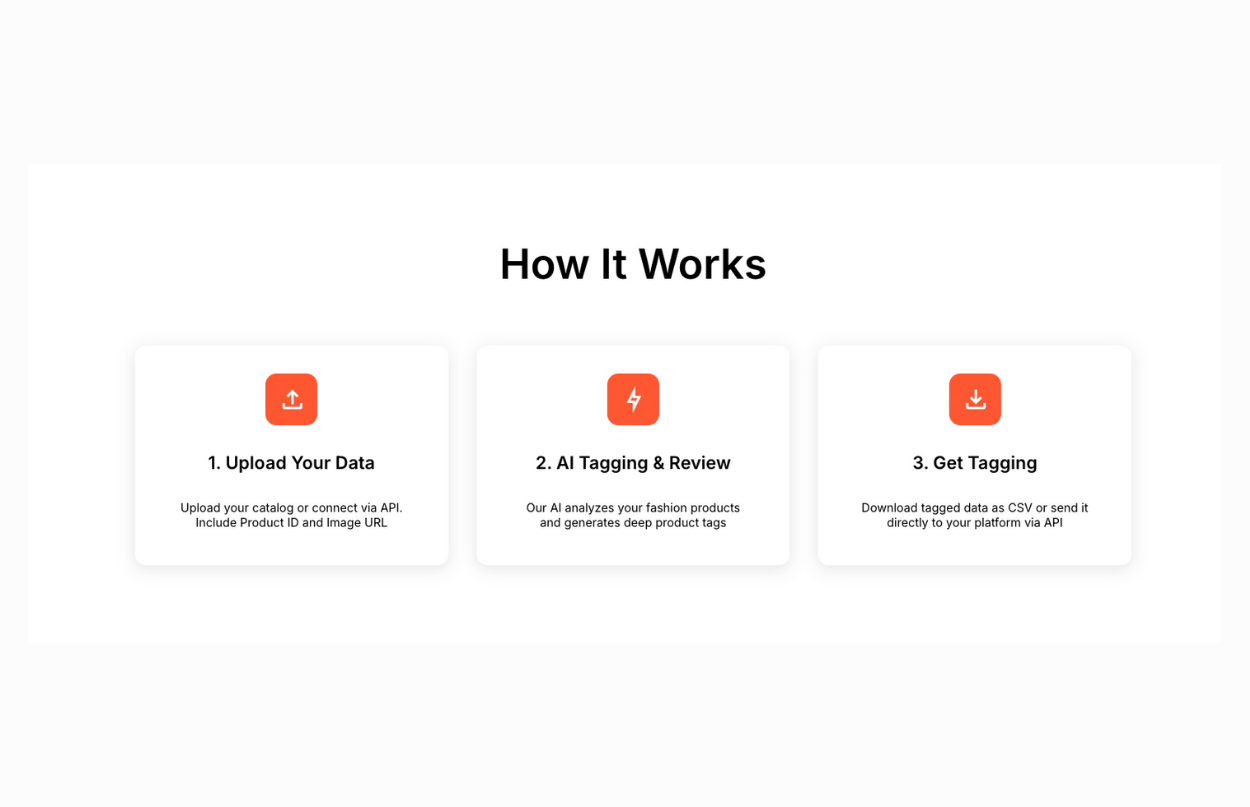
You start by uploading your product catalog to the tagging platform. Most solutions accept batch uploads via CSV or direct API connections for automated workflows.
Once uploaded, the AI goes to work. Using computer vision and machine learning, it identifies visual details in each product image.
The AI extracts detailed, accurate tags based on its analysis. For example, YesPlz AI fashion tagging is built on millions of fashion data points. The system can generate 20-60 attributes for a single product, from silhouettes and styles to materials and aesthetics.
Retailers can review the tags generated by the AI. While AI accuracy is high, human oversight adds valuable quality control. The AI continuously improves based on your feedback, learning your brand's specific terminology and preferences.
Enjoy full transparency and flexibility. No high upfront costs, just value for every product tagged. Self-service tagging platforms typically offer pay-per-product pricing, making it accessible for businesses of all sizes.
Once approved, download your tagged data as CSV or send it directly to your platform via API. Most platforms offer flexible export options to fit seamlessly into your existing workflows.
While virtually any eCommerce business can benefit from self-service tagging, certain types of retailers see impressive results:
If you are running a catalog of 500 - 10,000 products, you’re in the sweet spot. You’re large enough that manual tagging is painfully time-consuming. But you may not have the budget or scale to justify traditional enterprise solutions. Self-service product tagging gives you enterprise-level capabilities at an accessible price. So, you can compete with larger players on product discovery and shopper experience.
Rapid growth is exciting but challenging. Your product catalog might double or triple in a year. Your team struggles to keep pace with tagging demands. Self-service tagging scales effortlessly with your growth. It ensures that operational processes never become the bottleneck that slows your expansion.
If you’re selling products from multiple brands, consistency becomes even more critical. Each vendor might use different terminology. So, manually reviewing and editing to make tags consistent across your entire catalog is nearly impossible at scale. Self-service product tagging applies consistent standards across all brands. It creates a unified tagging system regardless of which vendor supplied the product.
If you’re investing heavily in personalization, visual search, or advanced recommendation engines, those technologies are only as good as your product data. Accurate, comprehensive tagging is the foundation that makes these website functionalities work well.
In today’s eCommerce landscape, product discovery is a competitive battlefield. Shoppers expect excellent search and filtering capabilities regardless of retailer size. They want visual search, personalized recommendations, and the ability to find exactly what they’re looking for in seconds. All of this depends on one thing: accurate, comprehensive product tagging.
Manual tagging simply can’t deliver the speed, consistency, and scalability that modern eCommerce demands. Meanwhile, traditional enterprise solutions price out smaller players. Self-service product tagging solves both problems. It’s accessible, affordable, fast to implement, and delivers enterprise-quality results.
For eCommerce teams tired of choosing between speed and accuracy, between cost and quality, self-service tagging offers a better path forward. Curious what it can do for your fashion business? Schedule a demo with us.

Written by YesPlz.AI
We build the next gen visual search & recommendation for online fashion retailers
