GEO for Fashion Brands: Why AI Visibility Starts With Product Data
Wondering how to get recommended by ChatGPT? Most retailers investing in GEO for fashion brands are optimizing the wrong layer. This piece breaks it down.

by YesPlz.AIJune 10, 2026

Wondering how to get recommended by ChatGPT? Most retailers investing in GEO for fashion brands are optimizing the wrong layer. This piece breaks it down.
by YesPlz.AIJune 10, 2026
AI is changing where fashion discovery begins. So, optimizing GEO for fashion brands is no longer optional.
Shoppers who once turned to Google now turn to ChatGPT. They ask conversational questions. Let’s say, find me a summer romper for a cocktail party under $150. And, they expect specific, shoppable answers.
For fashion brands, this shift creates a new question: How do you show up in those AI-generated answers?
Two paths get pitched. Hire a GEO agency to build your brand authority in AI systems. Or, enrich your catalog the way AI can actually read and recommend your products.
In this piece, we break down exactly what each does, where each falls short, and which to prioritize if your goal is to get individual products recommended by AI.
GEO is an abbreviation for Generative Engine Optimization. It is the practice of making your brand visible inside AI-generated answers. Classic SEO chases Google rankings. Meanwhile, GEO earns citations in ChatGPT, Perplexity, Google AI Mode, and whatever AIs your shoppers are using next.
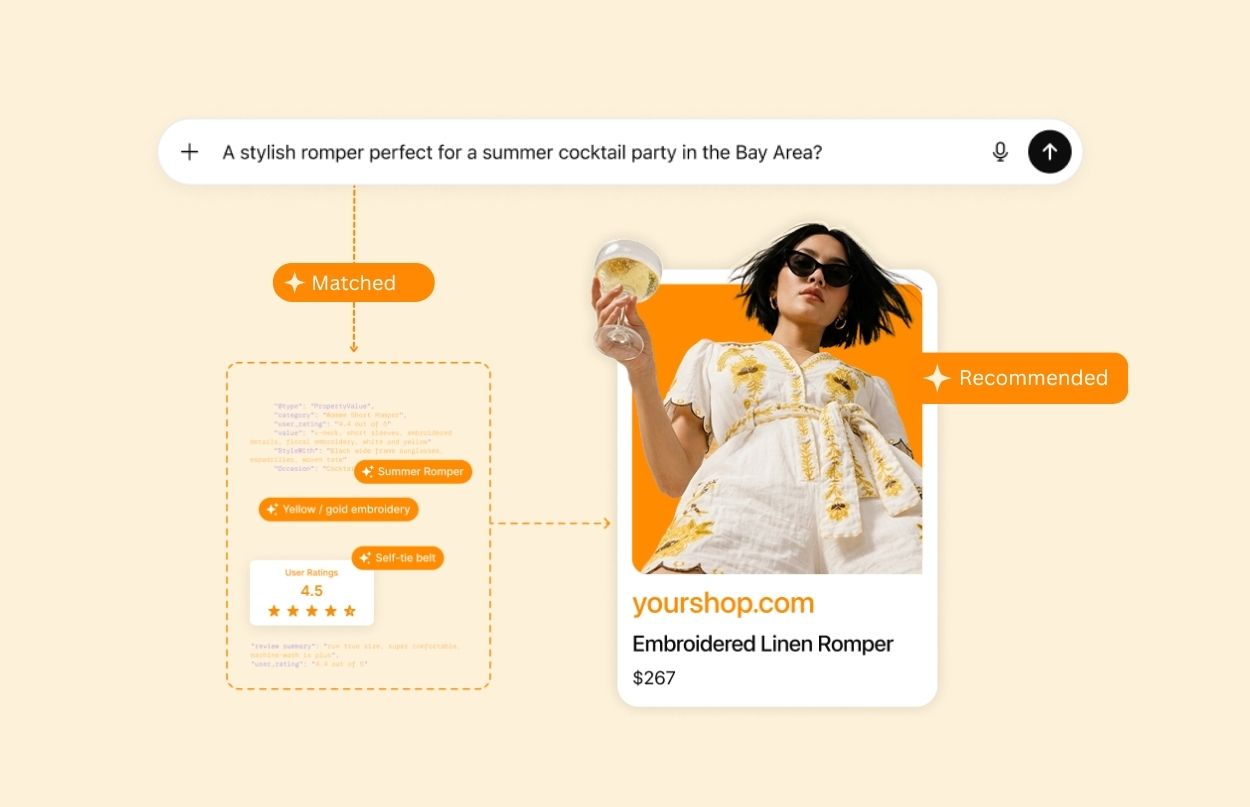
A growing share of shoppers now start product research by asking an AI rather than using traditional search engines. If your brand doesn't appear in those AI answers, you're invisible at the top of the funnel.
For fashion brands specifically, being cited as a go-to source for sustainable denim, occasion dressing, or contemporary workwear can meaningfully shape consideration in ways that a page-two Google ranking never could.
AI platforms cite informative editorial content. So, a GEO agency creates content designed to earn those citations:
Buying guides
Fashion trend reports
Comparison articles
Styling advice
Sizing guides
FAQs
Examples:
Cotton vs. Linen: Which Fabric is Better for Summer?
How to Choose the Right Jeans for Your Body Type
The goal is to help AI systems associate your brand with the fashion topics your shoppers care about. So, your brand name surfaces when those topics come up in a query.
AI platforms trust brands that appear consistently and credibly across the web. A GEO agency builds that footprint through:
Digital PR
Expert quotes
Industry publications
Brand mentions
Partnerships with fashion influencers and experts
The more consistently your brand is associated with a topic across trusted sources, the more likely AI engines are to cite you as an authority on it.
A good GEO agency also improves the technical infrastructure that AI systems rely on to understand and crawl your eCommerce site. Important factors include:
Crawlability
Site architecture
Internal linking
Product feeds
Traditional SEO agencies track rankings, traffic, and click-through rates. GEO agencies go further and measure:
Whether AIs mention your brand
Which products appear in AI-generated answers
Share of voice in AI search
Citation frequency across AI platforms
In practice, this means running test prompts, for example, the best sustainable clothing brands. And then, track how consistently your brand surfaces in responses across different AI platforms.
A GEO agency that executes well across all four areas gives your brand a continuing presence in AI-generated answers. But notice what every one of these four areas has in common?
They optimize how AI understands and talks about your brand. None of them touch what AI needs to recommend your products. This is exactly where GEO for fashion brands needs to go deeper.
A GEO agency can't provide deep product data enrichment to make every SKU in your product catalog discoverable by AI. And for fashion, the data that make an item searchable aren't just category and price. They're:
Fashion-specific attributes: neckline, sleeve length, silhouette, fabric, fit, etc.
Contextual wear data: what to style it with, what occasions it works for, how it fits into a wardrobe
Shopper reviews: how shoppers actually describe the fit, feel, fabric, etc. of the product in reviews
When AI platforms like ChatGPT handle shopping queries, they don't scan your blog posts or count your press mentions. They only rely on how well your product attributes are structured and tagged.
Consider this example. A shopper wants to find: ‘linen wide-leg trousers for a beach vacation under $200.’ No buying guide, styling advice, or digital PR makes your relevant products surfaceable. AI needs structured, accurate, consistent product attributes to display the right items the shopper is looking for.
Here's the gap:
Their job ends at the brand authority layer. Your product data, your attribute coverage, your catalog's AI-readability — those are outside their scope.
The result? Your brand might get cited in the ‘best affordable womenswear brands’ query. But it fails to display relevant items when the same shopper asks AI to show them specific products.
The core function is rich, consistent, fashion-native tagging attributes applied across your entire catalog. The kind of attributes let AI understand your products the same way a fashion stylist would.
Here's what that produces in practice:
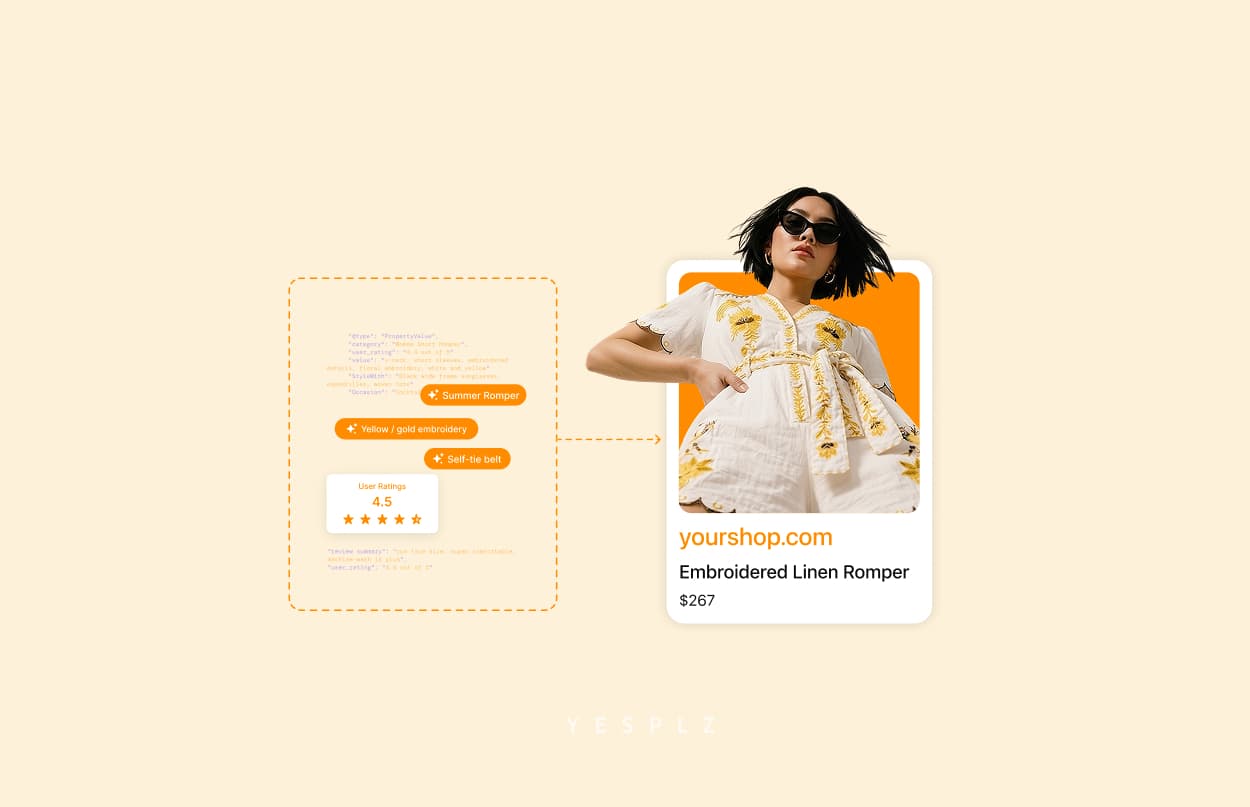
YesPlz AI leverages image recognition to analyze product images. It automatically extracts an average of 15-20 attributes per SKU. It isn’t just basic category and color attributes, but the granular fashion details that match how shoppers actually search.
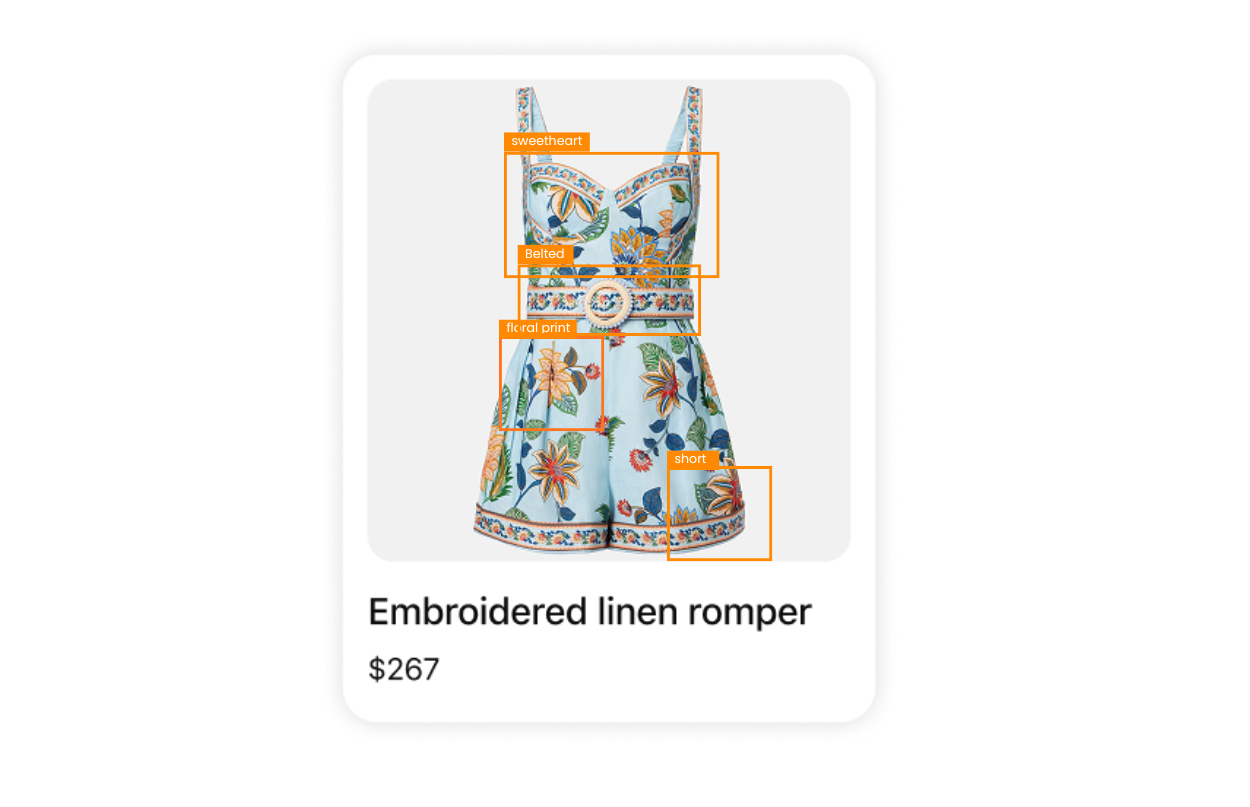 Take the embroidered linen romper above. The AI scans the image and extracts:
Sweetheart neckline
Sleeveless
Short-length
Wide pants
Belted
Tropical floral print
In other words, the AI labels the image with descriptive keywords (also known as fashion tags) to make it searchable. A product labeled this way can surface across dozens of queries. It can be:
a keyword search like ‘sleeveless summer romper’
or a conversational query such as ‘Find me a floral wide-leg short jumpsuit for vacation’
Some of the highest-converting AI shopping queries are occasion and context-driven, for instance:
What do I wear to a job interview
Beach vacation outfits
Date night in the city
Those queries don't describe a product; they describe a situation or an event. YesPlz AI tags each SKU in your catalog with occasion, context, and situational fit. So, when a shopper asks an AI for an outfit suggestion, your relevant products surface as the answers.
Real shopper language is one of the most underused fashion product data points. Reviews often contain the exact words shoppers use when searching.
YesPlz AI extracts recurring themes from shopper reviews and structures them into your product data. It helps close the gap between how your brand describes products and how your shoppers actually search for them.
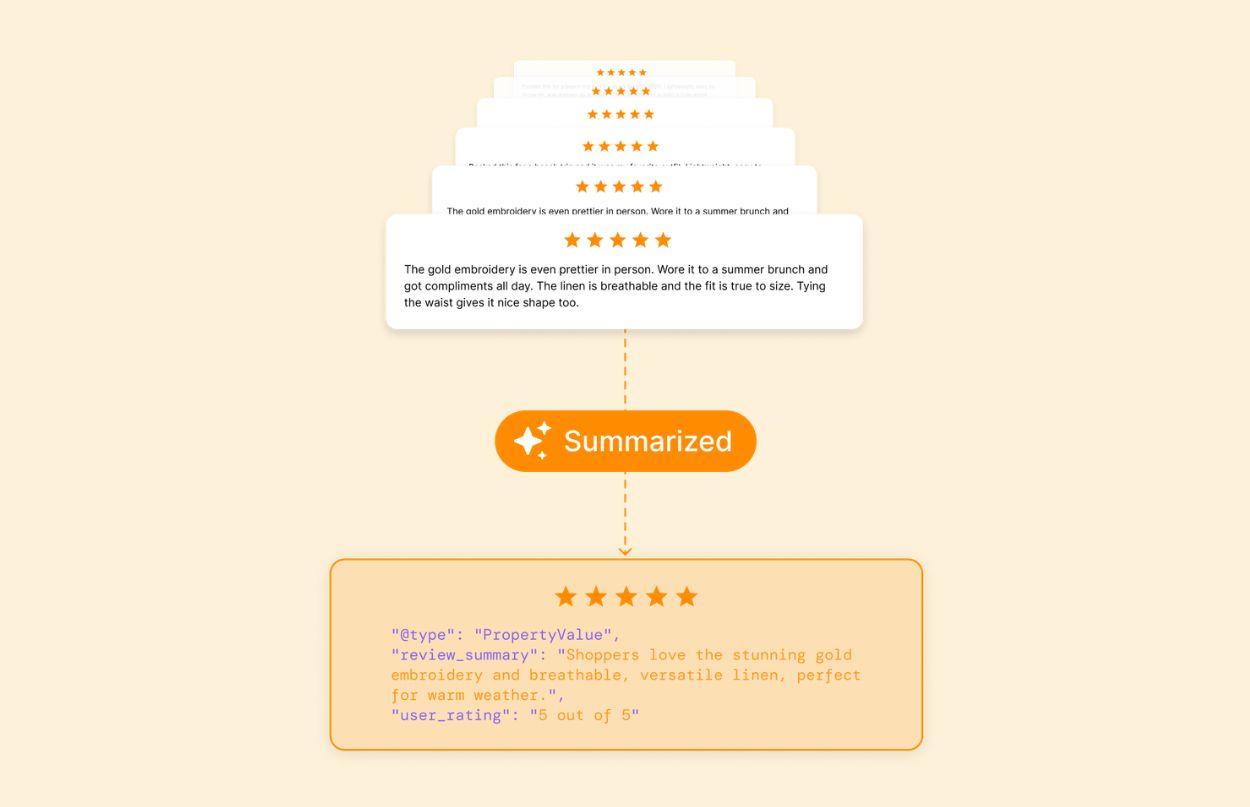
Take the romper example above. Across three reviews, shoppers mentioned the gold embroidery, the breathable linen, and, critically, it runs slightly large. YesPlz surfaces all of that as a structured summary.
The summary does two things at once. It gives the next shopper exactly the information they need to buy with confidence. And it gives AI the kind of natural, contextual language they need to recommend the product accurately — matching queries like ‘breathable summer romper’ or ‘vacation outfit that dresses up or down.’
YesPlz AI outputs every product attribute as structured JSON-LD at the SKU level. It is the same format Google recommends, and AI shopping agents rely on. This makes each product in your catalog fully AI-readable.
Catalog enrichment isn't a one-time project. New collections drop continuously. YesPlz AI applies consistent tagging to new products in real time. So, your catalog stays AI-readable as it grows.
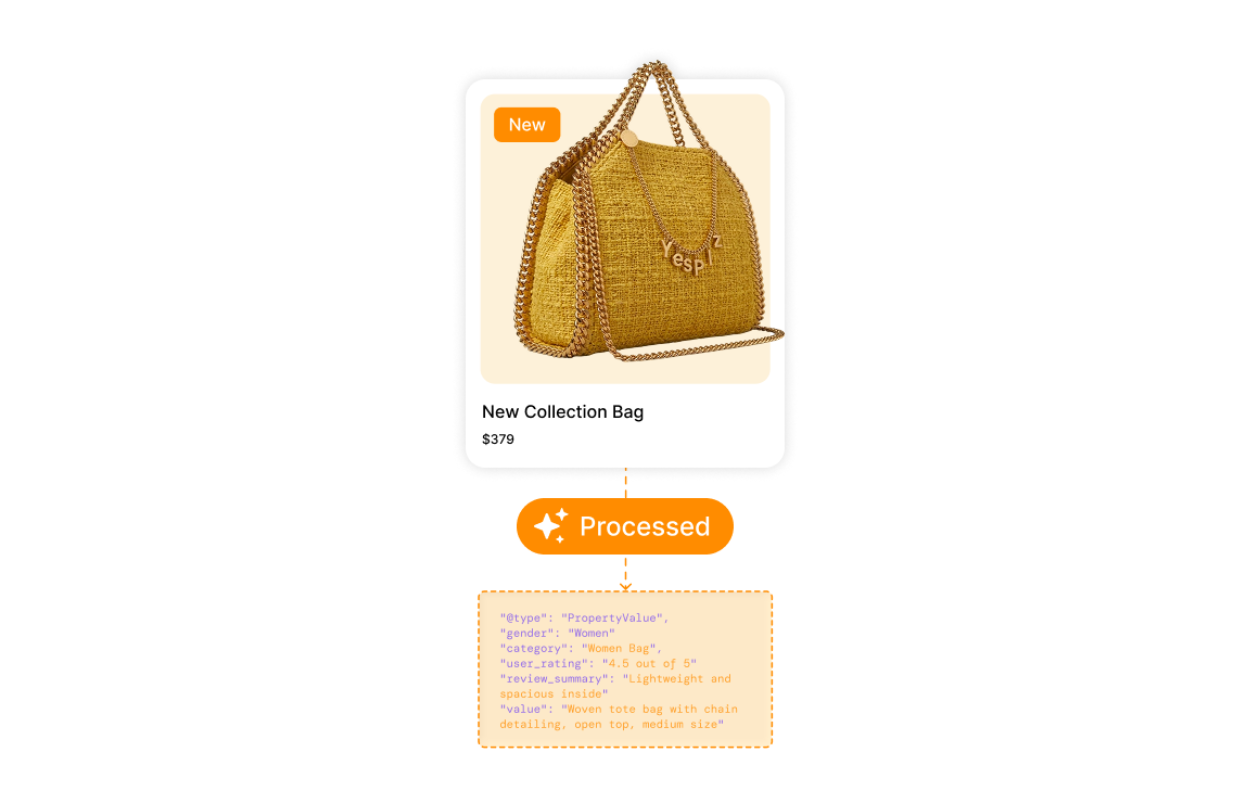
The same enriched data that makes your products searchable by external AIs also improves your own on-site search and recommendation systems. It's the same underlying problems:
AIs can't recommend what they can't understand.
And, shoppers can't find what your search can't surface.
Fix the product discovery layer once, and every downstream surface benefits.
When a GEO agency builds brand citations, those citations live on third-party sites. They're not yours — and those sites can update or remove them at any time.
When YesPlz AI enriches your catalog, that structured data lives in your systems. Every product tagged is an asset you own. And unlike citations, it compounds:
Growing more valuable as your catalog expands
Improving every surface your products appear on for their entire lifecycle
If you're evaluating where to invest your AI visibility budget, GEO agencies and YesPlz AI solve distinct problems on different layers. Here's how they compare side by side.
GEO Agency | YesPlz AI | |
What layer it works on | Brand discovery | Product discovery |
What gets optimized | Brand narrative PR mentions Authority signals | SKU-level attributes Occasion tags |
Query types it wins | Top-of-funnel awareness For example: "Best [category] brands" | Product-level recommendations For example: "Find me [specific item] for [occasion/budget/style]" |
Dependency | External Relies on third-party sites | Internal Lives in your own catalog and data systems |
Cost model | Ongoing retainer for content production | Platform subscription |
Fashion-specific intelligence | General SEO/GEO expertise applied to fashion | Specifically built for fashion |
Covers new product additions | Not automatically | Real-time tagging as the catalog grows |
Improves on-site search | No | Yes Same data enriches your own search and recommendations |
Honest take: GEO agency and YesPlz AI aren't strictly competing choices. They address different problems, and at scale, you may want both.
GEO agencies improve your online brand visibility. The editorial presence makes AI engines trust and cite you at the brand level. That matters for awareness, for consideration, for the "best brands for X" queries. If your brand has low AI visibility at that level, it's worth addressing.
But if the metric you care about is AI recommending SKUs from your catalog, the product discovery layer comes first. Here's why.
You can earn every brand citation available. But you still fail to convert when a shopper asks an AI to show them suitable products. The mention gets the shopper to know your brand. But the enriched product data determines whether AI can surface what they want when they arrive.
A well-enriched catalog gets more valuable as it grows. A product tagged today keeps getting discovered next season, next year, across every AI platform. Meanwhile, the brand authority-building work requires continuous investment to maintain.
If you're choosing where to allocate a limited budget, fix the product data layer first. AI engines can't recommend a product they can't read. Brand mentions are harder to monetize if the downstream product experience doesn't deliver.
Start with your product data. Make sure AI can actually read, understand, and recommend every SKU in your catalog. Then invest in GEO content to drive brand awareness. That way, when shoppers arrive, your catalog is ready to convert them.
GEO agencies help improve your brand visibility through various AI platforms. But they can't make your products AI-readable. They can't tag your 50,000 SKUs with the occasion, silhouette, and other fashion-specific attributes that an AI needs to match a shopper's intent to a specific product. That's a different layer, and it requires different expertise.
Before you commit to a GEO retainer, ask a more foundational question: Can AI engines actually read your product catalog? If the answer is no, or if you're not sure, that's where the work starts.

Written by YesPlz.AI
We build the next gen visual search & recommendation for online fashion retailers
