What is Hybrid Search?
Most search engines understand words. Hybrid search understands shoppers. Here's what hybrid search is and why it's becoming the new standard in eCommerce.

by YesPlz.AIMay 1, 2026

Most search engines understand words. Hybrid search understands shoppers. Here's what hybrid search is and why it's becoming the new standard in eCommerce.
by YesPlz.AIMay 1, 2026
The way people search and the way search engines work have never quite matched up. People search in feelings, contexts, and half-formed ideas. This is the natural way humans actually think. Search engines, for most of their history, have wanted something different. They've wanted keywords that are clean and specific.
Feed a text search engine the right keyword, and it returns exact matches. Give it anything resembling human language, and it falls apart, surfacing irrelevant results, empty pages, or a list of items that technically match the words but completely miss the point.
For a long time, the industry's answer was to put the burden on the searcher — try different search terms, apply more filters, and try again. From the retailer side — tag every product attribute that matters, write keyword-rich descriptions, and build synonym libraries by hand.
That’s why hybrid search comes in. Instead of forcing people to search like machines, it builds a search engine that understands people — combining the precision of keyword matching with the intuition of AI-powered semantic search. Hybrid search quickly becomes the new baseline for any search experience worth building.
To understand why hybrid search matters, you first need to understand:
The two ways conventional search breaks
And why fashion exposes both of them better than almost any other industry
Traditional keyword search — the kind that has powered most eCommerce sites for the past two decades — works by matching the words in a query against the words in a product catalog. Title match, tag match, description match. Exact words in, ranked results out.
This search tech works best for queries with highly specific, exact-match needs. That means shoppers already know what they want and how to search for it. For vague queries like ‘coastal grandma vibes’ or ‘going-out tops’, it fails because none of those phrases map cleanly to a product tag.
If you want this kind of vague, aesthetic queries to work on your site search, your merchandising team gets stuck in an endless tagging cycle — manually adding synonyms, guessing which keywords to add to product titles to improve the matching probability. It is like trying to patch a system that was never designed for natural language. It's an expensive treadmill with no finish line.
Over the last few years, AI-powered semantic search has emerged. Instead of matching words, semantic search understands meaning.
It works best for natural language queries. Shoppers can type whatever comes to their mind. But pure semantic search has a critical blind spot: it gets so focused on meaning that it loses the concrete details shoppers care about.
Imagine a shopper searching ‘minimalist white blazer, petite, under $150.’ A pure semantic search engine might return a beautiful set of minimalist blazers — in regular sizing, at $280, and half of them out of stock. Aesthetically correct. Commercially useless.
Hybrid search combines text search and semantic search into a single, unified result list — giving shoppers the best of both worlds in a single query.
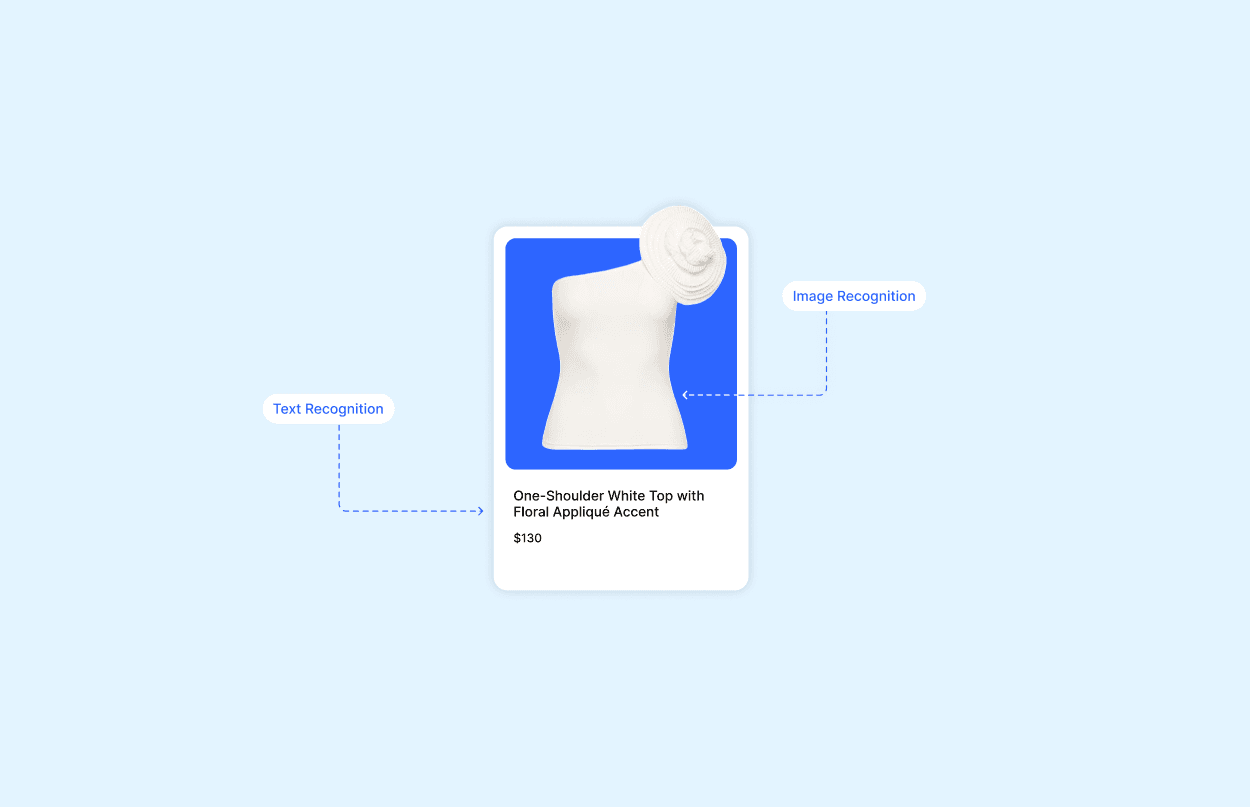
Text search excels at matching exact terms: product codes, unique brand names, sizes, and prices. Semantic search reads the intent behind a query, not just the literal words — understanding meaning from both text and product images to bridge the gap between how shoppers describe things and how products are cataloged.
In fashion, when a shopper types ‘something for a beach wedding,’ semantic search surfaces flowy midi dresses and linen sets — even if none of those products have the word ‘wedding’ in their title. Text search makes sure the results that come back are actually in stock, in the right size, and within budget.
Two searches run simultaneously, and the results are merged into one ranked list. Neither method alone can do what both do together.
To understand why hybrid search works, you need to understand what it's made of. Two very different search methods — each powerful on its own, each with a blind spot the other covers. They were built with different philosophies.
Text search was designed for precision: give it the right word, and it finds the exact matches. Semantic search was designed for understanding: give it any description of what you need, and it figures out what you mean.
For years, search engines had to pick one or the other. Hybrid search is what happens when you stop picking — and run both at the same time.
Text search works by matching the exact words in a search query against the words in product titles, descriptions, and tags.
Where it excels:
Matching keywords in product titles and descriptions (e.g., white for cute white tops) or brand names
Exact product codes (e.g., SKU-4471B)
Numeric values like price and size
Where it falls short:
Keyword search is blind to meaning. Two queries can describe the exact same product in completely different words. For example, ‘going-out top’ and ‘party blouse’ mean the same thing to a shopper, but to a keyword engine, they're unrelated. But to a text search engine, they're unrelated. It may miss it entirely because none of the query words match.
Semantic search understands what shoppers mean, not just what they type. When someone searches ‘date night dress,’ semantic search returns bodycon silhouettes, slip dresses, and going-out styles — even if none of those products contain the words ‘date night’ in their title or description.
Where it excels:
Understanding synonyms (sportswear vs. athleisure vs. workout clothes)
Tolerating typos, which rarely change a query's overall meaning
Understanding natural language and conversational queries
Where it falls short:
Semantic search can struggle with highly specific, exact-match needs. Search for a precise SKU or a unique proper noun, and a semantic engine may return similar-but-wrong results because the model focuses on meaning rather than exact words.
No single method wins across the board. Keyword search is fast and precise, but falls apart when users don't have the exact right words. Semantic search understands intent but loses the hard details that actually close a sale. Hybrid search doesn't pick a winner. It takes what each method does best and combines them. The table below shows exactly where each approach excels — and where it needs the other to pick up the slack.
Feature | Text Search | Semantic Search | Hybrid Search |
Exact term matching | Excellent | Poor | Excellent |
Meaning/intent understanding | Poor | Excellent | Excellent |
Typo tolerance and natural language | Poor | Good | Good |
Works without perfect tagging or comprehensive product info | No | Yes | Yes |
Setup complexity | Low | Medium | High |
Best for | Exact lookup, structured data | Conversational AI, semantic similarity | Most real-world applications |
Think of hybrid search like having two personal shoppers working the floor at the same time.
The first one - text search - is a stickler. She has the entire catalog memorized — every SKU, every price, every size. You say ‘petite, under $120, linen’ and she instantly pulls every linen piece in your size under $120. But ask her for ‘something for a beach wedding,’ and she will stare at you blankly, because that is not a field in the database.
The second one - semantic search - is a vibe expert. You walk in and say, ‘beach wedding, something effortless and a little romantic,’ and she nods, disappears into the racks, and comes back with five perfect options. But she sometimes floats back with a gorgeous dress that's two sizes too big and $300 over budget, because she got so excited about the vibe that she forgot the constraints.
When a shopper is looking for ‘minimalist linen set for a beach wedding, size medium, under $200,’ both personal shoppers go to work simultaneously. The stickler pulls every linen set in size medium under $200. The vibe expert pulls everything that has beach, wedding, minimal, and effortless vibes. Then a third process — the fusion step — looks at both piles, finds the pieces they agree on, and puts them at the top of the results page.
The shopper gets a result list that is both on-vibe and actually shoppable. That's hybrid search.
Fashion is subjective in ways most other categories aren't. There are a million ways to describe the same dress — by silhouette, occasion, mood, trend label, fabric, cultural reference. A single keyword alone will never capture all of them. At the same time, fashion has hard constraints that can't be fuzzy. A size 4 shopper cannot wear a size 12. A sold-out item is a dead end, no matter how perfect it looks.
This makes fashion uniquely bimodal: shoppers use both structured attributes and fuzzy aesthetic language, often in the same query. Neither text nor semantic search alone handles both sides. Hybrid does. The results speak for themselves: fashion retailers implementing hybrid AI search have seen up to a 1.5x lift in CTR — driven by results that finally match both the intent and the hard requirements of how fashion shoppers actually shop.
Text search has a ceiling. And no amount of optimization can break through it. It can learn a list of synonyms or prioritize the most relevant ones. But it fundamentally cannot understand meaning. For example, a text search engine can’t figure out that ‘coastal grandma’ is a style connected to linen clothes, beige colors, and loose-fitting outfits. Those ideas are related by meaning, not exact keywords. Closing that gap requires a different type of search technology. This is what semantic search introduces, and what hybrid search puts into practice.
Not quite. Semantic search is actually only one half of hybrid search. Think of it this way: hybrid search combines text search (precision on exact words) with semantic search (understanding of meaning). Each handles queries that the other can't. Text search is great at finding exact things, let’s say, a specific brand name, a product code, or a precise price. Meanwhile, semantic search is great at understanding what you mean, even when you don't have the exact words. Hybrid search handles both, which is why it's becoming the default for eCommerce search systems.
The basic setup of hybrid search is similar across industries, but the AI model behind it makes a big difference. Many general AI models are trained on common internet content like news articles, Wikipedia, and Reddit posts. Because of this, they may not fully understand industry-specific terms.
For example, in fashion, phrases like ‘coastal grandma’ describe certain styles, fabrics, colors, and outfit shapes. A general AI model may see these as just random words instead of understanding the fashion meaning behind them.
That’s why hybrid search works best when the semantic search system is trained on data from a specific industry. In fashion, the AI needs fashion-focused training data to understand style trends and give accurate search results.
Filters are great, but only for shoppers who already know exactly what they're looking for. They work when someone knows to click ‘linen,’ ‘midi length,’ and ‘under $150.’ But most shoppers don't think that way. They search in their own words, like ‘something for a beach wedding.’ Filters can't do anything with that.
They require shoppers to translate what they feel into your categories, which is a lot to ask. Hybrid search removes that translation step entirely, so shoppers can search the way they think, and still find what they need.
Filters help shoppers who already know what they want. They don't help shoppers who search in their own words — "cute summer top," "office-friendly dress," "something for a beach wedding." Filters require shoppers to translate their intent into your taxonomy. Hybrid search removes that translation step entirely.
They mean almost the same thing, and people use them interchangeably all the time. But they're not technically the same thing. Semantic search is the what: search that understands meaning, not just keywords. Embedding search is the how - the technique used to deliver it, where text and images get converted into numbers that capture meaning, so the search engine can find the closest match to what you're looking for.
You'll also hear vector search, neural search, and dense vector search thrown around. They're all pointing at the same general idea with slightly different labels. The technology is still young, so the vocabulary hasn't settled yet.
For retailers, none of the labels really matters. What matters is whether the system actually understands your products and your shoppers. For fashion, that means it needs to be trained on fashion data, not just generic internet text.

Written by YesPlz.AI
We build the next gen visual search & recommendation for online fashion retailers
