Algolia Alternative for Fashion: Why Algolia Falls Short (and What to Use Instead)
Why does Algolia return the wrong results for fashion searches? Compare it to a fashion-native search engine built for style and occasion.

by YesPlz.AIJuly 1, 2026

Why does Algolia return the wrong results for fashion searches? Compare it to a fashion-native search engine built for style and occasion.
by YesPlz.AIJuly 1, 2026
Fashion shoppers don't search the way someone buying a laptop or a dishwasher does. They don't type model numbers, specs, or feature lists. They search by category, style, occasion, and other fashion attributes.
The problem is that most search engines aren't built to handle this type of fashion search query. Since product titles and descriptions rarely capture every attribute a shopper might search for. So even when products shoppers want exist in a catalog, the search engine often can't find them.
In this article, we break down how Algolia and YesPlz AI handle these queries differently. Algolia represents the general eCommerce search approach — fast, flexible, and widely used. YesPlz AI is a fashion native search engine built specifically for the industry. We look at where the gap shows up and what it means for your store.
Algolia is one of the most widely used search engines in eCommerce. It's fast, scalable, and trusted by thousands of online stores. Here's what it does well:
Provide instant search-as-you-type results
Handles typos gracefully
Gives your team full control over ranking, boosting, and merchandising
Has strong developer tooling and documentation
Algolia is built to work across every industry, and that generality is its strength. A shopper searching for electronics, furniture, or groceries knows exactly what she wants and types it precisely. Algolia matches those words to product data and returns the right result.
But fashion is not like every other category. That's where a general search engine starts to break down. In the next section, we analyze four specific queries to understand how shoppers search. You’ll see the difference between a general search engine and a fashion native search engine.
Fashion search queries come in many forms. The four examples below represent different types of search queries shoppers bring to your search bar every day. They also illustrate why generic search engines fail to return the products shoppers actually want.
This is the simplest search query. Shoppers use a generic product name (a category) to search. However, it's where a surprising number of fashion catalogs already break down. The reason is simple: shoppers and retailers often use different words to describe the same product.
A shopper searches for 'denim.’ Your catalog uses the word ‘jeans.’ She types 'blouses.’ Your products are tagged as ‘shirts.’ She searches for ‘slacks.’ Your category is ‘trousers.’ The words don't line up, so nothing comes back.
Algolia matches the exact words in a query against words in product titles or descriptions. If your catalog doesn't use the same terminology the shopper does, the match fails. The problem isn't missing inventory. It's a mismatch between shopper language and catalog language.
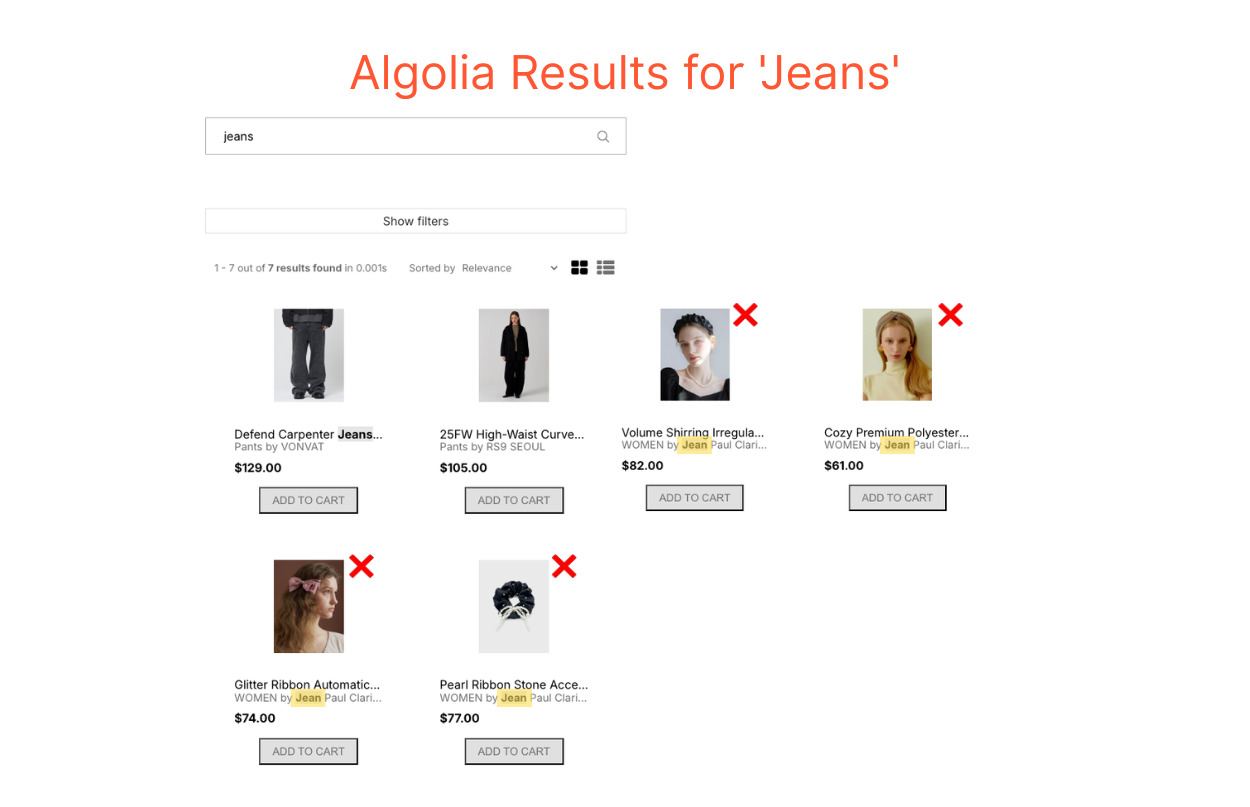
Take the example in the image below. A shopper searched for ‘jeans.’ Algolia returned 6 results, but only two are jeans. The rest are hair accessories. They showed up because their brand name includes the word jean.
Besides, this catalog is mostly titled denim. So even though the retailer has plenty of jeans in stock, Algolia struggles to surface them. This is what keyword matching technology looks like in practice. It doesn't know the difference between jeans - the product category and Jean - the brand name. It sees matching characters and calls it a match.
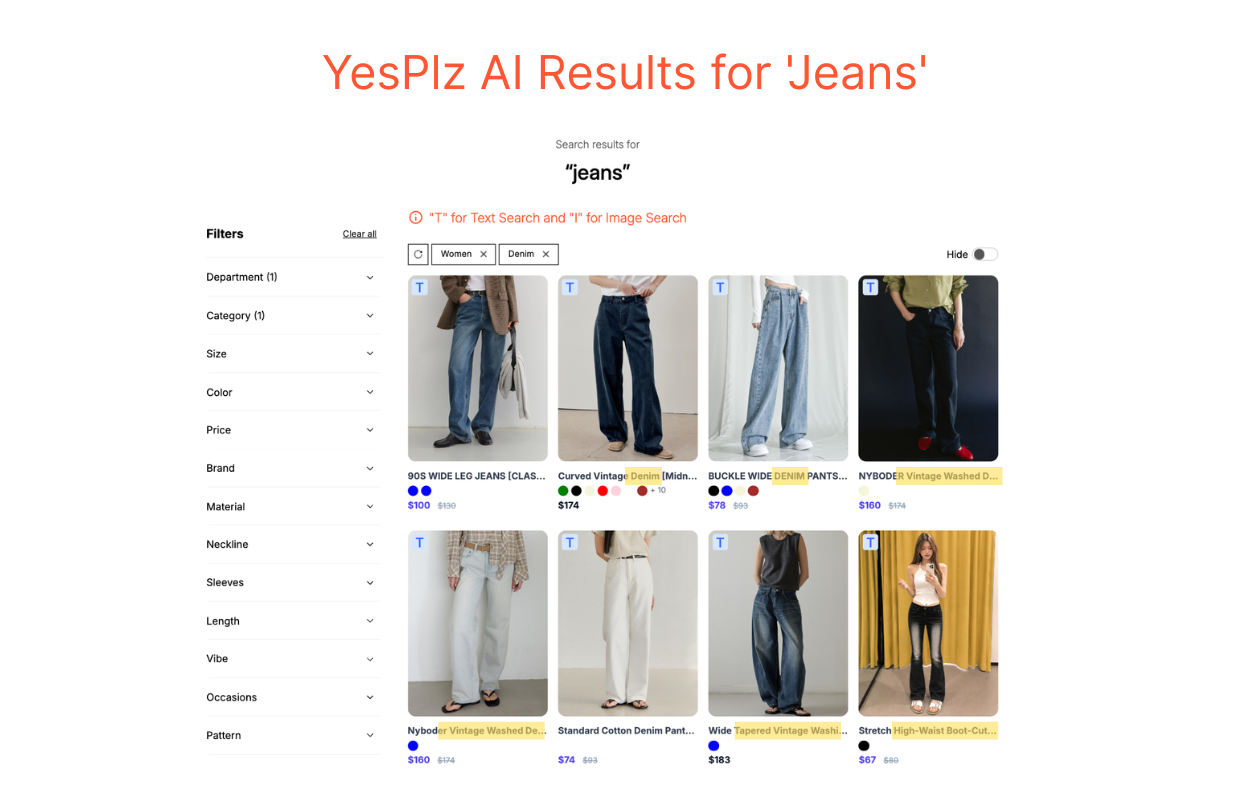
YesPlz AI solves this with fashion embeddings. Instead of relying on exact keyword matches, the model learns that different terms can refer to the same type of product. So ‘denim’ maps to ‘jeans.’ ‘Slacks’ maps to ‘trousers.’ ‘Blouse’ maps to ‘shirts.’
The AI can make these connections because it doesn't rely only on exact matching of text. It analyzes a product image and context, then recognizes the fashion attributes — the fabric, the cut, the color, and so on. Whether or not the product title says ‘denim,’ the AI can recognize it from product images.
With this type of query, a shopper isn't just naming a category. She's naming a category with a particular attribute attached to it. The category tells the search engine what product the shopper wants. Meanwhile, the style attributes narrow the results to the exact variation they're looking for.
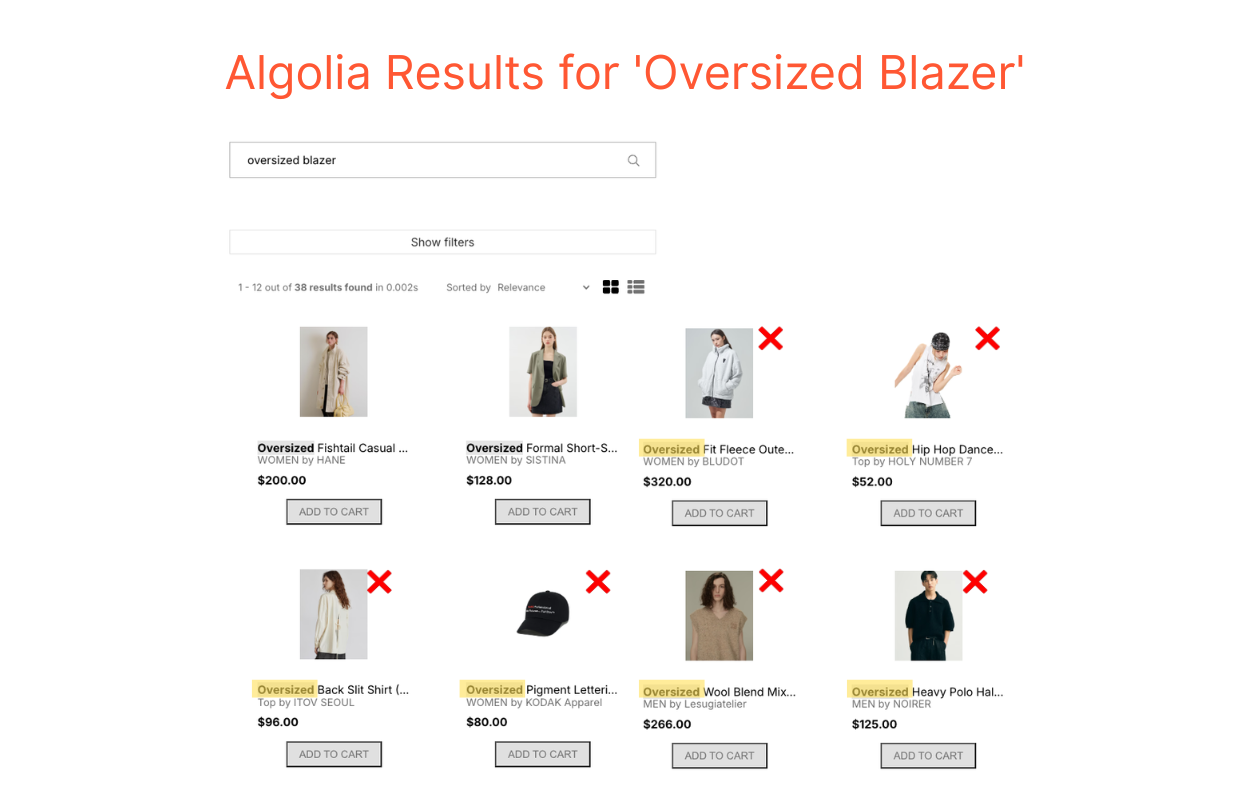
Algolia treats this search query as separate tokens, for example, ‘oversized’ and ‘blazer.’ Instead of understanding the query as one idea: a blazer, in an oversized fit, it searches for each word independently and returns anything that contains either one. That's why the results display irrelevant products. They happen to contain the word ‘oversized’ somewhere in the title.
This is the core issue with keyword matching. It treats a query as a bag of separate tokens to look for, not a single request to fulfill. It just matches tokens wherever they appear. For this reason, a shopper searching for one specific type of product ends up wading through a pile of unrelated items.
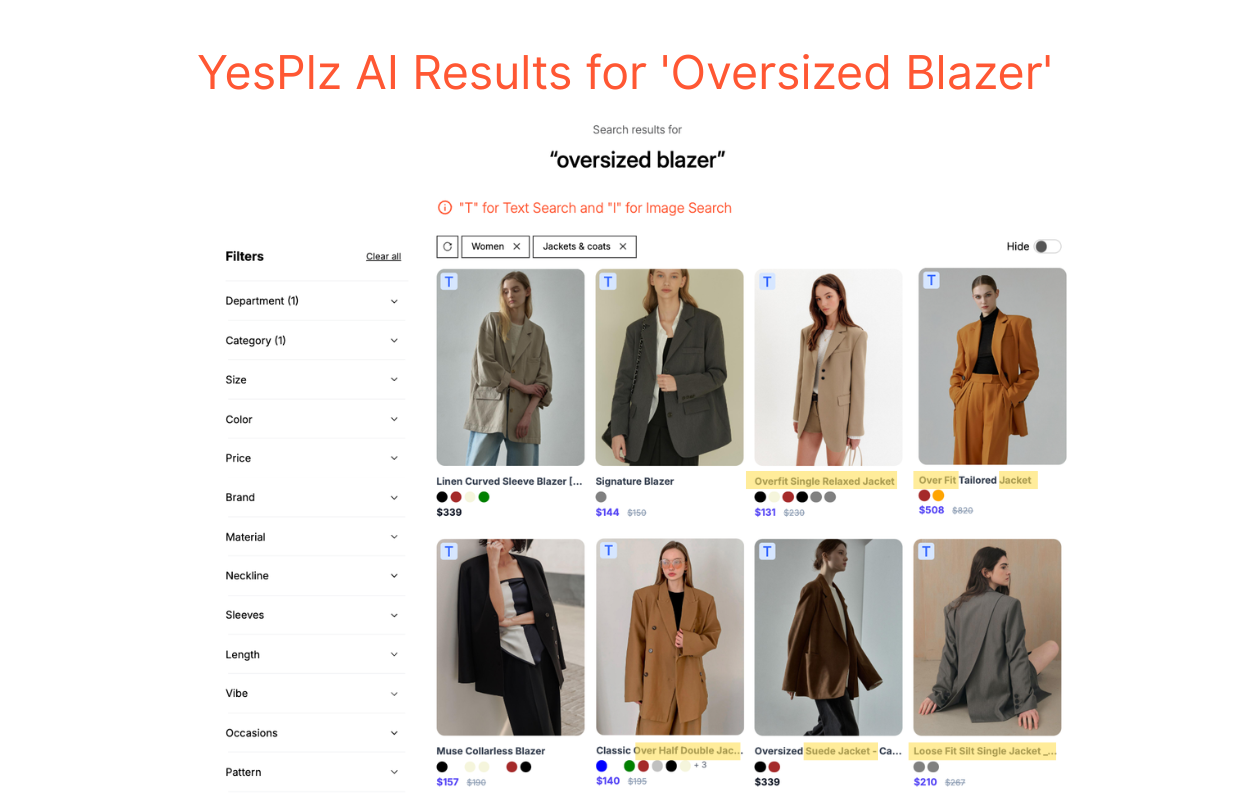
YesPlz AI combines automated fashion tagging with fashion embeddings. The model is trained to recognize specific style attributes. Each product is tagged with dozens of fashion attributes: neckline, fit, pattern, color, silhouette, sleeve length.
Because these attributes are generated from the image itself, they don't depend on what the merchandising team happened to write in the product description.
This time, a shopper is describing a product and the occasion for which she will wear it. The problem is that most fashion catalogs don't mention this information at all.
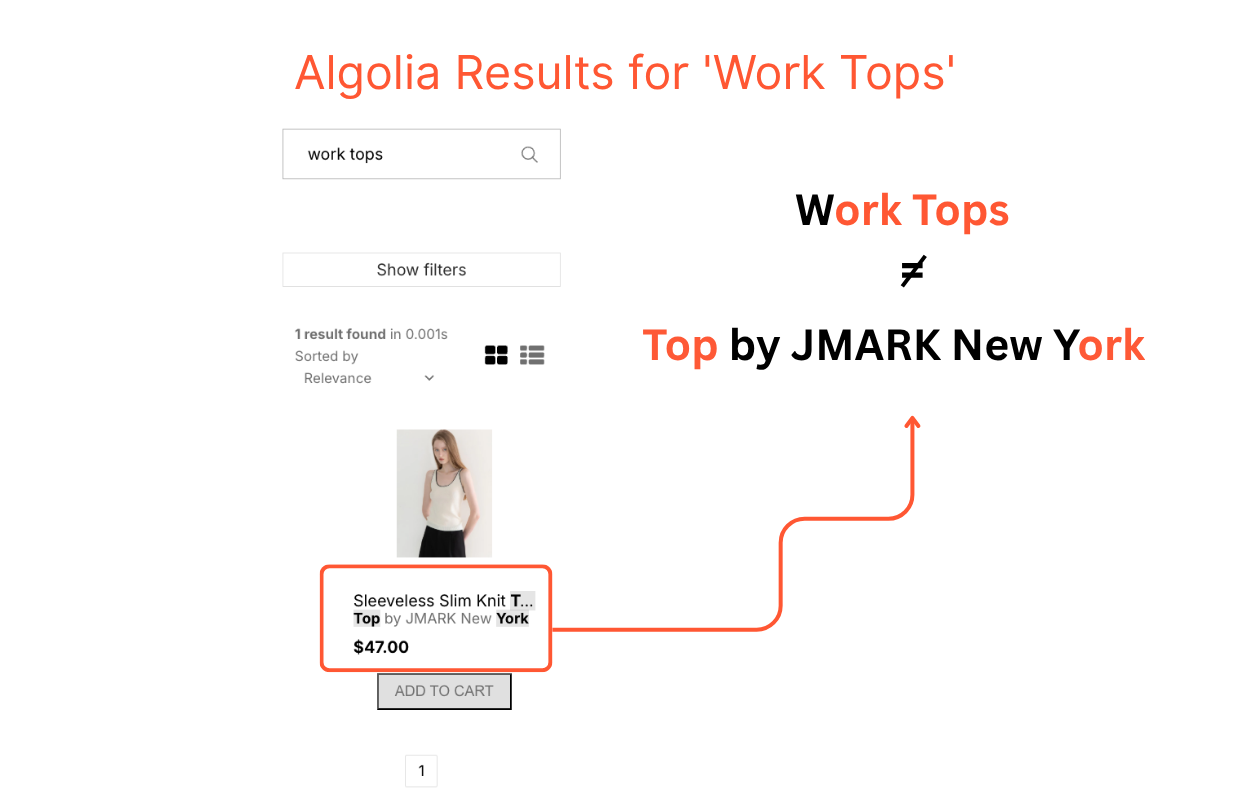
Consider the search query ‘work tops’. Algolia returned one result. It showed up because its brand name ‘JMARK New York.’ The token ‘york’ overlapped with ‘work.’ But as you can see, the result doesn’t match the shopper's search intent at all. This sleeveless knit tank isn’t the good pick for work.
This is what happens when an occasion isn't described anywhere in the catalog, or a search engine doesn’t understand the context of a search query. The engine has nothing meaningful to search against. It either returns nothing. Or, as in this case, latches onto an accidental match that has nothing to do with the shopper's intent.
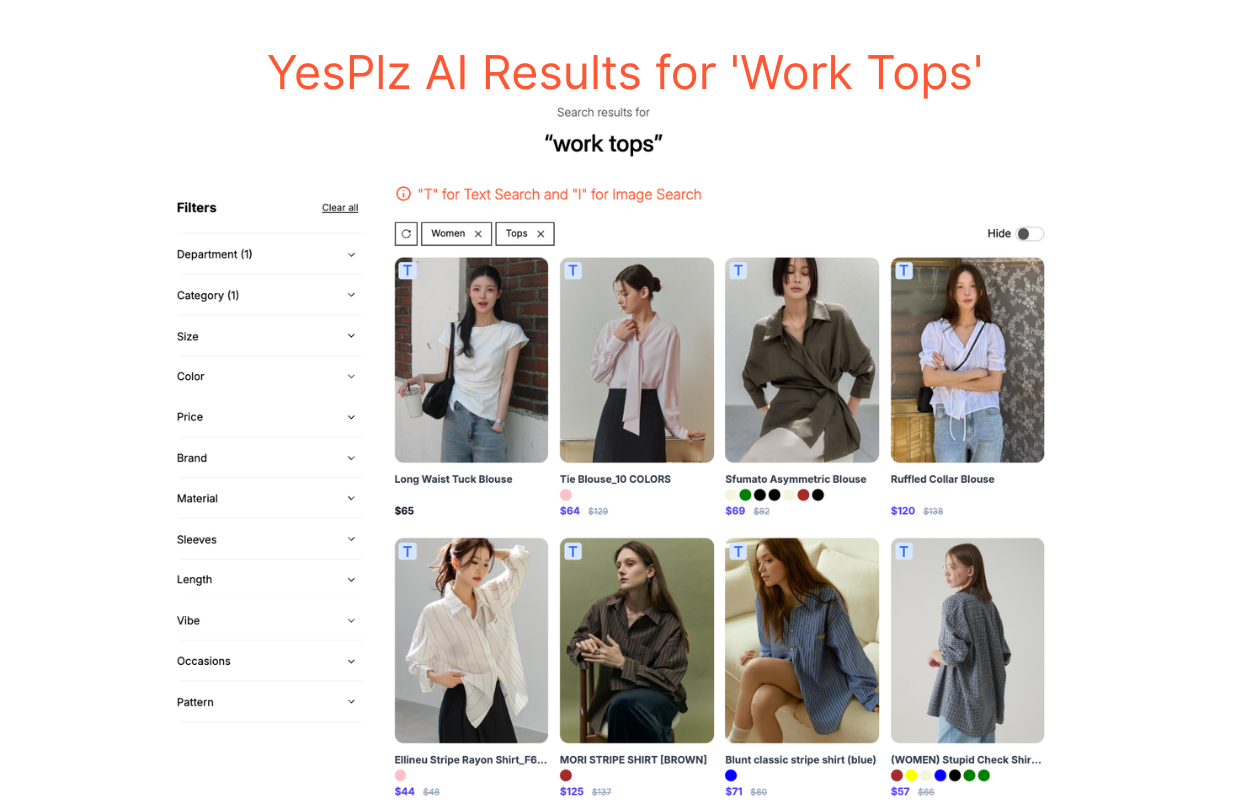
YesPlz AI first understands the context of the search query. It then maps it to a matching occasion, which includes a specific set of attributes — silhouette, fabric, color, and fit. These mappings come from real conversations with shoppers about what each occasion actually means to them. They're trained directly into the model.
That's why the same search query returns something completely different on YesPlz AI: tailored blouses, structured button-downs, tie-neck tops, striped shirts. All of it in colors and silhouettes that read as office-appropriate, even though the word ‘work’ doesn't appear anywhere in product data. It understands what ‘work’ means as a style, and returns the tops that fit that meaning.
This is a pretty complex query type. A shopper isn't typing one or two words. It combines everything above into one sentence. The shopper is describing the silhouette ('flowy'), the season ('summer'), the category ('dress'), and the occasion ('vacation') — all at once. She expects the search engine to understand the whole thing together.
Algolia doesn't read this as one request. It reads this as a string of words. It can't tell which word is the main category and which words are just modifiers describing it. So it usually does one of two things: it tries to match the full phrase and finds nothing, or it displays any products containing the exact word in the string.
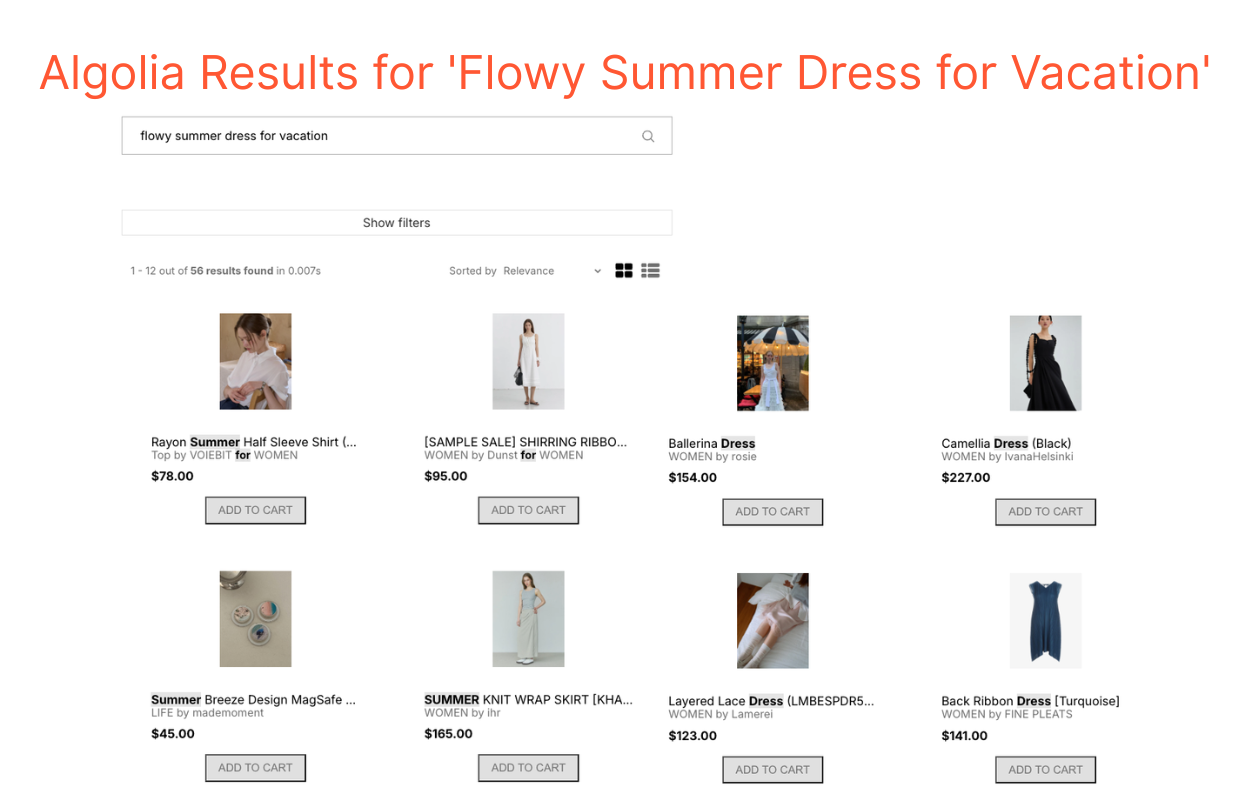
That's exactly what happens in the example below. A shopper searches ‘flowy summer dress for vacation’ and Algolia returns 56 results. The very first result is a Rayon Summer Half Sleeve Shirt. It is a top that happens to contain 'summer.' None of the results match the full intent of the query. The longer and more natural the query, the worse this problem gets.
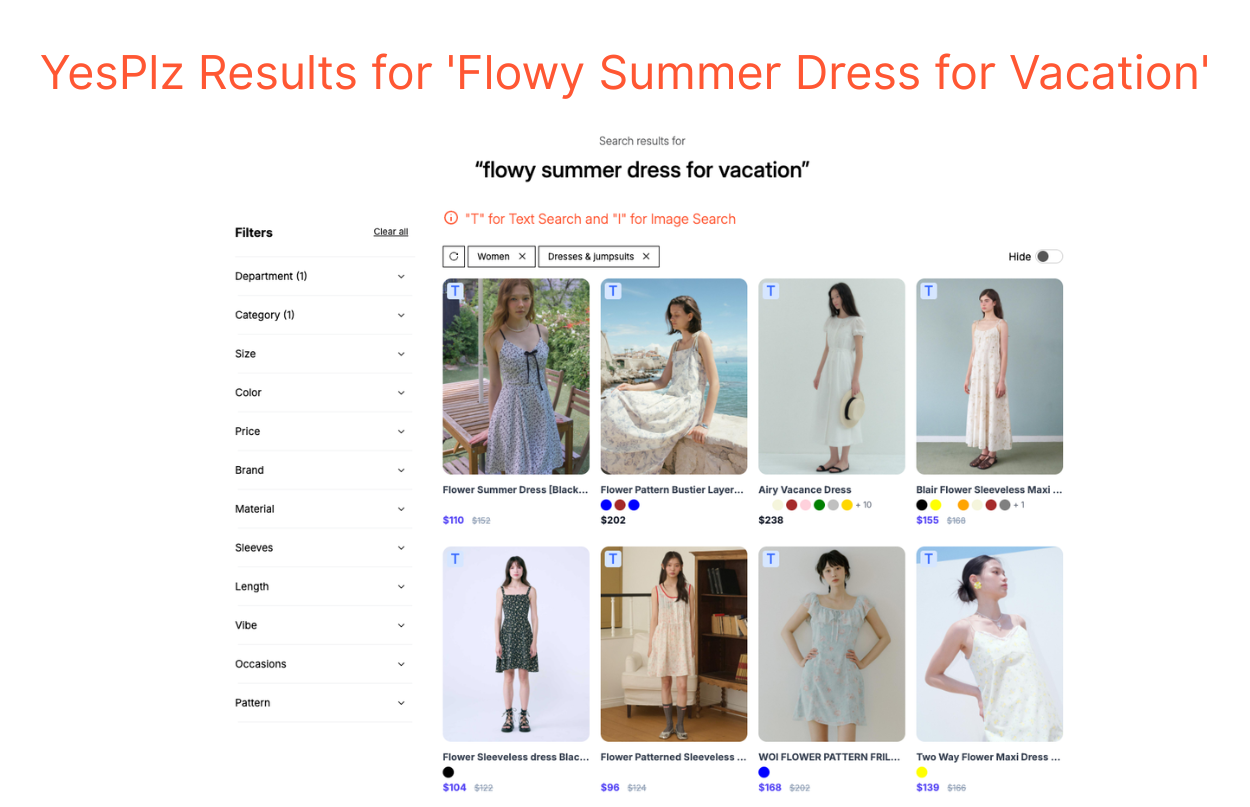
YesPlz AI processes the full query as a single idea, not a list of tokens to hunt for individually. It understands:
‘dress’ as the category
‘flowy’ and ‘summer’ as attributes tied to silhouette and fabric
‘vacation’ as an occasion mapped to a specific style profile — light, breezy, relaxed
That's why the same search on YesPlz AI returns only dresses. It specifically dresses that look flowy and vacation-appropriate: floral prints, soft fabrics, loose silhouettes, sleeveless and short-sleeve cuts suited to warm weather.
So you've seen four very different examples of how fashion shoppers search. Now, let's define what a fashion native search engine actually is.
YesPlz AI is a fashion native search engine, specifically trained on fashion data. It understands style language the way a human stylist does. It doesn't need the exact keywords to appear in product titles or descriptions because it understands what those words mean in a fashion context.
So, how does YesPlz AI work under the hood? It uses a triple-match approach to power product discovery for apparel:
Automated attribute tagging — YesPlz AI automatically labels products with descriptive fashion tags that make them searchable. This also solves a hidden problem: most fashion catalogs have incomplete or inconsistent product data.
Semantic understanding — Along with fashion tags, this is what makes fashion search queries returnable. The model understands the query as fashion intent, not just matching exact words.
Search tune agent — Monitor search queries and which keywords get clicked, then automatically update those keywords.
The table below shows the difference between general search engines (Algolia) and a fashion native search engine (YesPlz AI):
Algolia | YesPlz | |
Built for | Any industry | Fashion and apparel |
Understands style and vibe queries | With manual synonym rules | Natively, out of the box |
Ongoing tuning | Your team writes and maintains rules | Search Tune Agent handles it automatically |
Zilo, a fast-growing fashion platform, ran an A/B test to find out. They tested Algolia against YesPlz AI on the same catalog, the same shoppers, and the same time period.
Here's what they found:
Algolia | YesPlz AI | |
Avg. searches per session | 2.2 | 2.27 |
Search to add-to-cart rate | 19% | 21% |
Orders from search | 45% | 52% |
Zero-result rate | 13% | 3% |
The most telling number is the zero-result rate. With Algolia, 13% of searches returned nothing. With YesPlz AI, that dropped to 3%, meaning less bounce off and higher conversion.
This isn't a binary choice. For many fashion brands, the right answer is layering.
Algolia makes sense when:
You run a multi-category store where fashion is one vertical among many.
Your catalog is already cleanly attributed.
Or you have dedicated engineering resources to your own ongoing search tuning.
YesPlz AI makes sense when:
Your business is fashion.
Your shoppers search using style and occasion as part of the search query
Lack of resources to monitor and optimize search keywords
Layering makes sense when you want to keep Algolia's infrastructure but need to close the fashion intent gap on top of it. YesPlz AI can operate as a fashion search layer over your existing setup. We can add attribute enrichment and fashion semantic understanding that a general site search for fashion brands can't provide natively, without replacing what's already working.
The three examples in this article aren't edge cases. They're how your shoppers think. As social media moves faster and AI platforms become more advanced, search queries get more abstract, more cultural, and more trend-driven every season.
A general search engine can be configured to handle some of it. But configuration has limits. Someone has to write the rules, maintain the synonym lists, and catch every new trend before it becomes a zero-result page. That's a tax that compounds over time.
A fashion native search engine works differently. It continuously learns new trends from LLMs and shopper language directly from search behavior. So no matter how your shoppers search — whether by mood, aesthetic, or cultural reference — they always find the results they're looking for.

Written by YesPlz.AI
We build the next gen visual search & recommendation for online fashion retailers
