According to a recent study of eCommerce site search, searchers make up just 24% of eCommerce visitors. Yet they drive 44% of total site revenue, 45% of add-to-cart activity, and 42% of all conversions. They convert at 2.5x the rate of non-searchers.
Most eCommerce teams obsess over conversion rate, but it is a lagging indicator. It tells you something went wrong, not where. The numbers that actually explain it are rarely tracked.
In this article, we’ll walk you through four fashion search metrics that matter: zero-result rate, search exit rate, search-to-order rate, and share of revenue from search sessions.
Search is the highest-intent action a shopper can take on your site. They know exactly what they want. When search fails, 1 in 3 shoppers exits immediately. In fashion, the problem runs deeper.
Shoppers search in seasonal slang, trend terms, and regional variants your catalog doesn't recognize. Prefixbox found that fashion has the highest zero-result rate of any eCommerce vertical — 10.7%. One in ten searches returns nothing.
Most teams stop at conversion rate. But four numbers sit upstream of it. They reveal where your eCommerce site search is working, and where it's not. In this section, you’ll find what each one is, what good looks like, and how to find it in your data.
Metric 1: Zero-Result Rate
What is Zero-Result Rate?
Zero-result rate is the percentage of search queries that return no products.
Think of it like a librarian who can't find a book because it's filed under the wrong name. The book exists. It's on the shelf. But the system can't connect what you asked for to what's actually there.
That's exactly what happens when a shopper types "trainers" and your catalog only labels them as "sneakers."
How to Pull it?
Open your search platform dashboard. If you're on Algolia, Constructor, or Searchspring, it's already there.
If you're on a custom setup, pull your search event logs and filter for queries where results_count = 0. Divide that by your total query volume. That's the number.
What Does a Good Zero-Result Rate Look Like?
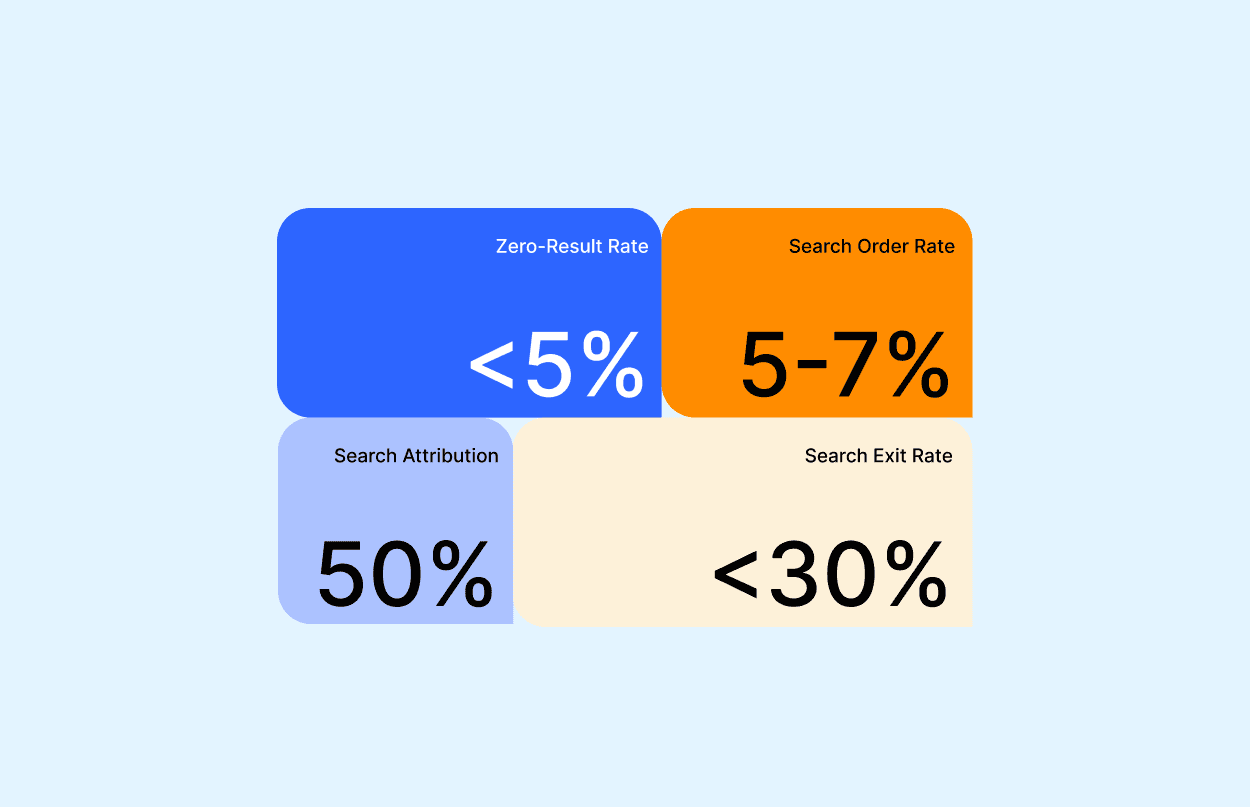
According to Luigi's Box's study of 4,000 stores, well-optimized fashion stores sit at 4.3%. Nobi puts the target under 5%. Hello Retail calls anything above 5% a revenue leak. And most no-result searches come down to fixable issues (missing synonyms, typos, plural forms, and product code formatting).
| |
| |
Well-optimized zero-result rate | |
Unoptimized zero-result rate | |
| |
How to Fix it?
Closing the zero-result gap does not require re-platforming or adding inventory. Enriching product attributes by tagging resolves most null queries. Most of them are vocabulary failures. As Nobi notes, every 1% reduction in zero-result rate corresponds to roughly a 0.5–1% increase in search revenue.
For teams that want to go further, Search Tune Agent can bring the zero-result rate down to under 2% — well below the 4.3% benchmark for well-optimized fashion stores.
Metric 2: Search Exit Rate
What is Search Exit Rate?
Search exit rate is the percentage of shoppers who leave your site immediately after seeing search results.
How to Pull it?
If you're on Shopify, Algolia, Constructor, or Searchspring, note that none of them report search exit rate natively. You'll always need your analytics layer to connect session behavior to search events.
In Google Analytics 4 (GA4), enable site search tracking under Admin → Data Streams → Enhanced Measurement, then filter exits by pages containing your search parameter (?q= or ?search=).
What Does a Good Search Exit Rate Look Like?
A high exit rate on a zero-result page is expected. Shoppers got nothing, so they left. But a high exit rate on a page with results means your results are not relevant enough to keep shoppers engaged. According to Luigi's Box, fashion has a 32% exit rate after a failed search. Nobi sets the target under 30%.
How to Fix it?
A high search exit rate is almost always a relevance problem. A search query may return technically matching products, but surface the wrong ones at the top. A few fixes that move the needle:
Improve your zero-result rate: Enrich product attributes to improve relevancy.
Calibrate your ranking logic: Boost products based on availability, new arrivals, and popular brands. This ensures the most relevant and appealing products surface at the top for each query.
Use a Learn to Rank model: A more sophisticated approach that learns what shoppers actually click for a given query, then boosts those products automatically. The more search data you have, the smarter it gets.
Metric 3: Search-to-Order Rate
What is Search-to-Order Rate?
Search-to-order rate is the percentage of search sessions that end with a completed purchase. It's a more honest measure of search performance than sitewide conversion rate.
How to Pull it?
If you're on Algolia, Constructor, or Searchspring, this metric is usually available in their analytics dashboard, under search conversion or search-driven revenue.
YesPlz AI also surfaces this metric directly, along with deep analytics and weekly email reports. So, your team can stay on top of search performance without manually pulling data.
In GA4, create a segment of sessions where a search event fired, then apply your purchase goal to that segment.
What Does a Good Search-to-Order Rate Look Like?
Nobi puts the fashion industry average at 4.8%. Well-optimized stores reach 5–7%. Anything above 7% is excellent. For context, Fast Simon's benchmarking report found AI-optimized fashion stores averaging 7.12%. It was more than double the sitewide CVR of 2.79%.
| |
Average search-to-order rate | |
Good search-to-order rate | |
Excellent search-to-order rate | |
AI-optimized search-to-order rate | |
Fashion sitewide CVR (for comparison) | |
How to Fix it?
A low search-to-order rate usually points to one of three problems. First, search is returning zero results. Second, search is returning irrelevant results. And third, the path from search to checkout has too much friction. The ways to fix it change accordingly:
The first two we already covered in the previous sections. For the third, once a shopper clicks a search result, make it easy to add to cart and check out. Unnecessary steps kill conversion.
Metric 4: Share of Revenue from Search Sessions
What is the Share of Revenue from Search Sessions?
Share of revenue from search sessions is the percentage of total revenue that comes from sessions where a shopper used search at least once.
How to Pull it?
If you're on Constructor or Searchspring, this is usually available in their dashboard under search-driven revenue.
In GA4, sum revenue from sessions where a search event fired, then divide by total revenue for the same period.
What Does a Good Share of Revenue from Search Sessions Look Like?
Independent sources all land in the same range for fashion, using different data sets and time periods. That consistency makes this the most reliable benchmark in this article.
Roughly 40 cents of every dollar in fashion eCommerce flows through a search session. If your zero-result rate sits at 10.7% — the industry average — a significant slice of that revenue is hitting a wall. Now you can put a number on it.
How to Fix it?
Search revenue share is a downstream metric. It moves when the three metrics above improve. Fix your zero-result rate, reduce search exit rate, and improve search-to-order rate, and then this number follows.
The tools you use matter too. Deeper analytics — keyword funnels, search performance tracking, weekly reports — make it easier to see where revenue is leaking and act on it quickly.
Not all search platforms offer this level of visibility out of the box. Some are built specifically for fashion, where the catalog complexity and query patterns are fundamentally different from general-purpose retail.
Search drives roughly 40% of fashion eCommerce revenue. It converts at 2.5× the sitewide rate. And for most stores, it's the least instrumented surface on the site.
The four fashion search metrics in this article are the baseline. They are what a team needs to have before any conversation about search relevance, re-platforming, or AI-powered query understanding is worth having.
Can your team produce all four numbers? If not, we can help. We’ll run a FREE search audit against your catalog and produce all four metrics — benchmarked, with root-cause analysis on your top zero-result queries.