How AI Curates an Outfit, Step by Step
Learn how AI outfit curation help retailers build Complete the Look recommendations, increase basket size, improve conversion, and drive fashion discovery.

by YesPlz.AIJune 23, 2026
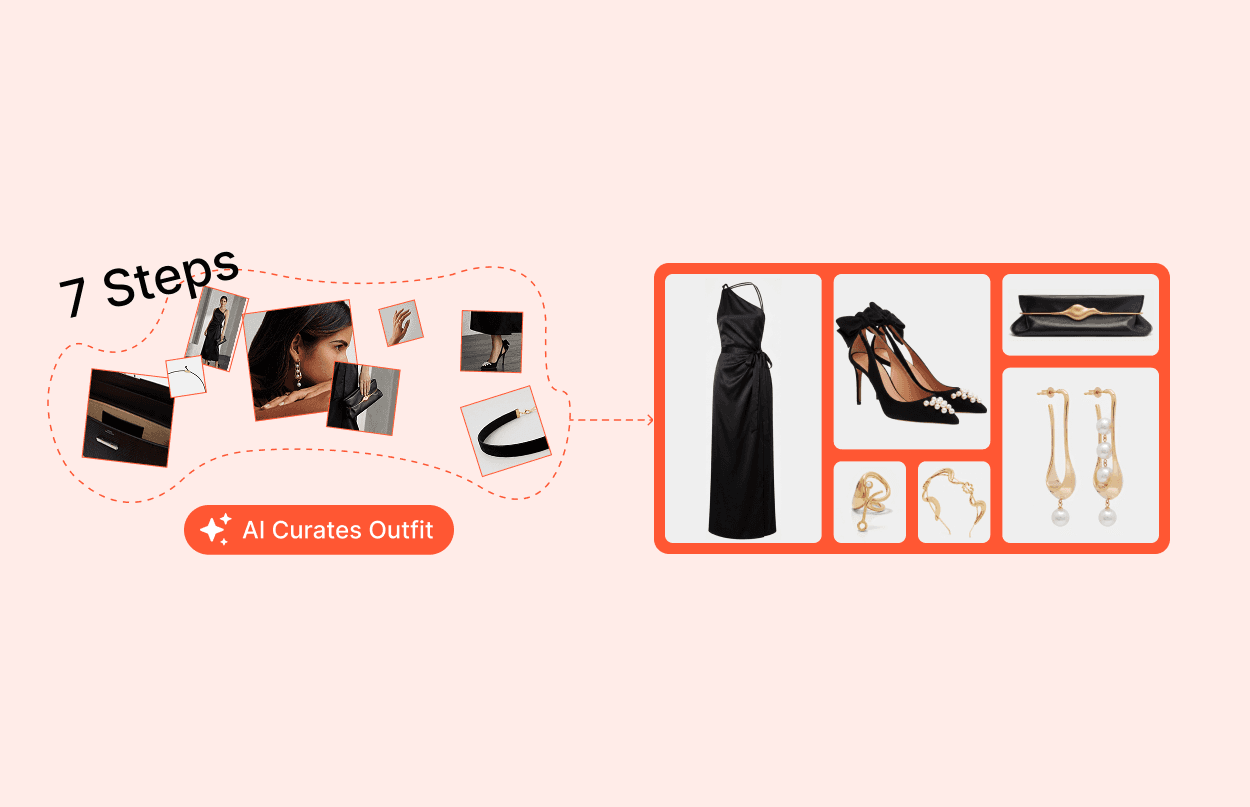

Learn how AI outfit curation help retailers build Complete the Look recommendations, increase basket size, improve conversion, and drive fashion discovery.
by YesPlz.AIJune 23, 2026
Many product recommendation engines answer one question: "What products are similar to this one?" But fashion shoppers often have a different question: "What should I wear with this?" That is the difference between “You May Also Like” and “Complete the Look” recommendations.
You May Also Like surfaces similar products. Meanwhile, Complete the Look builds a cohesive outfit around a hero item. Instead of helping shoppers discover more products, this recommendation type helps them visualize how a product fits into a complete look.
For fashion retailers, that distinction matters. One drives product discovery. The other drives outfit building, larger baskets, and greater purchase confidence.
At first glance, both types of recommendations seem to do the same thing: show shoppers more products. But the underlying logic is different. And so is the outcome for shoppers. Here is a side-by-side breakdown of what sets them apart.
You May Also Like | Complete the Look | |
Logic | Similar style | Style compatibility |
Category | Same or adjacent category | Cross category |
Output | More similar products | A coherent outfit |
Data required | Behavioral signal | Rich product attributes (rich tagging) |
Shopper's question answered | What are similar products? | What do I wear with this? |
Traditionally, building Complete the Look recommendations is a manual effort. A stylist team picks the items and makes sure they are in stock. A photography team shoots flatlays. Then everything gets uploaded to the site. This process is slow, costly, and hard to scale.
So, how does AI handle this complicated process? It’s not a simple task, indeed, a difficult task even for AI to do well.
In this section, you’ll discover how AI outfit curation works behind the scenes. In detail, how AI builds outfits, picks the right product images, and makes sure it never recommends something that is out of stock.
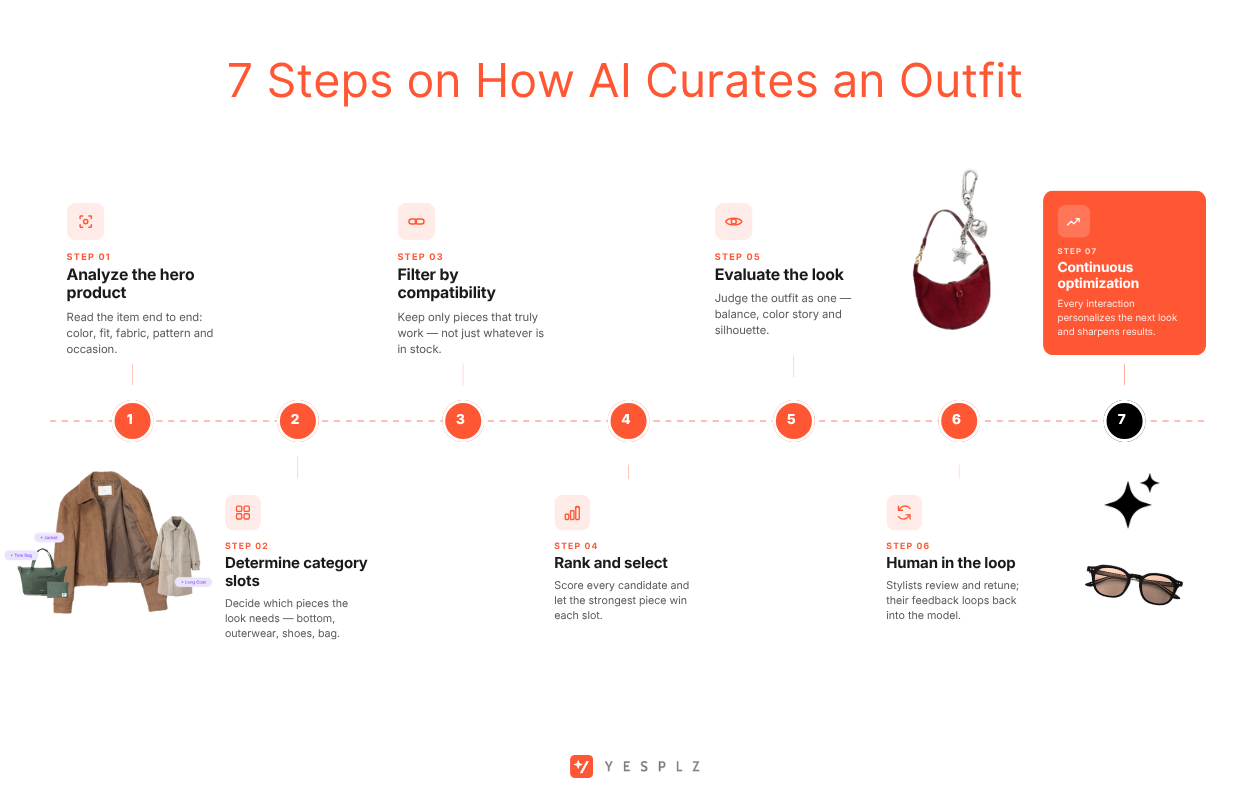
AI begins by analyzing the product the shopper is viewing. It detects and extracts dozens of attributes such as gender, category, color, material, season, vibe, and occasion. By doing it, AI can understand what the anchor product actually is. This attribute profile is the input. Every downstream recommendation is filtered through it.
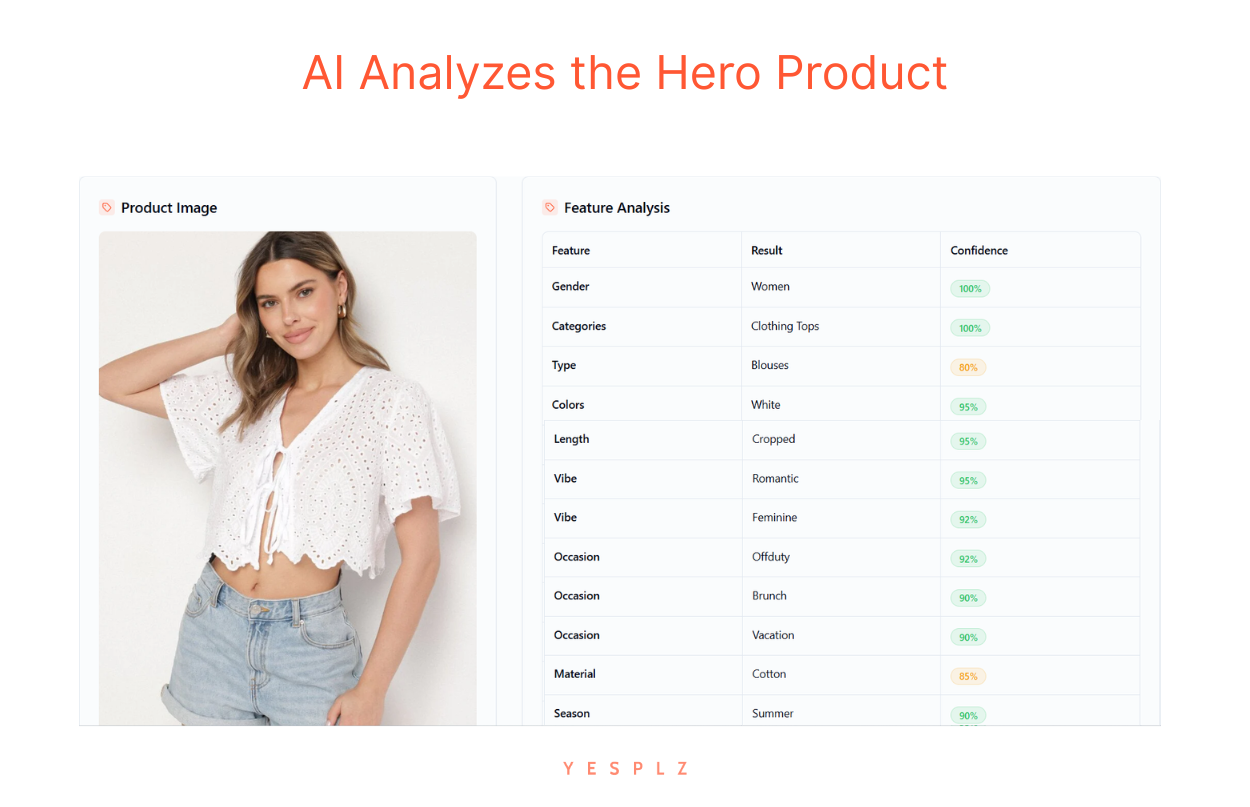 Consider the image above: a white, cropped eyelet blouse. To a human eye, it reads immediately as summery, feminine, casual-romantic. This is the kind of top that belongs at a weekend brunch or on vacation, not in a boardroom. AI reads it the same way, but in structured data:
Gender: Women
Category: Top
Type: Blouse
Color: White
Key Silhouette: Cropped, V-neck, short sleeves
Details: Eyelet, broderie anglaise
Season: Summer
Vibe: Romantic, feminine
Occasion: Off-duty, brunch, vacation
Each of those fashion tags becomes a filtering rule. It helps AI answer a style context question: “What kind of moment is this piece dressed for?”
Return to the white, cropped eyelet blouse above. Based on its tagging profile, AI knows this product should never be paired with a wool pleated skirt (season mismatch) or a formal heel (occasion mismatch).
Given the occasion, AI decides which product categories need to appear in the look. For example, a top is a partial garment. It fills only the upper-body slot. AI knows this and maps the remaining outfit slots accordingly: a bottom (skirt or trousers), footwear, a bag, and optionally outerwear or jewelry.
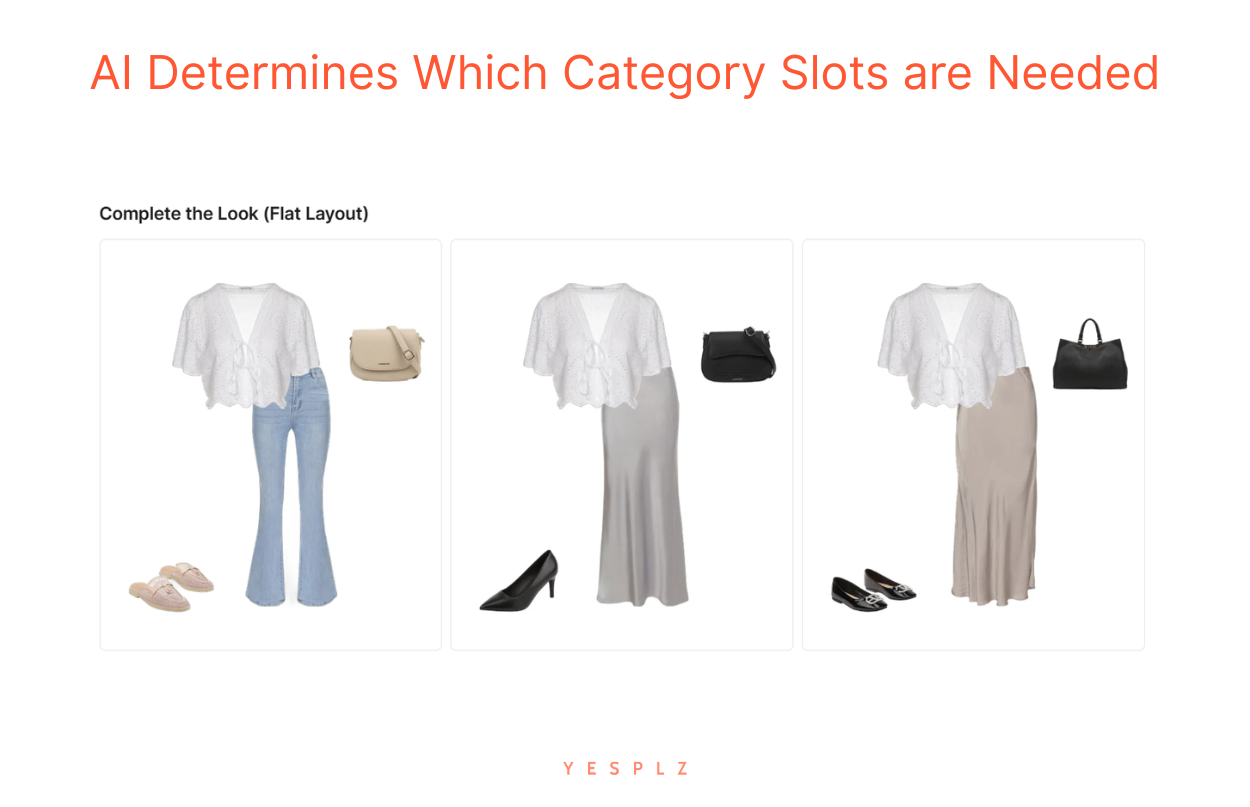 For the white eyelet blouse, that means AI is not going to recommend another top. And, it is not going to recommend a dress that would make the blouse redundant.
For each open slot, AI applies compatibility filters drawn from the styling logic in the hero product's attribute profile.
For the white eyelet blouse, each slot must satisfy:
Color (white, cream, light denim, or warm neutrals that harmonize with white)
Occasion (off-duty, brunch, vacation — ruling out tailored office wear)
Season (summer — ruling out heavy knits and wool)
Vibe (romantic or feminine — ruling out sharp, structured pieces)
A high-waisted linen midi skirt in ivory passes all four filters. A structured charcoal trouser fails three of them and never surfaces. Items that don't clear every filter are excluded from consideration, regardless of how popular or available they are in a product catalog.
This filtering step is the heart of an AI outfit curation where data quality matters most. A filter can only be as good as the tagging attributes it's filtering on.
After filtering, AI usually has many candidates per slot. Not all of them are equally good. So it scores each one: how well does it match the color, the occasion, the vibe? It also checks what's trending. The ranking stage may also consider inventory levels, margin goals, new arrivals, promotional priorities, and merchandising rules. Then it picks the best one per slot.
Building an outfit is only half the job. The harder part is making sure it is actually well styled. The most important thing for AI curated outfits is a solid evaluation system to ensure quality.
For example, one of the evaluation steps here is to check the overall styling, such as color match, style coherence, wearability, seasonality, etc. Any styling scores less would be flagged and regenerated.
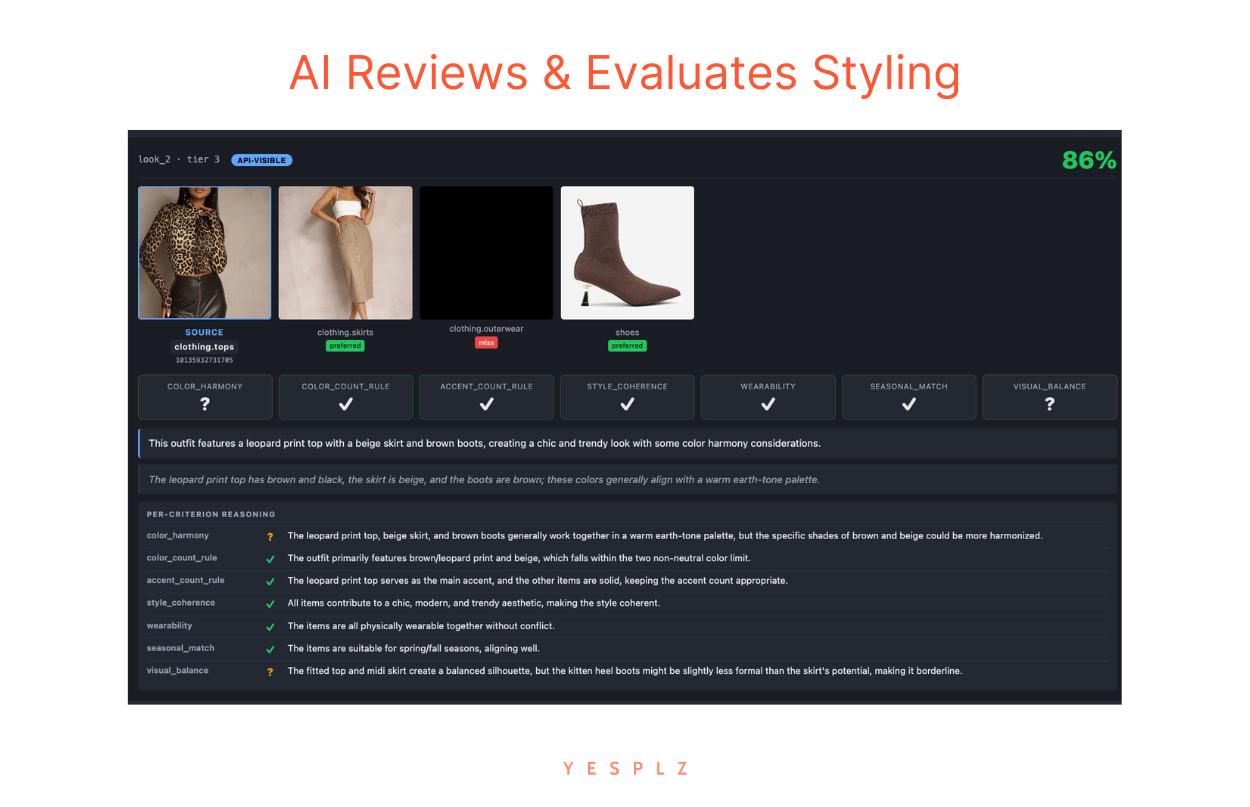 The image above shows one layer of our evaluation process in action. AI reviews a complete the look recommendation and evaluates it against several styling criteria. It identifies three issues. First, the outfit is missing an outerwear piece. Second, the color harmony is only partially successful. Third, the visual balance is questionable. The list goes on.
By flagging these issues, AI can improve the outfit before it reaches shoppers. The image shows just one of our 6 evaluation layers, designed to ensure every recommendation meets the brand's styling standards.
Even when AI follows styling rules perfectly, the output may not fully match a brand's aesthetic. Every brand styles differently. Some prefer bold mix-and-match looks. Others focus on lifestyle outfits that reflect their target shoppers. Styling is subjective, and there is no single correct outfit. So, how does AI address this issue?
First, AI learns unique styling based on a brand’s catalog and generates curated outfits. Then, the merchandising team reviews the results. The image below shows how this process works.
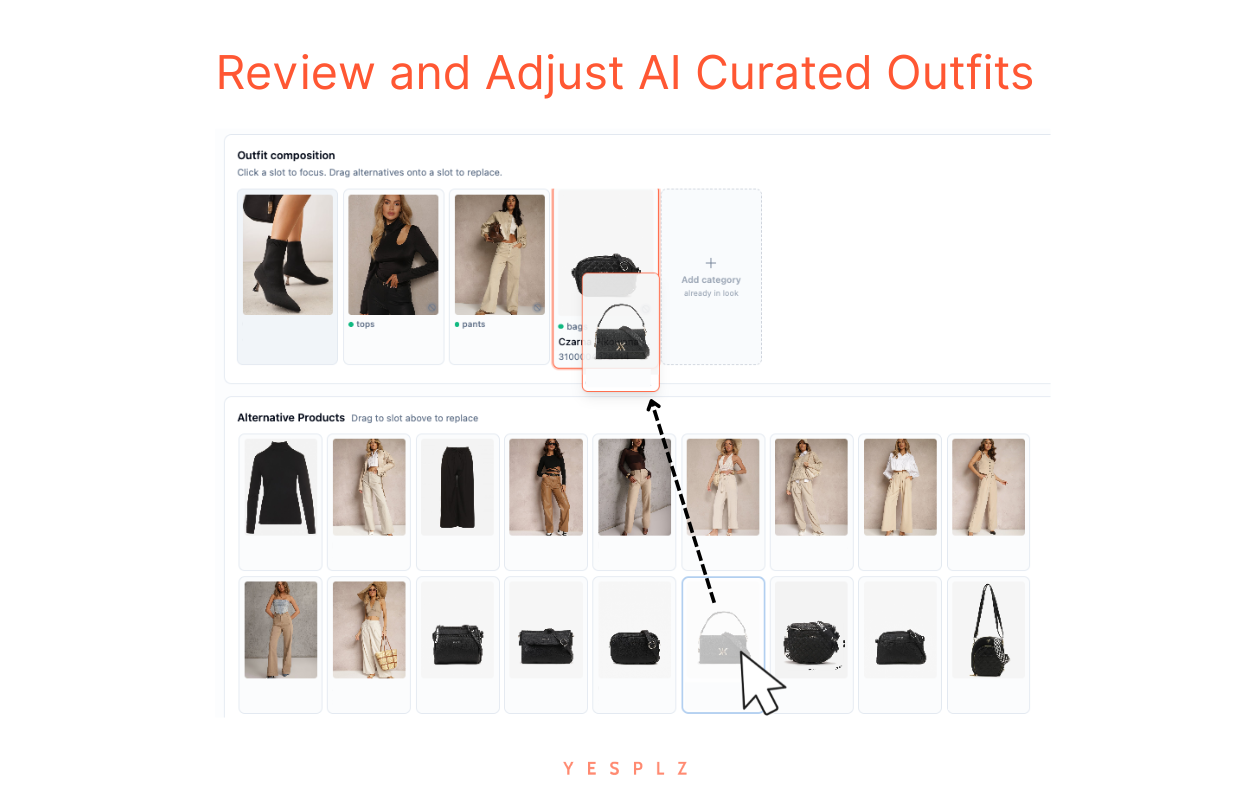 You are looking at part of YesPlz AI styling tool dashboard. We built it for fashion brands to easily provide feedback to our product recommendation engine. If a bag, shoe, or apparel item does not fit your brand's style, you can replace it with a better option just by drag and drop.
 These edits become feedback for AI. Every edit teaches AI to learn the brand aesthetic and apply it. Over time, AI learns which styling choices your brand prefers and uses those patterns when generating outfits.
This way, your brand stays in control of the creative output. Meanwhile, AI handles the heavy lifting, making sure every product in the catalog gets outfit recommendations.
Once an outfit goes live, the work is not done. AI continues to learn from shopper behavior. It tracks which outfits get more clicks, add-to-carts, and purchases. These signals reveal what shoppers actually respond to, not just what looks good on paper.
Every shopper interaction becomes a feedback signal. Over time, AI identifies styling patterns that perform well for a specific brand and its unique shoppers. Those patterns are then incorporated into future outfit recommendations.
From the previous section, you already know how AI generates a curated outfit. It identifies the hero product's attribute profile — color, occasion, vibe, season, and more. Then, use that profile to pull matching pieces from a catalog.
But AI can only work with attributes that actually exist. If there is no occasion tag, it can't be matched by occasion. So the quality of attribute data is everything. Which leads to a simple question: how do you generate rich, consistent fashion attributes at scale?
Most retailers today rely on two methods. Both have limits. Supplier-provided data is inconsistent and incomplete. They tag products for their own purposes, not for how a shopper discovers a look. Manual tagging produces high-quality output. But it doesn't scale.
The best practice is a hybrid. AI generates the attributes at scale. A merchandising team then reviews and corrects them. AI handles the volume. The humans ensure the quality.
At the heart of it all is one simple idea. To recommend what goes with a product, AI first needs to truly understand it. Not just its category, but its look, its feel, its mood, its occasion.
Complete the Look recommendations work across multiple touchpoints in the shopper journey. And, where it appears shapes what it needs to do. The table below breaks down each placement, the shopper's intent behind it, and the role it plays at that moment.
Placement | Shopper intent | Role |
Product Detail Page (PDP) | Evaluate a single item | Provide styling context and increase basket size |
Cart | Consider purchase | Surface complementary items before checkout |
Post-purchase | Look for styling ideas | Encourage repeat visits and future purchases |
Editorial / Lookbook | Seek inspiration | Drive product discovery and outfit exploration |
Complete the Look directly grows revenue in two ways: bigger baskets and higher conversion. When a shopper sees a full outfit built around the item they're already considering, buying multiple pieces becomes the natural next step. And when they're unsure how to wear something, a styled look removes the hesitation. The result is more units per order and stronger sales.
It also builds loyalty over time. Post-purchase styling gives shoppers a reason to return. Hard-to-find accessories get discovered through outfit recommendations instead of search. Gradually, the brand becomes a go-to styling resource, and that keeps shoppers coming back.
At its core, AI outfit curation transforms a product catalog into a styling experience. Instead of leaving shoppers to imagine how an item fits into their wardrobe, it shows them. That confidence translates into higher conversion, larger baskets, and stronger customer loyalty.

Written by YesPlz.AI
We build the next gen visual search & recommendation for online fashion retailers
