MCP vs ACP vs UCP: Which Agent Protocol Do Retailers Actually Need?
Shoppers are buying through AI. MCP, ACP, and UCP, which agentic commerce does your store need? The answer is simpler than the acronyms suggest.

by YesPlz.AIAugust 28, 2026

Shoppers are buying through AI. MCP, ACP, and UCP, which agentic commerce does your store need? The answer is simpler than the acronyms suggest.
by YesPlz.AIAugust 28, 2026
Shoppers are using AI to find and buy products. This isn't a prediction; it's happening right now. According to The State of Fashion 2026, ChatGPT accounted for 16% of Zara's inbound referral traffic between June and August 2025, and 8% of H&M's and Aritzia's. Traffic to retail websites from AI sources grew 4,700 percent between 2024 and 2025. This is why getting ready for agentic commerce can't wait.
Not long ago, purchasing a dress online meant visiting a store, searching, and paying there. The store owned every step of the buying journey. But that's no longer the only way. Today, shoppers can describe what they want to any AI search engine.
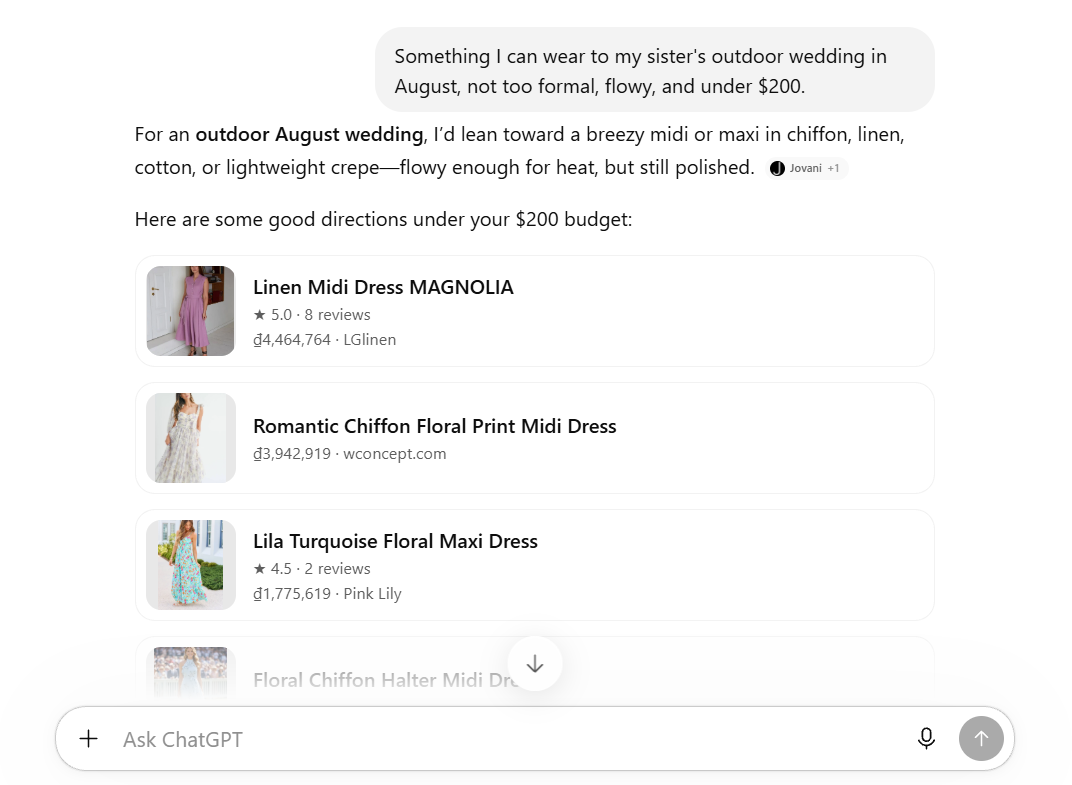 AI queries different catalogs and returns a shortlist of products in seconds. Each is displayed with images, price, rating, review, and a buy button. The purchase happens inside the AI platform, without the shopper ever landing on your site. If you've never heard of agentic commerce before, that's what it looks like.
As a retailer, you've probably seen three acronyms circling this shift: MCP, ACP, and UCP. And if your reaction has been "I'll wait and see which one wins," you're not alone. The confusion among these is quietly paralyzing retailers into doing nothing.
But here's the thing: There is no winner to wait for. The three protocols aren't rivals; they're actually layers. And the good news is that once your product data is properly structured, integrating it into all three is straightforward.
If you're not ready to hand off payments to an AI just yet, start with MCP. It's the easiest entry point and already works with the major players — Claude, ChatGPT, and others. When you're ready to streamline the full checkout experience, UCP is the natural next step.
This article will help you tell them apart and show you exactly what to do.
Each protocol was built by a different company. Each covers a different part of the shopping journey. They put your products in front of shoppers in a different way. The table below shows a quick snapshot of all three. Who's behind each one, what it does, and what it means for you as a retailer.
Protocol | Who's behind it | What it does | Where shoppers encounter it | What a retailer must do |
MCP (Model Context Protocol) | Anthropic (Nov 2024) | Lets AI agents read and query your product catalog. | Any MCP-compatible AI assistant | Structure your catalog so an AI agent can query it. |
OpenAI + Stripe + Meta (Sep 2025) | Enables AI agents to complete purchases on behalf of shoppers; Allows shoppers to buy without leaving the AI platform | ChatGPT Instant Checkout | Submit a clean, attribute-rich catalog to AI agents. | |
Google + Shopify (Jan 2026) | Enable the whole agentic shopping: discovery, checkout, and post-purchase | Google Search, Shopify storefronts, Target, Walmart, Etsy, Wayfair | Set up a queryable catalog endpoint; Handle the full order lifecycle |
Understanding the difference between MCP, ACP, and UCP isn't about picking a winner. It's about understanding where your discovery challenge lives. Think of it this way:
ACP is how ChatGPT checks out on your shopper's behalf.
UCP is the whole trip: discovery, checkout, and everything that happens after the order is placed.
Both ACP and UCP have a checkout built in. Both let a shopper complete a purchase without visiting your store. But the way they work behind the scenes, and what that means for your store, is quite different.
Our CTO, Sukjae Cho, puts it best:
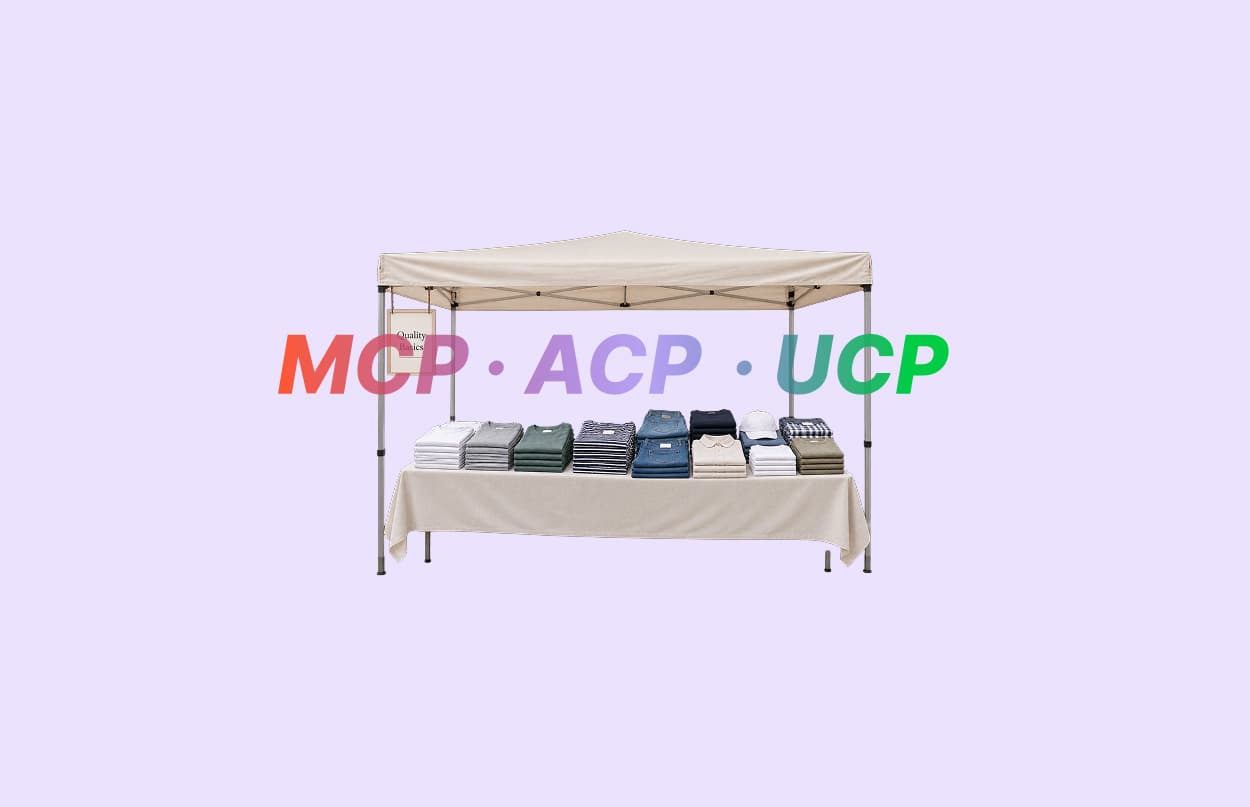
"ACP is like submitting a well-made catalog to OpenAI: your products sit right where the shoppers already are, but inside a static catalog it's hard for a shopper to find the exact product they want. UCP is like setting up your own well-organized market stall: once a shopper arrives, they find exactly what they're looking for — but first they have to find your stall."
— Sukjae Cho, CTO, YesPlz AI
Two different challenges, but only one root cause. Both come down to the two jobs:
And make your catalog findable by AI agents
You submit your products to ChatGPT's ecosystem. The shopper discovers and buys inside ChatGPT. You don't host anything queryable yourself. ChatGPT holds the catalog and runs the checkout session by calling your backend only at the moment of purchase.
Think of it like applying to sell on a marketplace. You integrate your store with ChatGPT's system. Your products become part of a catalog that ChatGPT can pull from.
When a shopper finds a product, ChatGPT searches its index, surfaces your products, and handles the checkout flow.
You're right where hundreds of millions of online shoppers already are. You don't earn the visit; it's built in.
You're one of thousands of retailers in that same index. If your product information is poor, ChatGPT's AI agent will pass over your products for ones it can interpret more clearly and confidently recommend.
You publish your own machine-readable endpoint that any AI agent can discover and query directly. Any compatible AI agent, for example, Google's AI Mode, Gemini, Shopify's agents, can find your store by reading your published profile. This profile tells them exactly what your store sells, what it can do, and how to query.
When a shopper finds a product, the agent reads your profile, browses your catalog directly, and completes the full journey: discovery, cart, checkout, all through your endpoint.
AI agents can connect to your stores directly to find the most relevant results.
AI agents have to find your profile first. That means you need to be listed in places they go looking, like the Fashion MCP Directory.
ACP puts your products inside the AI's house. UCP gives your store its own front door that any AI can knock on.
Both models reward the same thing at the foundation: product data that an AI agent can efficiently work with: rich attributes, clear descriptions, consistent sizing, styling context.
Whether a shopper's agent finds you through ACP's index or UCP's discovery, what happens next depends entirely on what's in your catalog.
Once you get past the acronyms, the actual setup work starts to look familiar. It is nearly identical across all three: structure your catalog so an AI agent can query it.
When an AI agent queries your catalog, it's looking for specific, reliable information such as:
accurate pricing
real-time inventory
size availability
product attributes
occasion context
If that information is missing, inconsistent, or buried in unstructured text, what happens? There are three cases:
The agents use the wrong information to recommend products.
The information is missing, so the agents have to guess.
The agents skip your products and recommend one from a catalog that gave it better information.
This isn't theoretical. According to The Information, OpenAI has been slow to enable checkout within ChatGPT. It isn’t because of payment infrastructure issues, but because of unstructured product data.
When someone types into an eCommerce search bar, they use short keywords. Let’s say, midi dress, black heels, linen blazer. The traditional search engine was built to match those keywords, and it does that reasonably well.
However, when a shopper asks AI, the pattern changes. It is often a long, complete sentence. For example: "Something I can wear to my sister's outdoor wedding in August, not too formal, flowy, and under $200." It looks like a brief to a stylist. And an AI agent reads it exactly that way.
The agent then goes to your catalog and tries to find a match. If your product title only says "floral midi dress," the agent has very little to work with. It doesn't know if the dress is appropriate for an outdoor wedding. It doesn't know if the fabric is breathable enough for August.
Getting your catalog agent-ready means making sure every product has the structured, attribute-rich data. That's exactly what product enrichment does. Tagging each item with detailed attributes, occasion context, and styling information so that any agent, on any protocol, can find and recommend it confidently.
But clean and structured data is half the job. The other half is making sure agents can find you in the first place. A shopper's AI agent needs to know your store exists and how to reach it. So, make sure you set up a queryable catalog endpoint, and AI agents can find you through the Fashion MCP directory.
The Fashion MCP Directory offers a free catalog scan. It shows you what an AI agent can actually find, what it misses, and where your readiness score stands before a shopper's agent tries and walks away empty-handed.
Or if you'd rather walk through it with someone, book a demo with us and we'll show you exactly what agent-ready looks like for your catalog.
The protocol landscape will keep shifting. New specs will drop. Platforms will keep competing for the checkout layer. None of that changes your job. Make your catalog agent-ready. You're not choosing between MCP, ACP, and UCP. You're preparing your catalog to serve all of them.

Written by YesPlz.AI
We build the next gen visual search & recommendation for online fashion retailers
