A shopper opens ChatGPT and types:
"I need a black midi dress, under $200, in stock, size M.”
ChatGPT’s AI shopping agent thinks for a moment, then returns some recommendations. However, none of them are yours.
That's the problem a fashion MCP server solves. And right now, almost no fashion retailer has one.
When a shopper Googles a product, Google's crawler has already visited your site, indexed your pages, and built a model of your catalog. It's imperfect, but it works. The infrastructure — structured data, sitemaps, product feeds — has been refined over two decades.
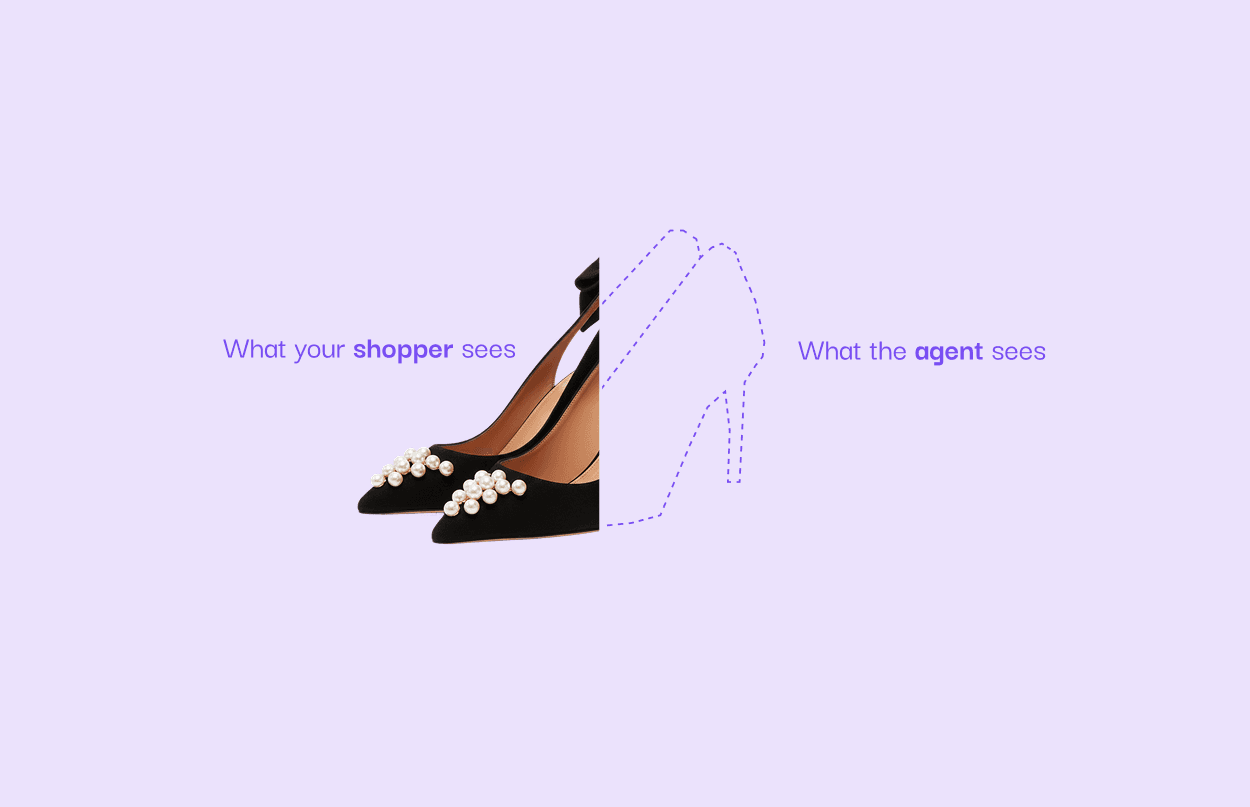
AI shopping agents have no equivalent infrastructure to lean on. When one tries to recommend products to its users, it's largely doing one of two things: scraping your pages in real time, or pulling from a cached snapshot someone else indexed. Either way, it's working with incomplete information.
Your product pages weren't built for AI shopping agents
Most product pages weren't built to give AI shopping agents what they need. Titles and descriptions are written for shoppers, not machines. Prices change, inventory fluctuates. None of that gets updated in a scraped page. So, the agent fills the gaps by guessing. And it guesses wrong more than you'd think.
What a wrong guess looks like
Take a simple example. An agent finds a black midi dress listed at $150. What it can't tell: the size M sold out two weeks ago. The $150 was a sale price that ended last month. The dress is now $250 and only available in XS and XL.
The outcome for your brand
That's the optimistic scenario, where your product shows up at all. More often, agents quietly skip stores whose data is hard to read. They prefer to surface other sites with cleaner, easier-to-read catalogs instead. You don't get a notification when this happens. You just don't show up.
MCP stands for Model Context Protocol. It's an open standard, started by Anthropic, now adopted across major AI assistants. MCP lets agents query live tools and data sources, instead of scraping web pages.
Think of it this way: what a Google Shopping feed did for search ads, MCP does for AI shopping agents.
When you set up a Google Shopping feed, you stopped relying on Google to crawl and guess at your product data. You gave it a structured, authoritative file: price, availability, GTIN, condition, category. Google could match your products to queries accurately because you handed it clean data in the format it expected.
MCP is the same concept, one layer more sophisticated. Instead of a static feed, it's a live server that agents can query directly. The server receives the query, searches your actual catalog against your actual inventory, and returns structured results the agent can trust.
As mentioned earlier, product pages are written for shoppers, not for AI agents. A description like "effortlessly chic, perfect for warm-weather occasions" looks great to humans.
However, to an agent trying to filter by occasion, silhouette, or size availability, it's almost useless. So the agent guesses. And as we've seen, it guesses wrong a lot. A fashion MCP server fixes this by giving agents clean, structured data to work with.
How an agent reads a shopper's query
Consider this example. A shopper types into ChatGPT:
"I'm looking for comfortable cropped linen pants, under $100, for my upcoming vacation."
ChatGPT’s AI shopping agent doesn't pass that query directly to your search engine’s store. It translates it first, breaking it down into a structured format, for instance:
fabric: linen
style: cropped
fit: relaxed
price: under $100
occasion: vacation
Then it queries your catalog using those structured terms. What happens next depends entirely on how well your product catalog is structured.
Why your catalog structure decides what happens next
If your store's site search engine only does basic text matching, it looks for those words in your product titles or descriptions. If your linen pants are described as "casual summer trousers" with no mention of linen fabric, cropped cut, or vacation, they won't show up, even if they're a perfect match.
But if your MCP server has defined each product attribute clearly — fabric, fit, occasion, price, length — the agent can search and filter precisely. The right product surfaces. The shopper finds exactly what she's looking for, from your store.
This is why good catalog structure isn't just a nice-to-have. It's the difference between showing up and being invisible.
Structured attributes — so agents stop guessing what your products are.
Structured attributes matter at every level, from the basics to the specifics. A shopper is looking for “everyday high-quality fabric tees for women." For this to surface the right product, your catalog needs the following attributes clearly defined:
gender: women
category: t-shirts
occasion: everyday
material: 100% cotton
Miss any one of those fields, and your tees don't show up, even if they're a perfect match. The same logic applies to every product in your catalog. When the fields are there, agents query them directly. When they're missing, the agent guesses. And as we've seen, it guesses wrong.
Live inventory and real-time pricing — so agents only recommend what shoppers can actually buy.
Agents scraping your site don't know what sold out yesterday. A fashion MCP server queries your inventory at the moment someone asks. If a size is gone, it doesn't recommend it.
Besides, sale prices change and promotions end. An agent working from a cached page might quote last week's price. A fashion MCP server returns today's price every time.
Styling context — so agents can recommend an outfit, not just a product.
This is the part that goes beyond basic data. A fashion MCP server can tell an agent how items are meant to be worn together — what pairs with what, what works for which occasion. Instead of just surfacing a dress, the agent can build a complete look from your catalog. So, a shopper who came for one item leaves with three.
Shopify merchants have a head start here. It's worth understanding exactly what that means and where it stops.
Shopify launched its own catalog MCP server, giving merchants a machine-readable layer over their store data that AI agents can query. If you're on Shopify and your catalog is reasonably well-structured, you have MCP connectivity out of the box. It means a shopping agent can query your store directly rather than scraping your storefront.
But Shopify MCP is a general-purpose commerce layer, not a fashion-specific one. Generic product attributes, for example, title, price, inventory, category, are what it exposes. The fashion-specific taxonomy that lets an agent reliably distinguish a fit-and-flare from an A-line — that layer doesn't come with Shopify MCP.
So, if you're on Shopify, you already have better infrastructure than most. However, you still need a fashion-specific layer on top to make your catalog agent-queryable.
MCP is a pipe. It can only surface what flows through it. If your product data is inconsistent, then your MCP server surfaces that inconsistency to every agent that queries it.
Before an MCP server can make your catalog agent-queryable, your catalog has to be agent-ready. That means:
This is the work that most retailers haven't done, because until now there was no agent layer that required it.
Audit your catalog data first: Pull a sample of 100 SKUs across categories. Then, score them against a fashion attribute checklist: silhouette, occasion, fit, neckline, sleeve, formality, fabric. How many are complete? How consistent is the terminology? This tells you what your MCP server would actually surface.
Run a free scan on the Fashion MCP Directory: If you already have an MCP endpoint (Shopify merchants likely do), the Directory will score it against: search & browse, filters & sorting, brands, recommendations, shop info & support. You'll see exactly where agents struggle with your catalog and what to fix first.
AI agents are already shopping on behalf of your shoppers. The brands they recommend most are the ones with the clearest data. That can be you, but only if your catalog speaks a language agents understand.
Ready to see where you stand? Run a free scan of your catalog on the Fashion MCP Directory. Or, book a demo to see how YesPlz makes your catalog agent-ready.