Search is the most important feature on any eCommerce site. When a shopper lands on an online store, she has three ways to find what she wants: the search bar, the filters, or the navigation menu. Each of those three touchpoints is an opportunity to connect her with the right product. However, these features are the most commonly underbuilt on many sites.
As part of improving our own fashion search and recommendation technology, we at YesPlz AI regularly study search and discovery experiences across various websites. This month, we looked at two British brands we admire: Holland Cooper and Sunspel.
Both Holland Cooper and Sunspel have strong products, distinctive brand identities, and well-crafted sites — exactly the kind of retailers where search and discovery should be working hardest.
What We Found
On both sites, we found high-intent search queries returning zero results or off-target results and proven recommendation placements not yet in use. These issues aren’t unique to these two brands. They're the norm across fashion eCommerce, including on sites with far bigger tech budgets. Which means they're also one of the most accessible conversion levers in the industry.
Why It Matters
Every zero-result query is a shopper who told you exactly what they wanted but left empty-handed. When those searches start returning the right products, the revenue impact is direct and measurable.
How We Ran the Comparison
We ran each query against two different search settings: the brand's current site, and the same catalog with a fashion-native search engine embedded. The catalog was identical in both cases; the only variable was the search engine.
The query set covered the types of searches shoppers commonly type: one-word queries, two-word queries, occasion-based queries, attribute-based queries, and common typos.
For each query, we assessed the first eight products displayed — the top two rows of the results grid. Then, we counted how many were relevant to the query.
We focused on the top of the grid because it's what shoppers see and judge before deciding whether to scroll or leave. In cases where fewer than eight products were returned, we assessed everything shown.
Note that both sites may have changed since then. We have no inside knowledge of either brand's roadmap. Everything below is what any shopper would see.
Our Takeaways
Great product alone isn't enough — search and discovery need to surface the right item at the right moment. What follows is a look at where those gaps show up on both sites, and what closes them.
The search bar is where most shoppers start and where the quality of the shopping experience varies most. The results, across both brands, were mixed. Some queries worked well while others returned nothing at all.
One-word queries like 'jeans' performed well on both sites. But two-word queries and typo variants seemed to struggle. The two tables below show our Holland Cooper and Sunspel search comparison with and without using fashion-native search.
Holland Cooper With and Without Fashion-Native Search
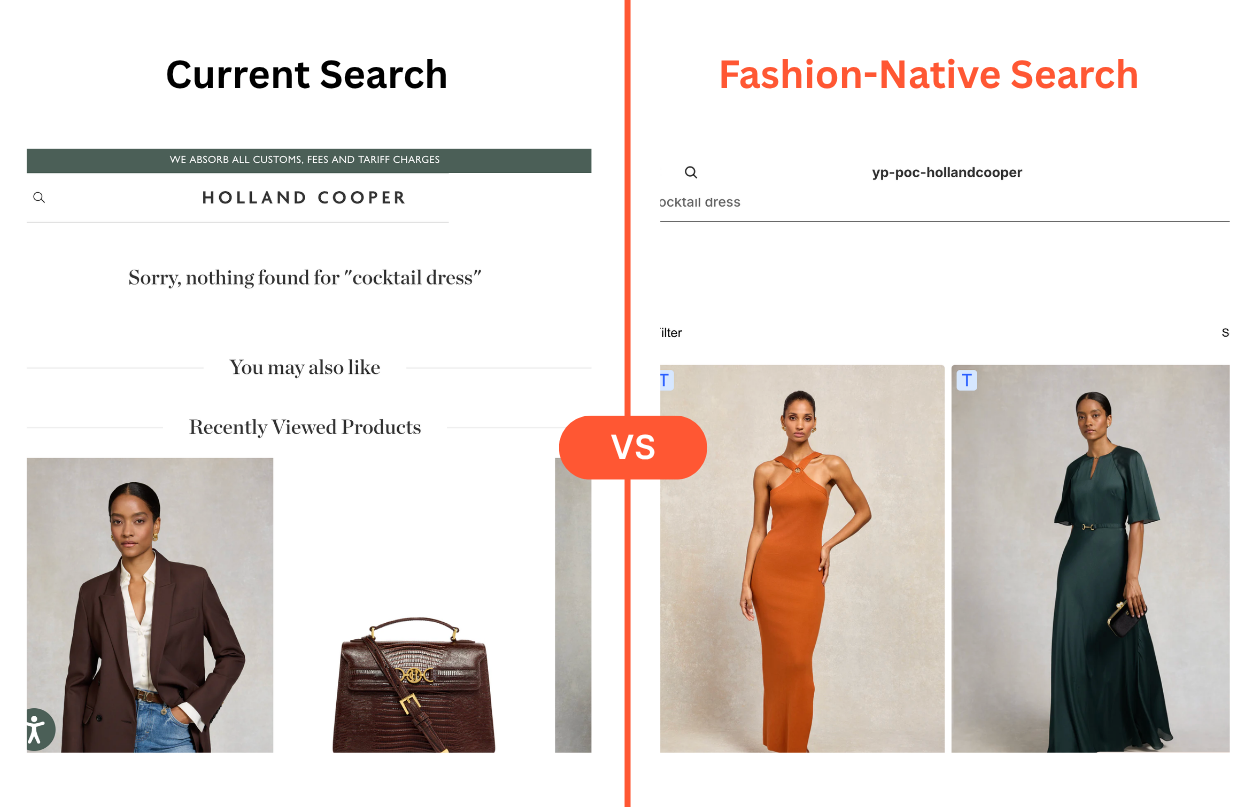
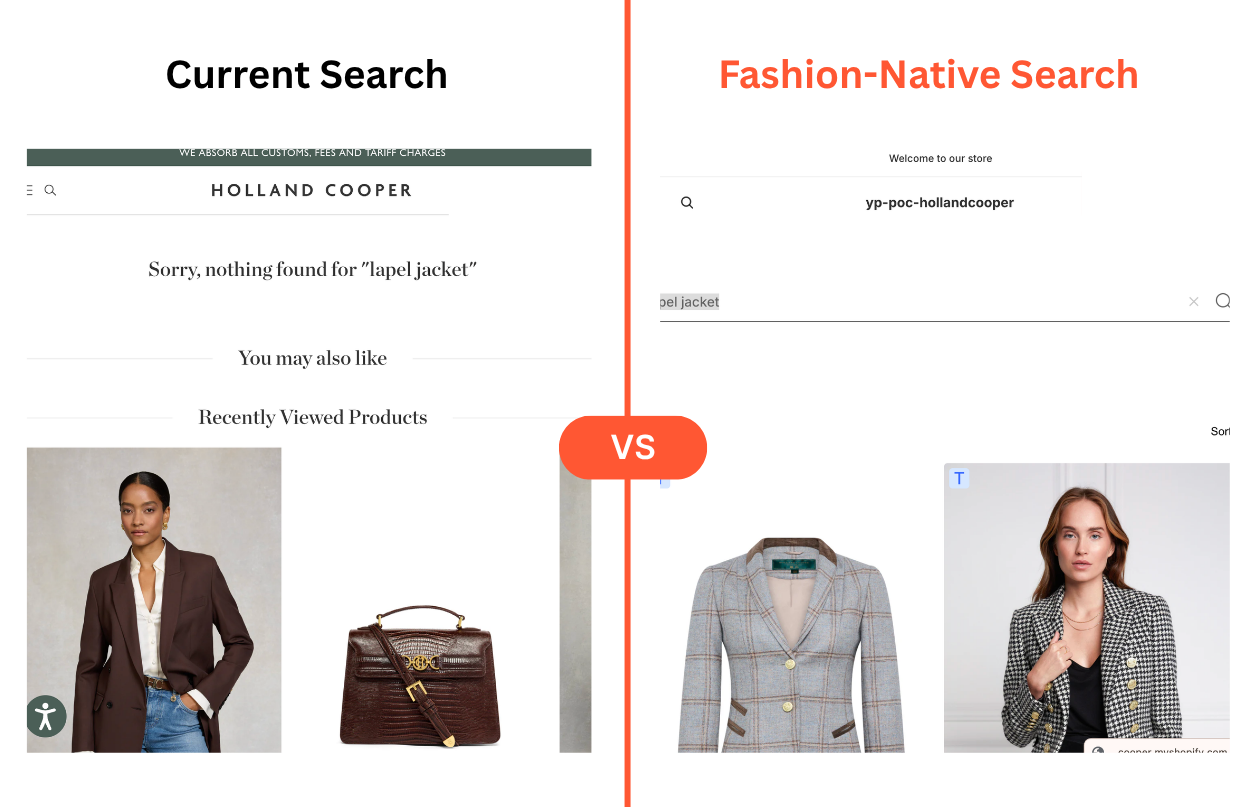
Holland Cooper returned zero results for 6 queries: lapel jacket, cocktail dress, work tops, crewneck, bateau neck, and short skirts.
A note on the scores: 0/0 means the search returned no products at all. A score like 5/8 means 8 products were returned, and 5 matched the query.
Holland Cooper: Same Catalog, Two Search Engines |
| | Holland Cooper’s Current Site Search | YesPlz AI’s Fashion-Native Search |
| | | |
| | | |
| | | |
| | | |
| | | |
| | | |
| | | |
| | | |
| | | |
| | | |
We can classify them into two categories. The first is occasion-based queries, like cocktail dresses or work tops. Shoppers are looking for products suited to a specific occasion or setting — the office, a party, or a wedding.
Search Query for Cocktail Dress
 The second is style-based queries, for instance, lapel jacket or short skirts. With these queries, shoppers have a specific attribute in mind and are searching for exactly that.
Search Query for Lapel Jacket
 Sunspel Search With and Without Fashion-Native Search
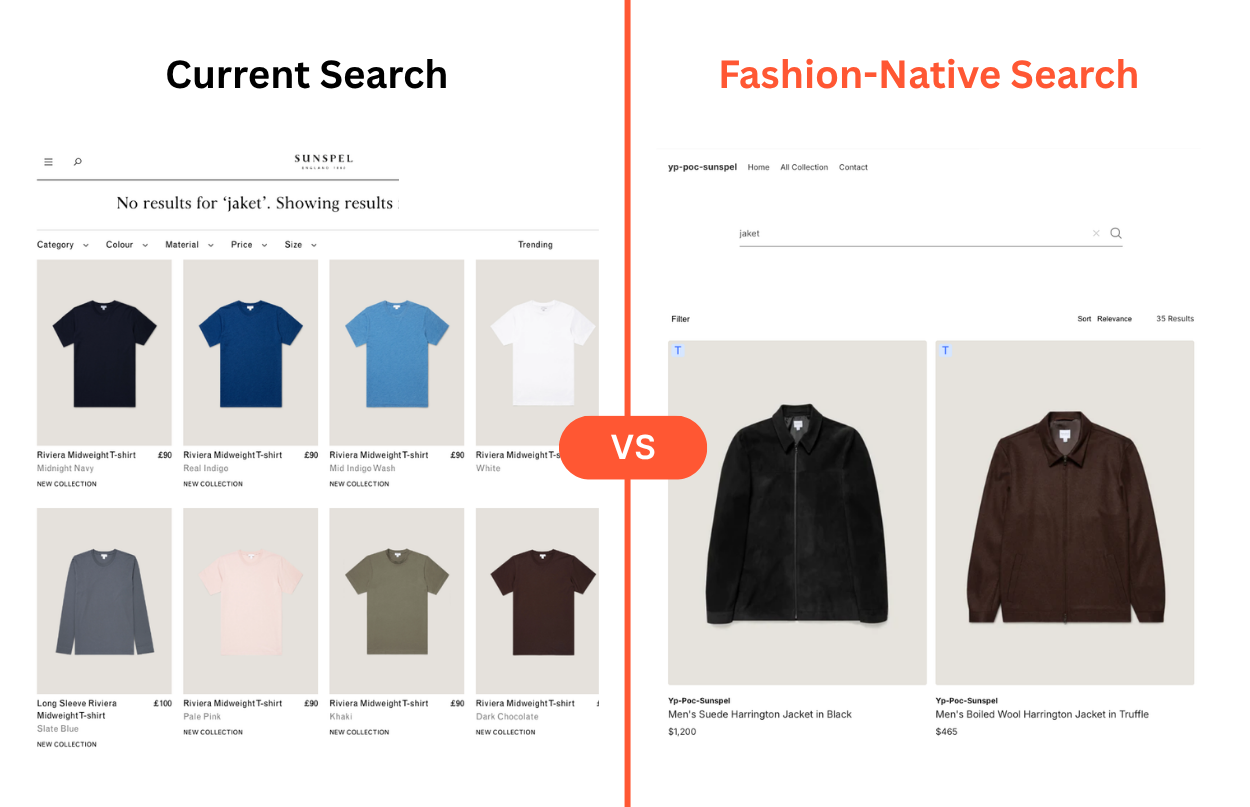
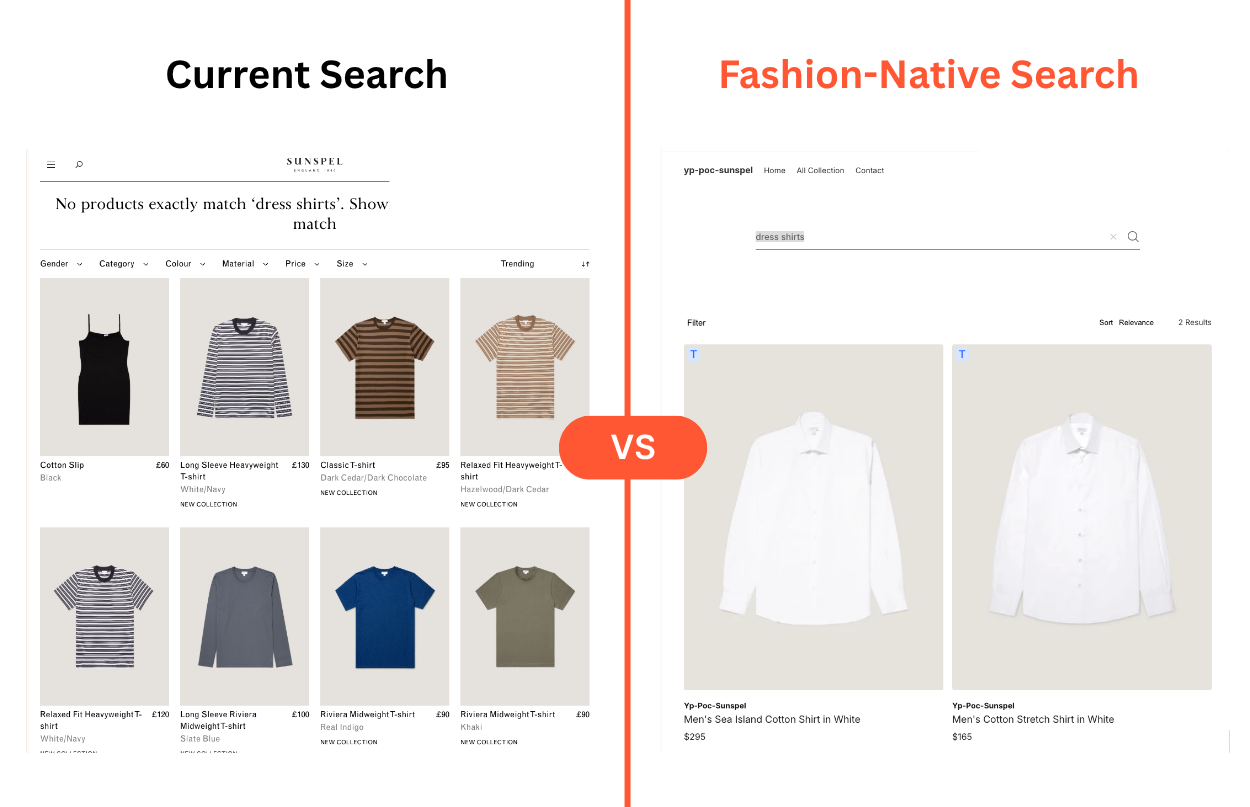
Sunspel returned results for most queries. For 5 of them — dress shirts, bateau neck, puffer vest, work tops, and jaket — the products shown didn't match what we searched for.
A note on the scores: 0/0 means the search returned no products at all. A score like 0/2 means products were returned, but none matched the query.
Sunspel: Same Catalog, Two Search Engines |
| | Sunspel's Current Site Search | YesPlz AI's Fashion-Native Search |
| | | |
| | | |
| | | |
| | | |
| | | |
| | | |
| | | |
| | | |
| | | |
| | | |
These fall into the same two categories as Holland Cooper: occasion-based queries (work tops) and style-based queries (bateau neck, puffer vest), plus product queries like dress shirts that returned off-target results.
Search Query for Dress Shirts
 Plus a third: typo queries. For example, ‘jaket’ is a common misspelling of jacket. Or, instead of typing sweatpants as a single word, shoppers used a space between the words sweat and pants.
Search Query for Jaket
Not every shopper arrives at a fashion site knowing exactly what they want. Discovery features are what serve those shoppers — the ones who are browsing, comparing, and building an outfit in their head.
These features include recommendation widgets and filtering options. Done well, they guide shoppers from one product to the next, turning a single page view into a longer session and, ultimately, a larger basket.
Holland Cooper Recommendations
Holland Cooper does have “Complete The Look” and “You May Also Like” recommendations in place.
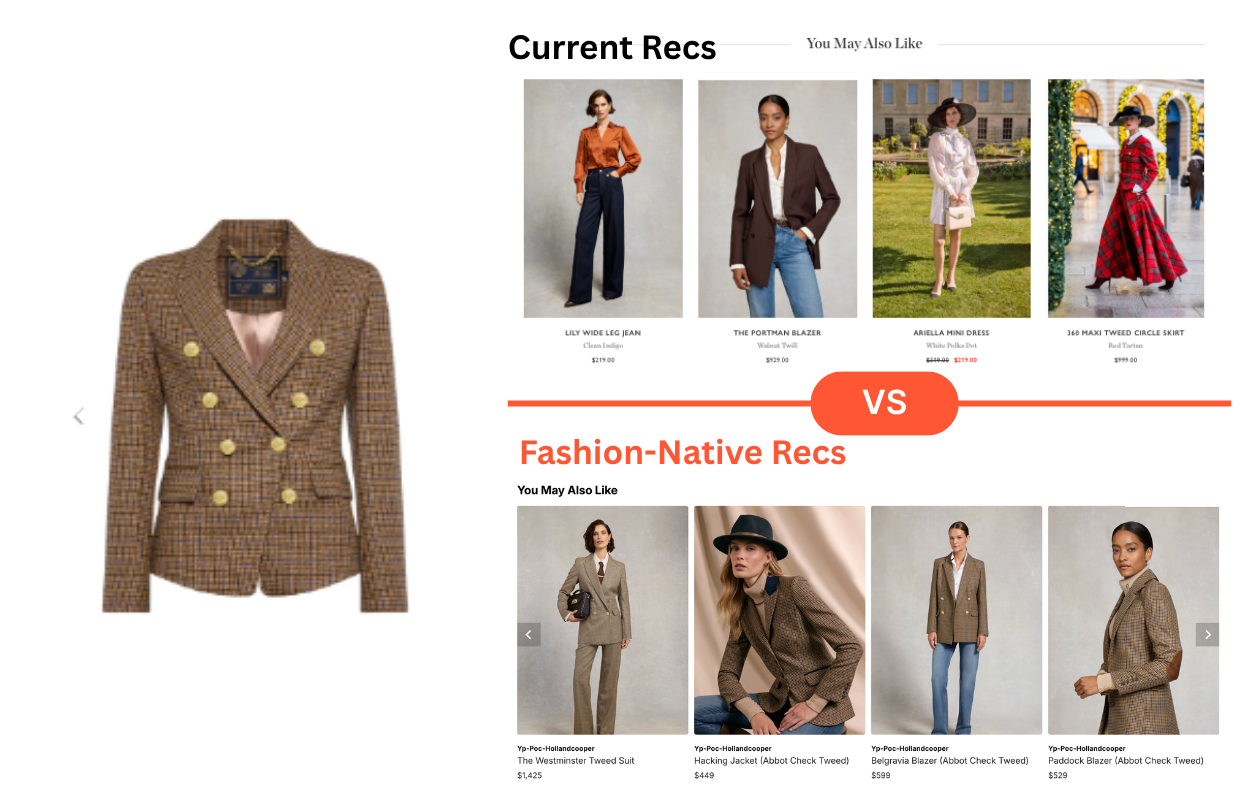 But “Similar Products”, the feature that keeps shoppers exploring the same style beyond the first product they land on, was absent. “More by Brand” and “Shopping Cart” recommendations were also missing.
According to our research, each missing feature carries a real revenue cost. “Similar Products” and “More by Brand” each drive an average of 5–8% sales attribution. “Shopping Cart” recommendations go further — averaging 15% sales attribution for logged-in users, making it the highest-value placement on any fashion site.
Holland Cooper's filters cover the basics — size, color, and product type. Fashion-specific filters like neckline, sleeve length, pattern, and cut style, which let shoppers narrow results by the attributes they actually care about, aren't currently offered.
Sunspel Recommendations
Sunspel offers "Similar Products" and "You Might Also Like" recommendations. But "Complete The Look" was absent. This is the feature that turns a single product view into a complete outfit package. It encourages shoppers to add complementary items to their basket rather than buying a single piece. Building those outfits used to mean manual merchandising work for every product; AI styling now generates them automatically from the catalog.
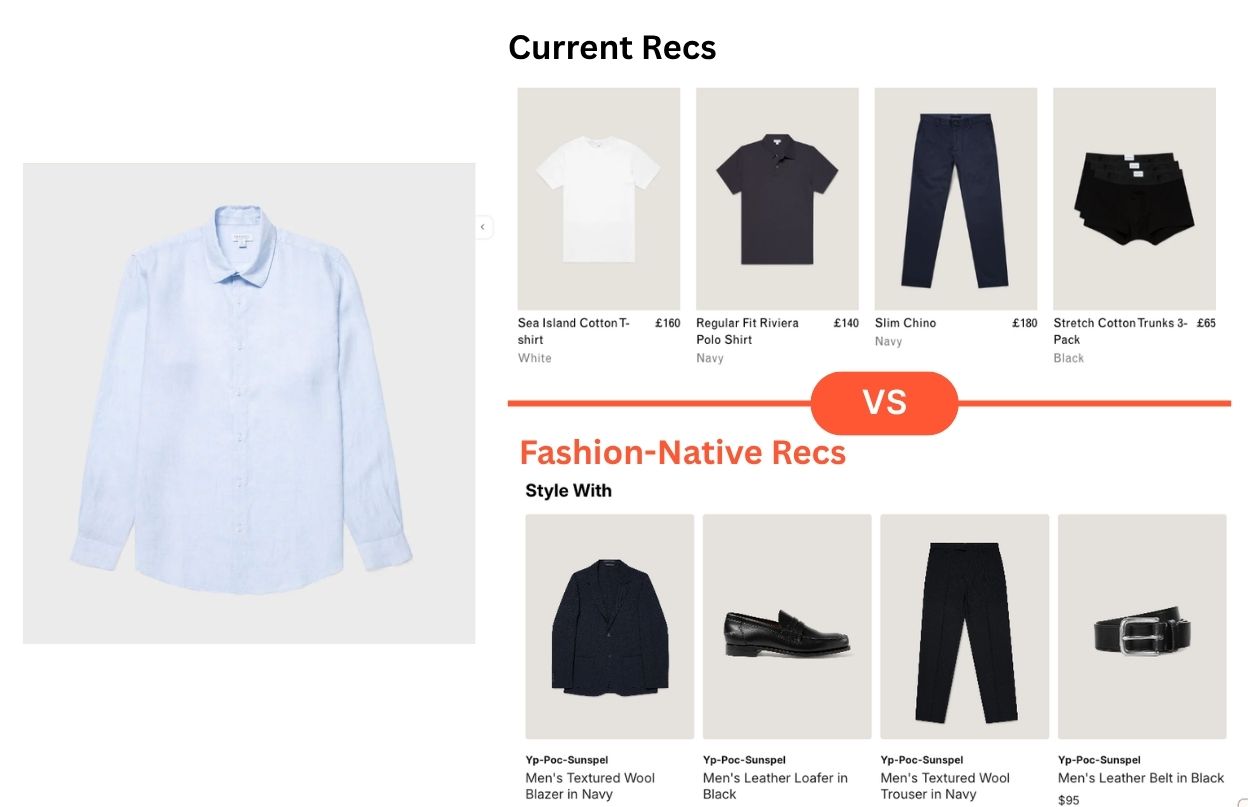
Like Holland Cooper, Sunspel's filtering options cover basic filters. Fashion-specific filters were not available, making it harder for shoppers to narrow down results based on the specific attributes they are looking for.
The search and discovery problems we found at Holland Cooper and Sunspel are not unique to these two brands. They are common across fashion eCommerce. And they share a common root: thin product data.
When the search and recommendation engines don’t really understand what each product is, they can’t return relevant results. So, how can fashion retailers solve this issue? What closes that gap is fashion-specific AI. There are three components that make the difference.
Image Tagging
Image tagging leverages AI to automatically extract detailed attributes directly from product photos — product type, gender, color, pattern, neckline, sleeve length, vibe, and occasion.
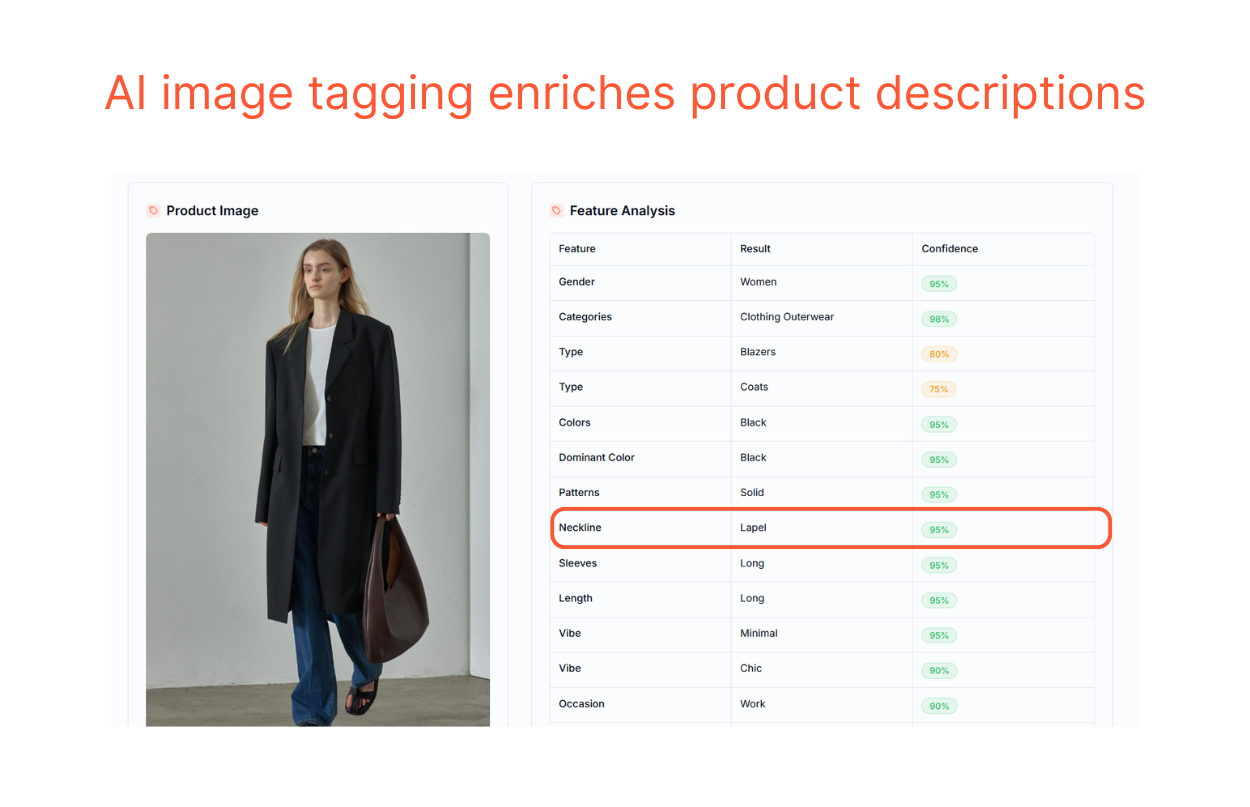 Take the image above. The black blazer gets enriched with a full set of attributes: women's clothing, outerwear, blazer, black color, solid pattern, lapel neckline, etc. Each of those attributes becomes searchable.
This is what makes search queries like bateau neck or lapel jacket findable, even when those exact words don't appear in the product description.
Even when it is titled "jacket" with no further information, it still will surface in a search for a lapel jacket because the AI tagged it with a lapel neckline — as shown in the feature analysis above. Without that tag, the query returns nothing.
This image tagging technology also powers different types of outfit recommendations. When every product in the catalog is understood at this level of detail, the search and recommendation engine can match fashion items by the attributes that actually matter to shoppers.
Natural Language Processing
From the previous section, you learned that there are different types of search queries: style-based queries and occasion-based queries.
Besides, shoppers can make typos or use synonyms for the same product. Natural Language Processing (NLP) is what bridges that gap. It allows the search engine to understand the intent behind a query, not just the exact words used.
Work tops and office blouses are different phrases describing the same need. Jaket and jacket are different spellings of the same product.
Without NLP, the engine treats each of these as entirely separate queries and returns mismatched or empty results. That's the pattern behind several of the results we saw on both sites.
Insights from Shopper Behaviors
Image tagging and NLP give the search engine a deep understanding of the catalog. But understanding products is only half the equation. The other half is understanding shoppers. Two sources of shopper insights make a significant difference.
The first is shopper reviews. Reviews capture how shoppers describe a product in their own words: the fit, the fabric, the occasion they wore it to. A product tagged as ‘for a formal occasion’ by the brand might be described as perfect for a garden party by ten different reviewers. That language, when fed into the search and recommendation engine, makes the product findable for queries the brand never thought to tag for.
The second is shopper behavior: views, clicks, and purchases. When a shopper clicks on a lapel jacket after searching for work tops, that tells the engine something about how those two concepts relate. Over time, aggregated behavior data refines search results and recommendations, making them more accurate and more personalized for every shopper.
Together, reviews and behavior data turn a static catalog into a living system — one that gets smarter the more shoppers interact with it.
Holland Cooper and Sunspel are strong brands with catalogs their customers love. Our findings show how much conversion upside is sitting inside search and discovery at even well-built fashion sites — high-intent queries waiting to be answered, and proven placements waiting to be switched on.
The good news is that the problems are specific, the solutions are known, and the payback is measurable: when zero-result rates fall, search revenue follows. Fashion-specific AI — built on image tagging, natural language processing, and shopper insights — closes the gap between what a site currently shows and what it could.
If you are curious about where your site stands, we run these audits regularly. Schedule a demo or reach us at hello@yesplz.ai.