After many calls with eCommerce fashion retailers, we've noticed two misconceptions that come up almost every time.
Most people assume all site search works the same way. They also believe that the more expensive the search engine, the better it performs.
That isn't true, especially for online fashion stores. To understand why, it helps to look at how a general search engine works and how it differs from a fashion search engine.
How a General Search Engine Works
A general-purpose search engine isn't built to understand fashion styling. No matter how complex its algorithm is, it still runs on keyword matching. If the exact words aren't in the product title or description, the product doesn't show up.
A general search engine can't recognize style from a product image either. It can't understand a photo the way a shopper sees it.
And it doesn't keep up with how fashion shoppers search. New terms, new trends, new ways of describing a look — someone on your team has to maintain all of that manually.
The Difference Between a Fashion Search Engine and a General One
Search built for fashion works differently. It understands styling — the search intent behind how fashion shoppers think and search.
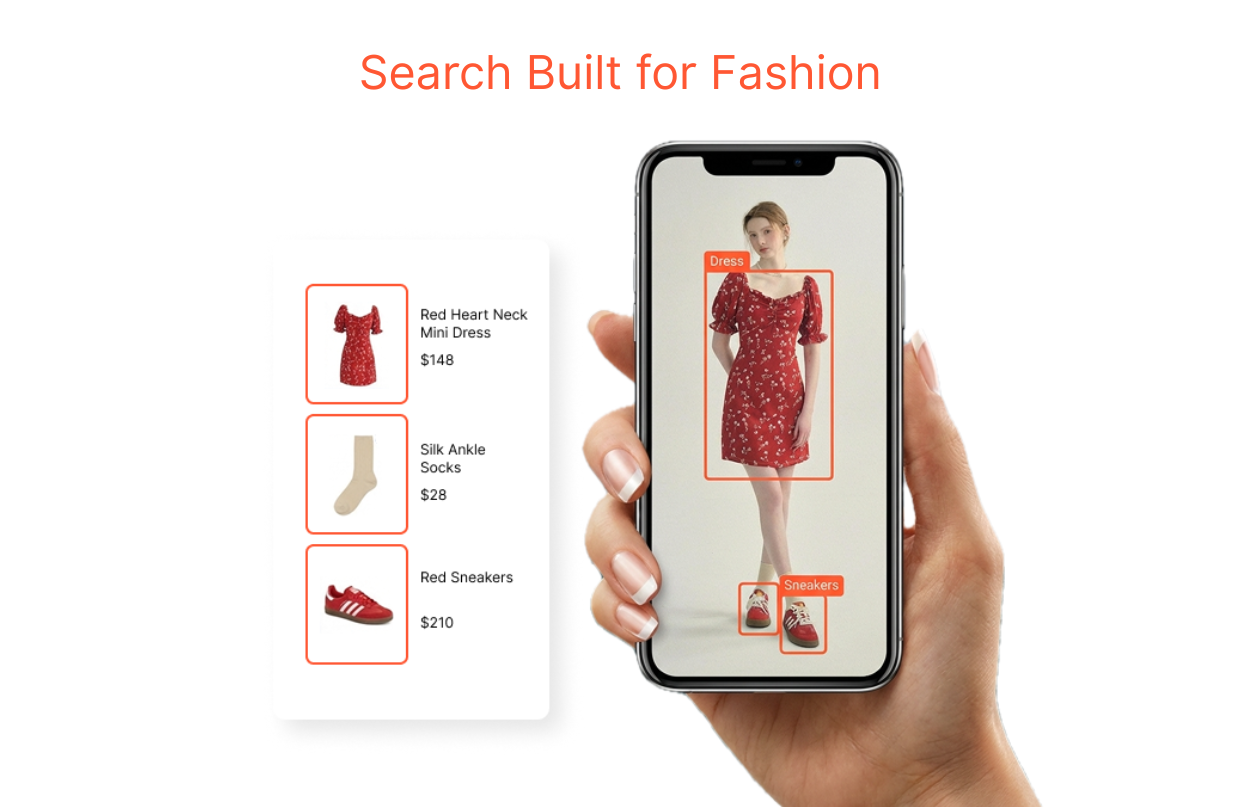
It can analyze product images. So shoppers can find what they're looking for even when the words don't match perfectly.
 And it keeps itself current, tracking trending terms and updating automatically without your team having to intervene.
3 Questions Every eCommerce Fashion Retailer Should Ask
A good search is accurate and relevant. A good fashion search engine defines accuracy and relevance by what fashion shoppers are actually searching for.
If you want your site search to convert more fashion shoppers, ask three questions:
1. Does it understand fashion styling?
2. Does it understand product images, so it doesn't rely only on keyword matching?
3. Does it update trending keywords automatically, so your team doesn't have to?
The rest of this post answers all three.
Is your site search returning irrelevant results? A high zero-result rate or low search conversion usually has one cause: your search doesn't understand fashion shoppers' intent.
Before diving into features, let's look at the problems first. Each of the three features solves an issue that plays out on fashion sites every day.
Shoppers Who are Looking for Fashion Styles
Fashion shoppers don't always search the way a general search engine expects. They don’t shop for a product, but a style.
For example, romantic style for a date night, flowy summer patterns, something effortless but put-together.
If the style language a shopper uses doesn't appear in your product titles or descriptions, a general search engine can't process that.
Shoppers Who Can't Describe What They Want in Words
The second gap is shoppers who know exactly what they want but can't put it into words.
They saw something on Instagram, on a friend, or in passing somewhere. They open your site and type their best guess, but leave without finding the outfit they came for.
For fashion shoppers searching from a feeling or a visual memory, finding the right words is often the hardest part. This is where a general search engine hits its limit.
Merchandisers are Stuck in Manual Upkeep
The third issue is less visible to shoppers but matters to anyone on the merchandising team.
Every week, someone on the team updates synonym lists, adds trending terms, and fixes typo variants by hand.
The problem is that fashion moves fast. So, these tasks never end and scale with catalog size. Most teams have accepted these as part of the job, but it doesn't have to be.
Each of the three problems above has a direct fix in a fashion-native search engine. And most teams don't know any of them are options until someone walks them through.
From Keyword Matching to Relevant Answers
| |
Matches the words in a search query to words in your product data | Understands what those words mean in a fashion context |
What Happens When a Shopper Searches for a Fashion Style, Not a Product
Take "barrel pants" as an example. It’s a trending style term that shows how shoppers search for a style instead of a specific product.
As you can see from the image below, most product titles don’t include the keywords "barrel pants". So a general search engine might return nothing.
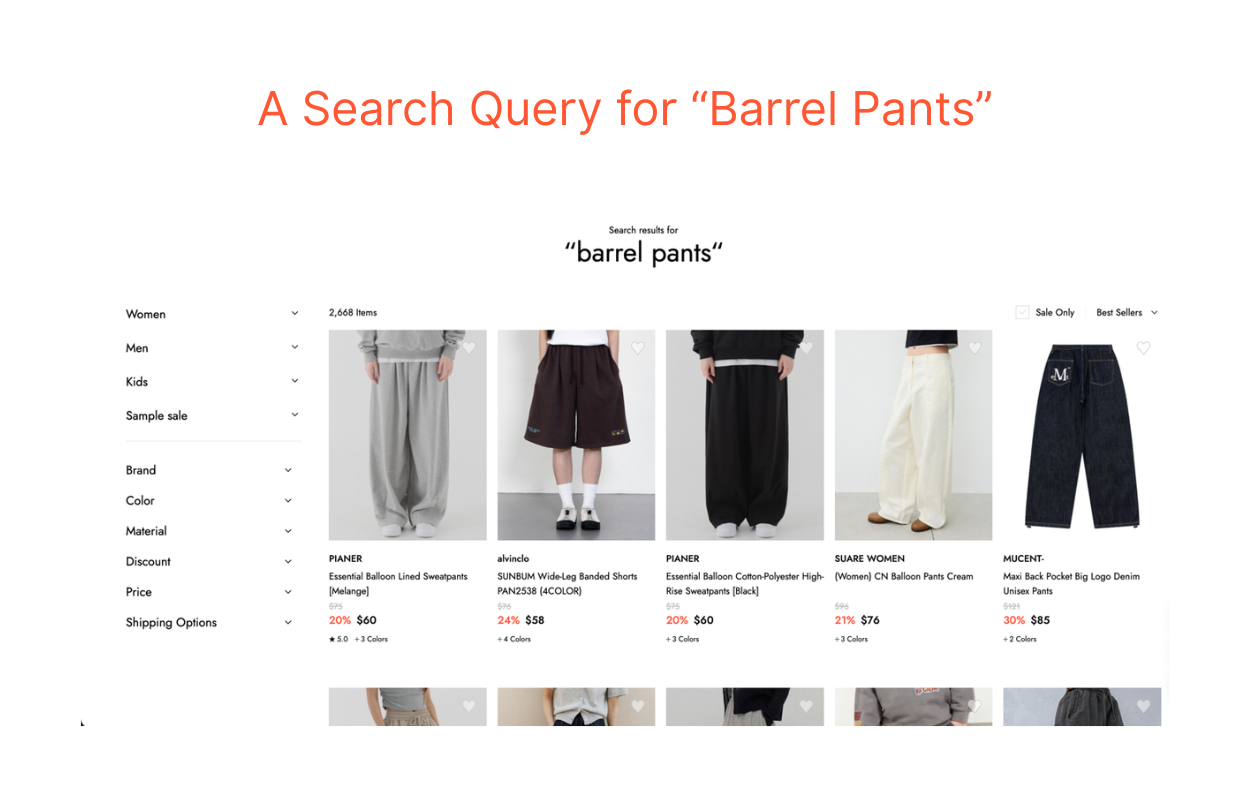 But our fashion-native search understands the styling concept behind the query. It understands the wide, tapered silhouette and the voluminous cut. So it surfaces the right products anyway.
Why Fashion Search Engine Understands More Than Keywords
This is what fashion intelligence looks like in practice. Our search is trained on fashion data—product tagging and embeddings built specifically to understand styling keywords, occasions, silhouettes, and how fashion shoppers describe what they want.
That foundation is what separates a search bar that matches letters from one that understands fashion.
It also shows up in smaller moments that add up. As a shopper types "barrel," Autocomplete surfaces "barrel pants" before finishing typing.
When someone opens the search bar without a query in mind, Popular Searches shows what other shoppers are looking for right now.
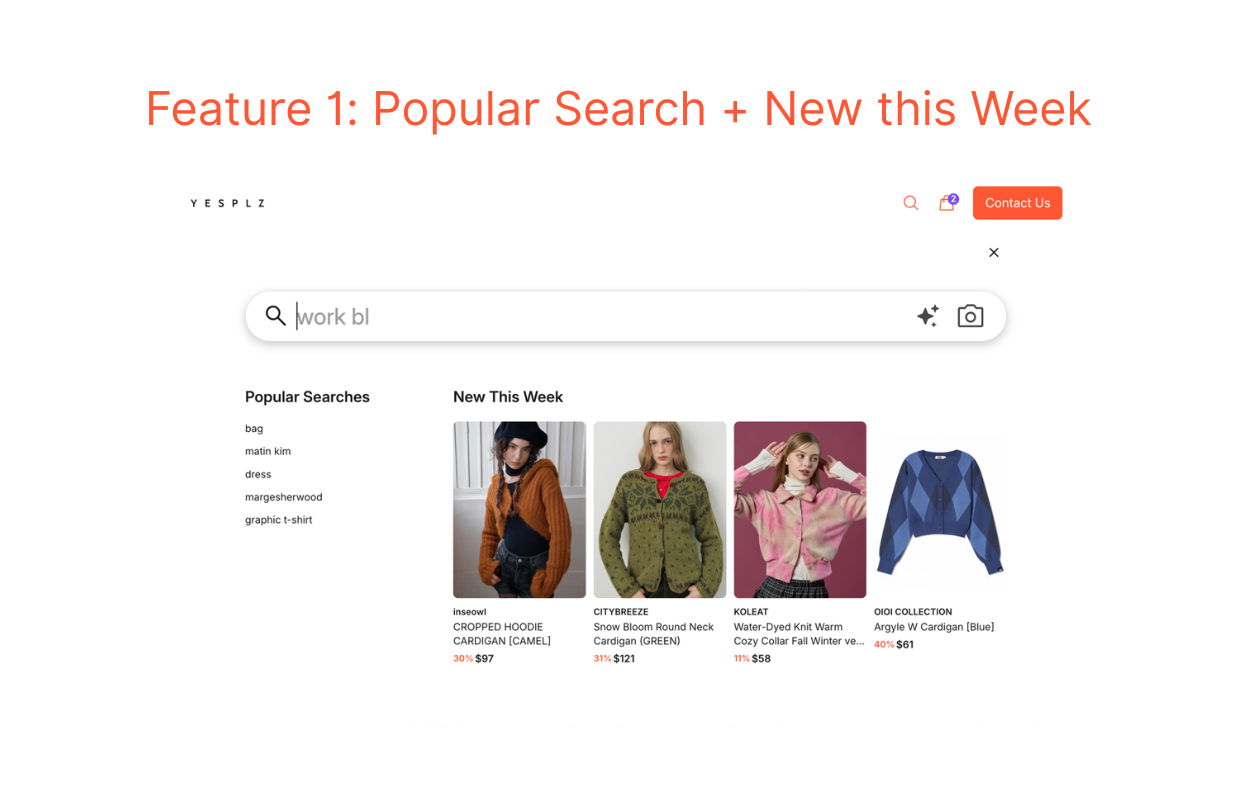 New This Week surfaces fresh arrivals directly in the search experience. So shoppers discover new inventory without having to navigate anywhere else.
All of these features, based on fashion intelligence, make it much easier for fashion shoppers to find what they’re looking for.
When Words Fail, a Product Image Does the Job
| |
Asks shoppers to describe what they saw in words | Lets shoppers show an outfit they want in a photo instead |
How Image Search Connects a Photo to Your Catalog
A shopper sees a celebrity wearing something they love. They can take a photo of the outfit, then visit your site, and upload the photo directly into the search bar.
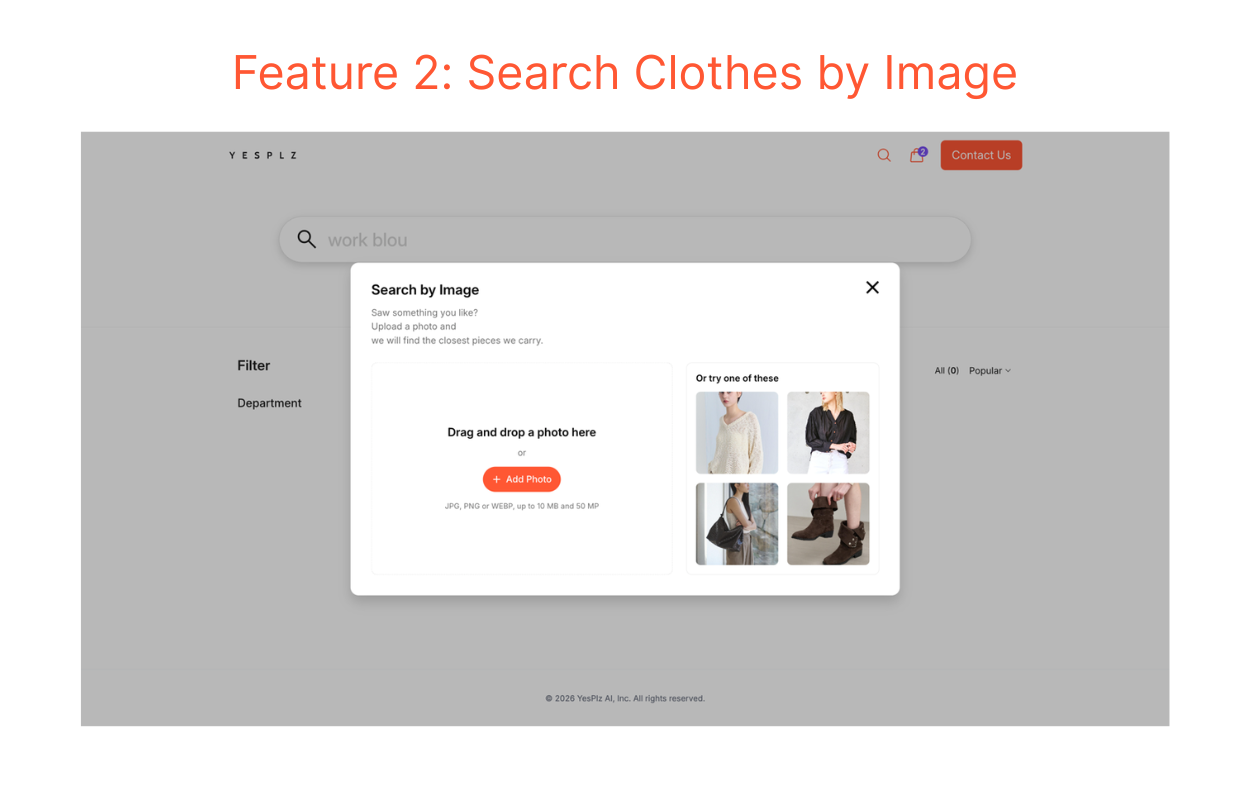 Our search engine analyzes the image, matches it against your catalog, and returns visually similar products. No text query is needed.
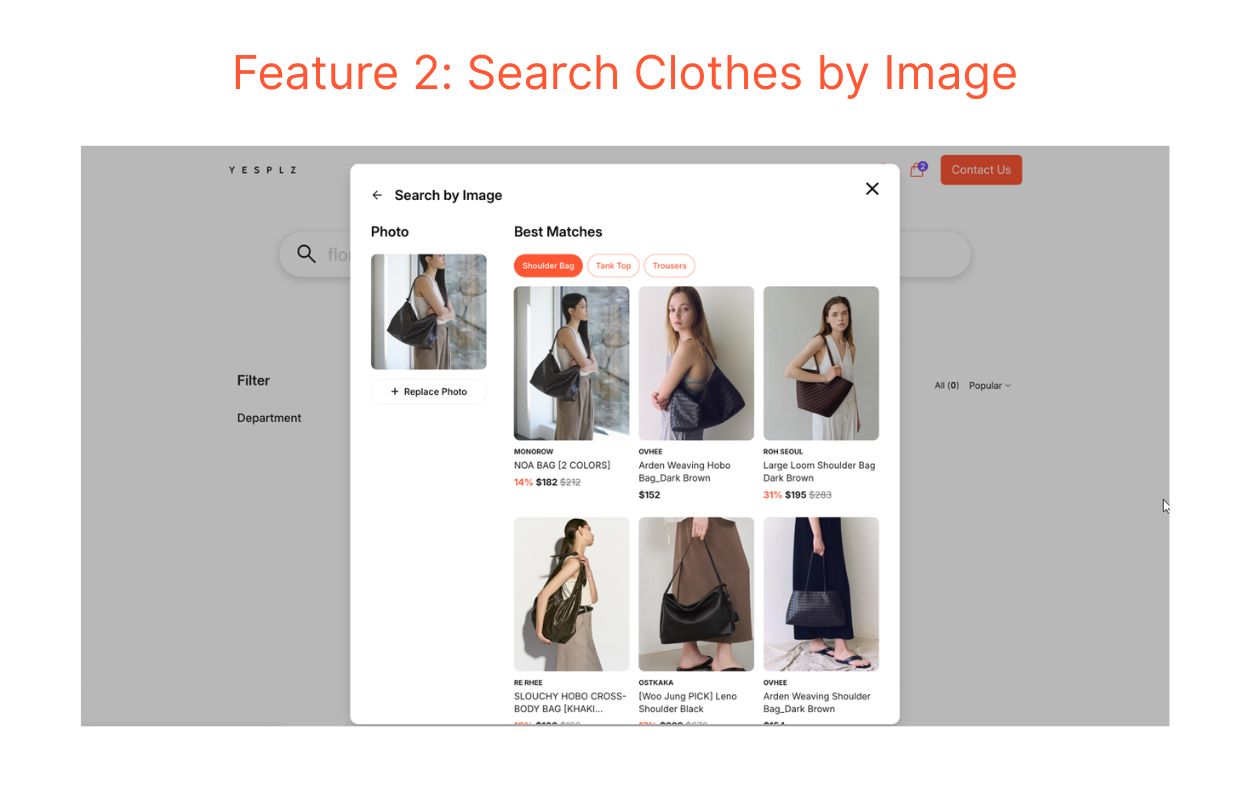 The key detail here is that the results come from your catalog. That's what separates it from something like Google Lens.
Google Lens is built for the open web, so it returns products from across the Internet. It has no idea what's in your inventory.
One of our clients, a Nepal-based fashion retailer, ran into this problem directly.
Why Fashion Tagging Makes Image Search More Accurate
Our visual search technology can detect specific attributes of an outfit. Every product in your catalog is tagged with deep fashion attributes.
When a shopper uploads a photo, the engine has a rich, fashion-trained index to match against. And because the same fashion tagging powers your text search too, both inputs work from the same foundation.
Stop Updating Keywords by Hand: Your Fashion Search Engine Should Handle That
| |
| Updates trending keywords automatically Improves accuracy and relevance on its own Reads the search intent of both short keywords and long questions
|
Automatic Trending Keyword Updates
Our Search Tune Agent automatically updates the search library with trending fashion keywords as they emerge.
It monitors live query logs continuously, detects new terms before they become gaps, and adds them to the search library without anyone on your team having to intervene.
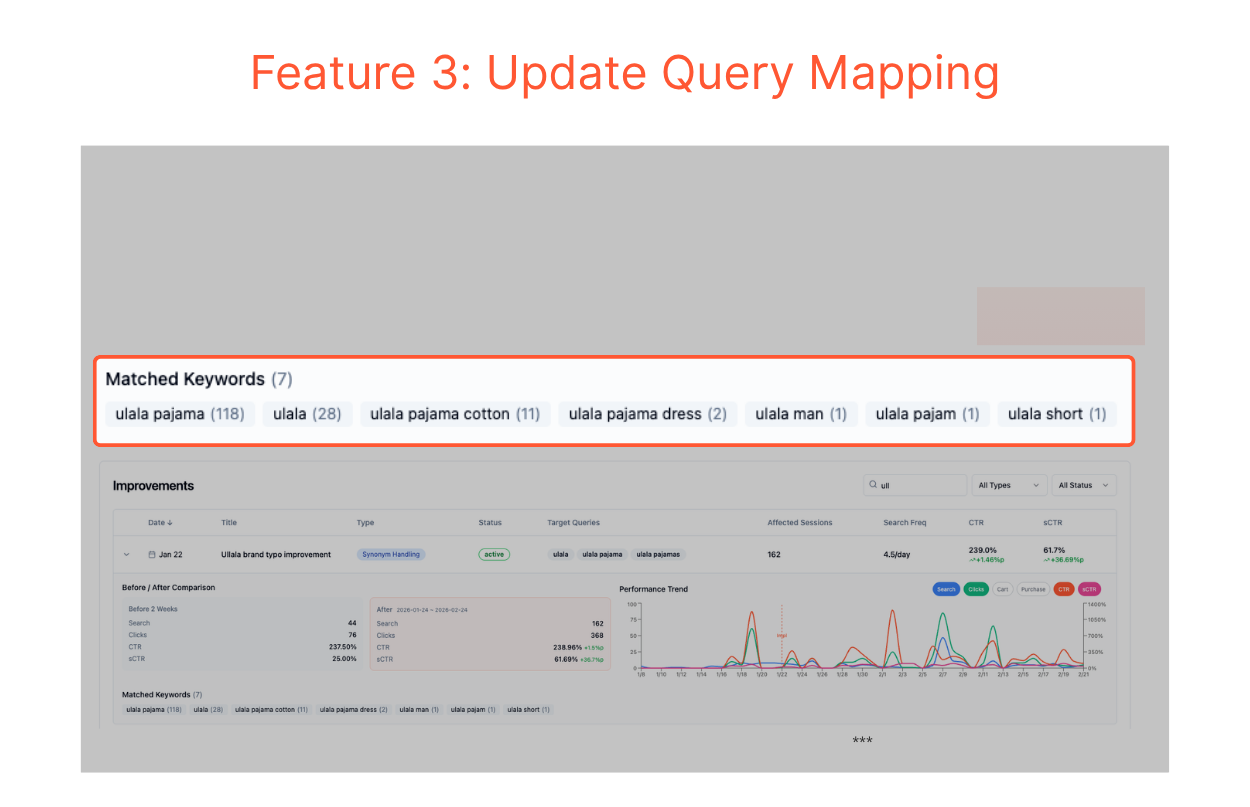 Learn to Rank: Accuracy and Relevance, Automatically Improved
Keeping keywords current is only part of it. Our Learn to Rank model automatically improves search accuracy and relevance over time.
Accuracy means returning products that match the query. Relevance means knowing which of those products to show first.
As a result, your shoppers can expect the best matching results at the top of the first page.
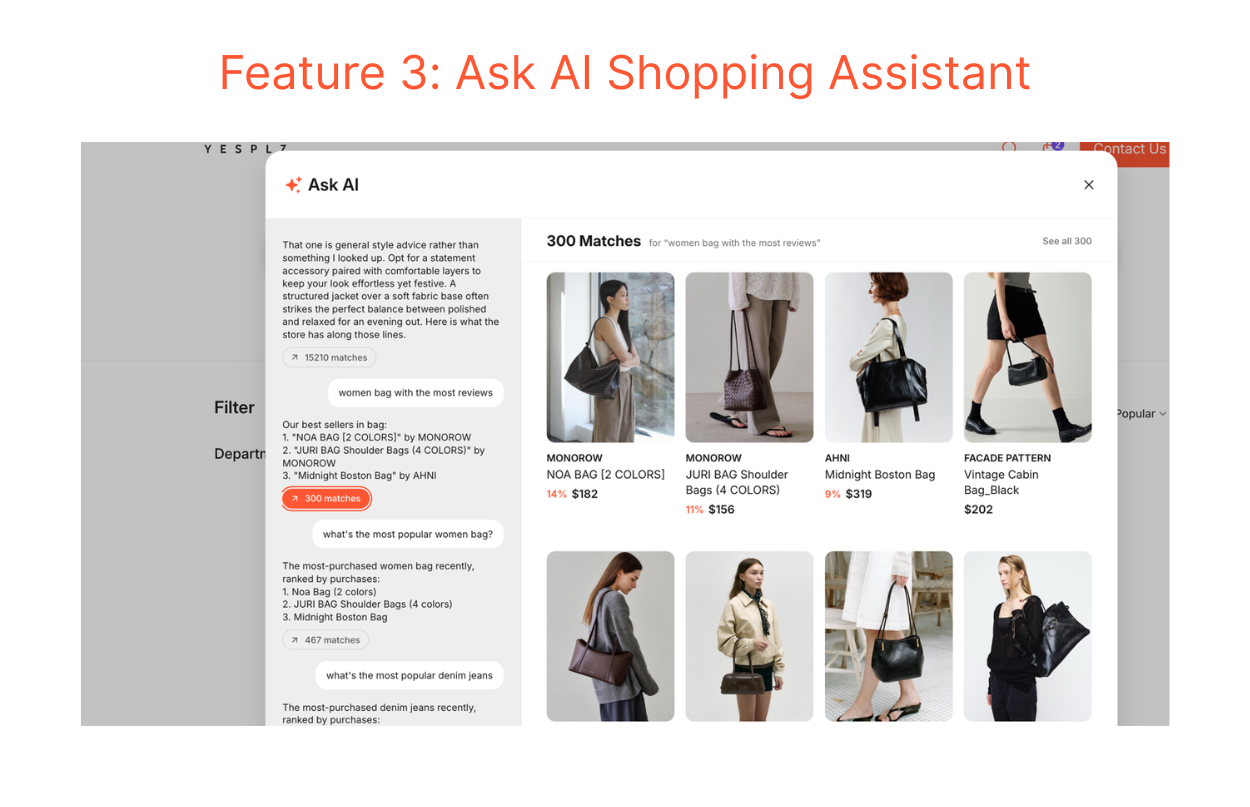
Ask AI: When Shoppers Ask Real Questions
Our Ask AI feature automatically indexes user reviews and product popularity signals.
So, alongside keywords, the search bar can also answer shopping questions like "Which leather bag has the best reviews in your store?" "What's your most popular denim right now?"
Our fashion search engine reads the intent behind the question and returns a curated, ranked answer directly.
Visual search that matches a photo to your catalog.
An AI shopping assistant that answers long-tail questions.
Automation that takes manual search upkeep off your team's plate entirely.
In our experience, at least one of these three is still a gap for most teams.
The useful question for you to walk away with: which of these is your fashion search engine still missing?