5 Manual eCommerce Merchandising Tasks Burning Out Your Team
Is manual work in eCommerce draining your team? See the five merchandising tasks that fashion AI can take over, from tagging to collections.

by YesPlz.AIOctober 31, 2026

Is manual work in eCommerce draining your team? See the five merchandising tasks that fashion AI can take over, from tagging to collections.
by YesPlz.AIOctober 31, 2026
A new batch of products lands. Hundreds of styles need to go live by the end of the week. Meanwhile, your team is still cleaning up after the last batch.
Someone else is entering attributes into each product page. Another is clicking through complete-the-look recommendations to see which items have since sold out.
None of this is what you hired these people for. You hired them for taste, trend sense, and commercial judgment. Yet, a large share of their week goes to repetitive data work.
This manual work in eCommerce doesn’t only slow down launches. It leaves your product data inconsistent.
In our discovery calls with online fashion retailers, the same five merchandising tasks keep coming up. The brands and platforms differ, but the list barely changes.
Here is what each one looks like by hand, why it keeps eating your team’s time, and what changes when fashion AI takes it over.
Collections are one of the simplest ways to keep a site fresh. A summer or a Valentine’s Day collection gives your shoppers a theme to browse, instead of a whole catalog to dig through.
We want tastefully curated collections, lots of them, but building each one takes forever. Can your AI help?
Say you want to build a Valentine’s Day collection: romantic styles, in red, across the dress, top, bag, and shoe categories.
Someone on your team has to search the catalog and add each item one by one. And like many manual merchandising tasks, it doesn’t end when the page goes live. Every time the stock changes, someone has to go back and check it again.
What you really want is to set smart rules. So every matching item goes into the collection on its own. Once the rules are set, new products that fit are added automatically while sold-out ones drop out. No one on your team has to hand-pick anything. Your collections stay fresh without the extra work.
Product tagging and enrichment, which we cover in task 5, is what makes this work. Once every item in your catalog is enriched with attribute tags, you can define a collection by those tags instead of a hand-picked list.
Product tagging enables dynamic collections that update themselves as your inventory changes. A few examples:
Seasonal collections: From May to September, a summer collection shows everything tagged “summer” or “lightweight.” New products with those tags appear in the collection immediately.
Themed collections: A cottagecore page can be populated from tags like “romantic,” “floral,” “vintage,” and “nature-inspired.” When the trend shifts, you adjust the tag criteria instead of rebuilding the page.
Cross-category collections: A romantic collection can span dresses, tops, accessories, and shoes, which suits shoppers who browse by style rather than by item type.
This is what automated collections for eCommerce look like in practice. For more use cases, see our guide to six essential fashion product tagging use cases.
You tag once and let automation handle the rest. The team can run more collections with less upkeep. And your collections stay fresh without anyone maintaining them.
SEO copy is one of those merchandising tasks everyone agrees matters, yet nobody has time for.
Open a few product pages from the middle of your catalog. There’s a good chance their meta descriptions are blank, copied from a supplier, or nearly identical to the page next to them.
We had a GEO consultation, and it was great. But we don’t have the people to apply the guidelines to every single product. Our fall collection is about to drop, and honestly, it probably won’t get the GEO treatment.
Imagine your new winter collection just landed. SEO and GEO are your priority. But every product needs its own meta description, product title, and product description, written by hand, one at a time.
No one on your team has the hours to do it. The updates keep slipping down the to-do list while the new styles sit live with thin copy.
That leaves your team rationing attention. Bestsellers get careful copy. The long tail, which is most of your catalog, gets whatever time is left. Quality ends up uneven across the catalog, and so do the results.
AI starts by analyzing product images to generate tags and structured data. Based on that, it automates meta descriptions, product titles and descriptions.
This is how AI product descriptions for eCommerce stay consistent across a large catalog without a copywriter touching every page.
Besides, structured, consistent product data is exactly what AI search engines and shopping assistants need. That means GEO for fashion product pages becomes a by-product of the work you were already automating.
Our guide to optimizing SEO, AEO, and GEO for fashion product pages covers this in more depth, and you can see how GEO Ready fits in.
Every product page gets the same level of care. And your catalog is ready for how shoppers will increasingly search.
Consider this scenario: A shopper types “evening gown.” Your product is titled “formal dress.” Unless someone has linked the two, the shopper sees zero-result pages. Until now, many teams still handle this by manually maintaining a synonym list.
I start every day going through our most popular search queries and mapping suggested keywords to the top ones. Can your AI take that off my plate?
Without smart tools, you spend your precious time digging through search queries. You count which ones are popular, work out which keywords are related, and map each one by hand.
Take “pajama.” Shoppers enter “pijama,” “pyjamas,” or “pj set.” You have to connect every variation to the pajamas you sell.
And the list never ends. You can’t predict every keyword variation shoppers will type, so your fixes are always reactive. You usually find a gap after shoppers have already hit a dead end.
Keeping the list current is one of the most repetitive merchandising tasks there is, because even a finished list starts over with the next trend.
AI spots every search keyword variation and updates trends in real time. Our Search Tune Agent is built for this job. It watches your search activity around the clock and picks out queries with high volume but low click-through.
It then works out why, for example, a typo, a synonym your catalog doesn’t recognize, or a tagging gap. Based on that, it applies the fix and checks whether the change performed better. Here is what that looks like in practice.
Shoppers at one of our clients kept misspelling the brand name Ullala. “Ulala pajama” alone was searched 118 times in a single week. Search Tune Agent spotted the typo cluster and added the variations to the synonym library. Click-through on that query rose from 25% to 61.69%.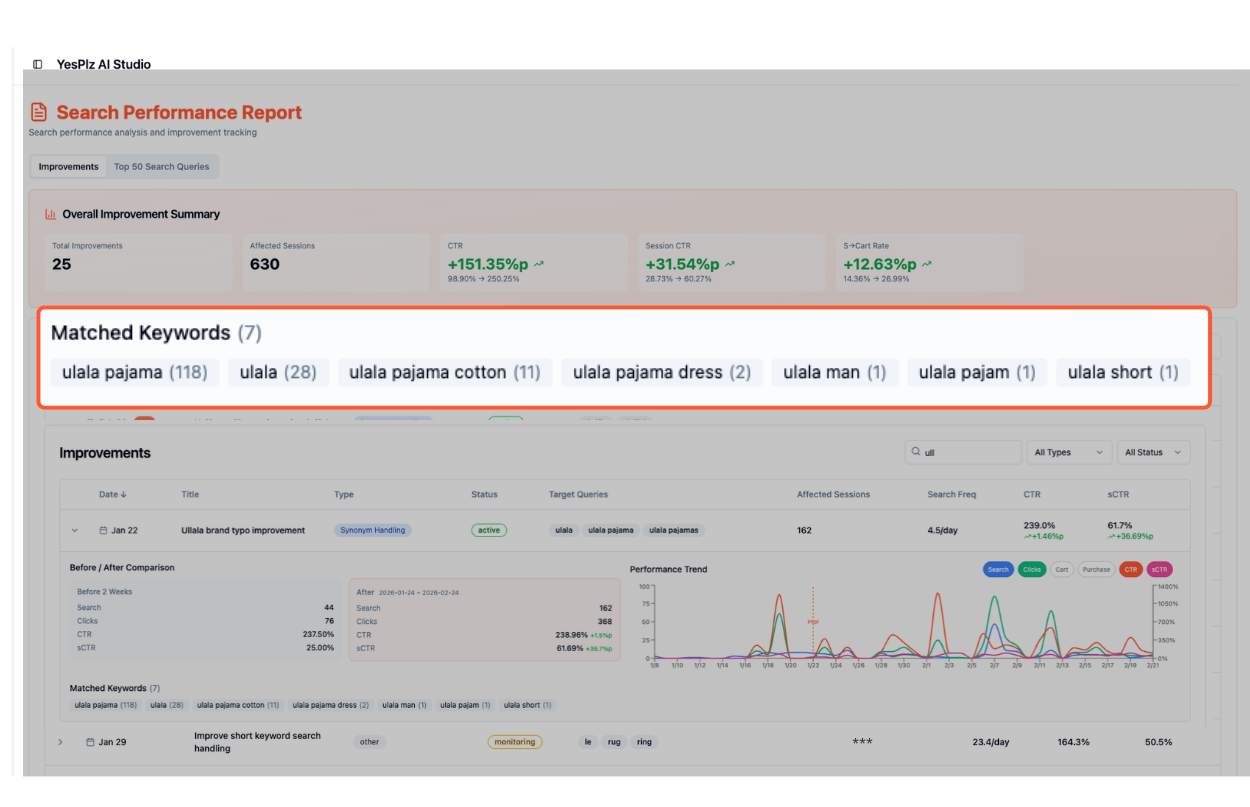 You can read the full story about how Search Tune Agent improves fashion store search.
Your team no longer spends time patching gaps one query at a time. Your shoppers enjoy fewer dead-end searches.
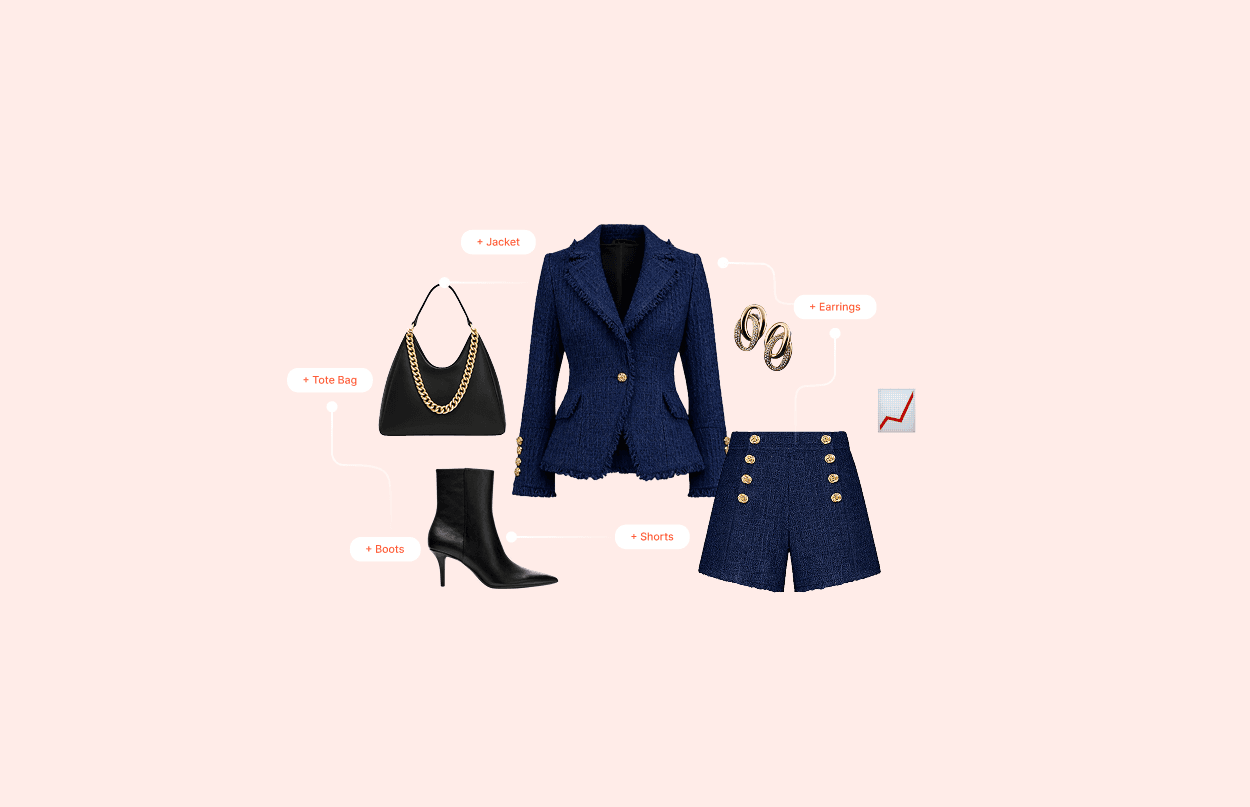
Picture a shopper on a floral maxi dress page. Under it, a “complete the look” section shows sandals, a clutch, and a hat. She likes the sandals, clicks, and finds them sold out. The hat is gone too.
Let’s say you have 3,000 products. How long would it take to build an outfit for every one of them? Among all your merchandising tasks, this is one that never gets finished.
You go back and forth across the catalog to match pieces by style. And you have to make sure each one has enough inventory. Even then, the recommendations break whenever stock changes, so you keep re-checking pages.
Typically, it takes 10 to 30 minutes to curate a single outfit. At 15 minutes each, 3,000 products add up to about 93 days of full-time work on curation alone.
So your team puts outfits together for a handful of products instead of the whole catalog, even though you know outfits inspire shoppers on style and drive upsell.
AI reads product images, tags its category, color, occasion, and vibe. Then, it searches your catalog for pieces that go with it. Because the logic runs on tags, AI generates recommendations automatically and refreshes them as inventory changes.
Your team stays in charge of the look. You can review each outfit, swap individual items, and approve before anything goes live. The volume goes to the AI while the taste stays with your people.
See how Complete the Look works, or read about how AI styling drives multi-item orders.
Styling suggestions are always current. And automated cross-sell supports larger baskets without anyone babysitting the links.
Enriching a product means adding attributes and keywords that turn a bare product record into something shoppers and search engines can use: color, neckline, sleeve length, fit, occasion, vibe.
Every time new products arrive, your team has to enter those details into every product page. Hundreds of styles arrive at once. New batches keep landing all year, so the work never really stops.
Start with the volume. A fashion item can carry anywhere from 20 to 60 attributes. Tagging just 1,000 products by hand takes more than 83 hours. That’s over two full work weeks for one person, with no breaks and no rework.
Of all these merchandising tasks, this is the one where the numbers get big fastest. Every new batch becomes a bottleneck. Products sit in a queue while shoppers can’t find them.
Then there’s consistency. One tagger calls a neckline “scoop,” another calls it “round neck.” Same product, different tags, and your filters and search treat them as two different things.
With AI product tagging for fashion, the system analyzes product images and applies consistent fashion attributes the moment products are uploaded.
And the consistency matters as much as the speed. In a controlled study, our team compared site search results with and without product tagging. Tagged search returned 22% more matching results and an 11 percentage point higher click-through rate, with one caveat: the gains only show up when the tagging is clean and well structured.
If you want to see what a complete attribute set looks like, our fashion tagging essential guide walks through it.
Products go live faster. You get one consistent attribute taxonomy that every other task on this list builds on.
Look at the five tasks together, and a pattern appears. They all depend on the same thing: product data that someone has to enter by hand.
That’s why these tasks tend to pile up together. A messy tag in task 5 turns into a missed result in task 3, a weak outfit suggestion in task 4, and an outdated collection in task 1.
Inconsistent tagging undermines every use case that follows. When attributes are applied automatically and consistently, the other four jobs get easier.
For this reason, we always recommend that online fashion retailers begin with automated product tagging. It’s also the most practical way to cut manual work in eCommerce at the source.
The point of automating these merchandising tasks isn’t to replace humans. It’s to give them back the work only they can do, such as:
Trend curation: spotting what’s coming and deciding what it means for your brand.
Assortment strategy: choosing what to buy, in what depth, and when.
Styling and storytelling: shaping how collections and campaigns feel to a shopper.
Performance analysis: reading what’s selling and why, then acting on it.
When your team spends less time on repetitive data entry, you can scale merchandising without hiring. Your catalog can grow while the workload stays manageable.
Take a look at your team’s last week of new arrivals. How many of these five merchandising tasks were still done by hand? If it’s two or more, there’s likely a lot of time to win back.
A good place to begin is product tagging, because everything else builds on it. If you’d like to see what it looks like on your own catalog, we’d be glad to show you.
Book a demo to see how fashion AI takes over the repetitive work, so your merchandising team can get back to the creative work.

Written by YesPlz.AI
We build the next gen visual search & recommendation for online fashion retailers
